
Pontiac Built Six Special 405-HP Station Wagons In 1963
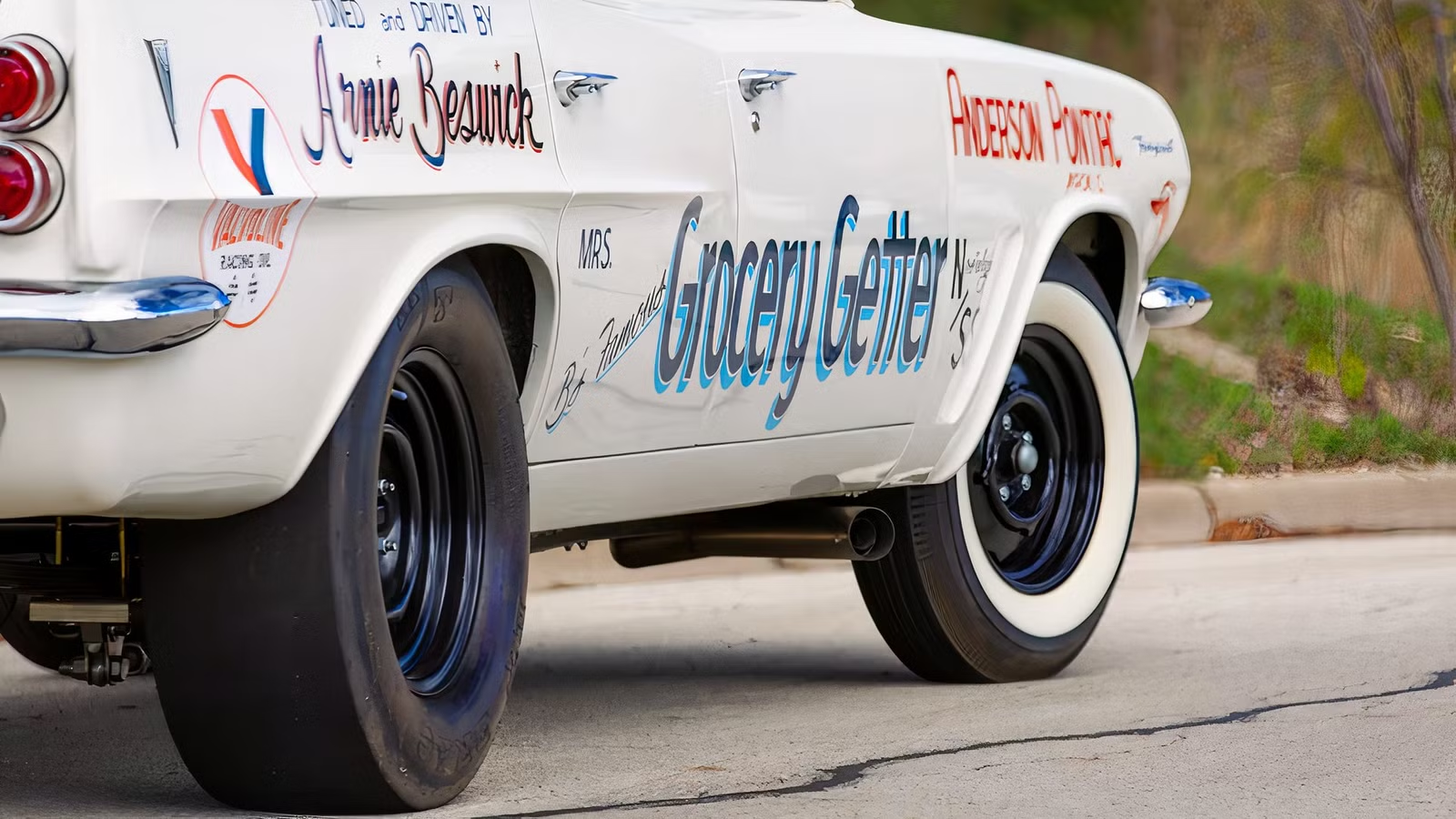
Station wagons are supposed to haul groceries, kids, lumber, and maybe a canoe if you’re feeling ambitious. They are not supposed to leave the factory with hardware intended for NHRA competition. But Detroit in the early 1960s was operating under a different set of social norms. When Pontiac went hunting for quicker quarter-mile times in 1963, it drafted the last car you might expect into the horsepower war.
By 1963 Detroit’s Big Three Were Battling For Better 1/4-Mile Times

By the early 1960s, Detroit’s horsepower war had escaped the showroom in search of a starting line and ¼-mile of asphalt instead. Ford, Chevrolet, Pontiac, Dodge, and Plymouth were building “factory” cars whose whole reason for existing was a quicker quarter-mile. Each generation featured bigger engines, lighter bodies, stripped interiors, and just enough production-car DNA to satisfy the stock class rulebook.
Pontiac’s 1963 421 Super Duty Catalina was among the era’s most extreme examples. The car used aluminum body components and mechanical bits, while the famous “Swiss Cheese” version came with roughly 120 holes drilled through the frame to drop even more weight. Chevrolet had its 427-powered Z11 Impala, Ford had its lightweight 427 Galaxies, and Mopar had the 426 Max Wedge cars. But the next great innovation would be adding weight. Strategically.
A Heavy Station Wagon Does Better At the Drag Strip Than You Might Think


Drag racing a station wagon may sound like something you’d only attempt after losing a bet. But the physics are friendlier than the silhouette. During hard acceleration, a vehicle’s weight transfers rearward. This increases the force on the rear tires. In an RWD car, that force translates to race-winning traction. Starting with more static weight in the back can help too.
Winning racers really did make that trade. “Dyno Don” Nicholson received a factory-backed Mercury Comet A/FX station wagon, the charmingly nicknamed “Ugly Duckling,” before Eddie Schartman inherited it. The catch is obvious: every extra pound still has to be accelerated. A wagon only makes sense when the added traction is worth the mass it brings to the starting line. But an automaker with a compact station wagon already in the lineup might be sorely tempted to drop a racing engine into one to see how it would perform.
Pontiac Built Just Six 405-HP Super Duty Tempest Wagons

Pontiac’s regular 1963 Tempest/Le Mans compact V8 was a 326 cubic-inch unit rated at 260 horsepower. When the automaker assembled a handful of factory drag racer specials with two-door Le Mans bodies, they featured Pontiac’s 421-cubic-inch Super Duty V8, advertised at 405 horsepower and fed by two Carter AFB four-barrels. But the engineers with a need for speed didn’t stop there: Pontiac threw the same powertrain into six Tempest station wagons. Some experts believe Pontiac built as many as eight coupes: two prototypes and six factory-ready cars.
These compact Pontiacs had one more trick up their fender. They carried the transmission at the rear in a “transaxle” unit. If you’re keeping track at home, you know what that means: even more weight over the rear wheels. The race cars received a specialized four-speed “Powershift” arrangement and heavy-duty hardware. Aluminum front-end pieces, deleted comfort equipment, and other weight-saving measures helped offset the heavier wagon body.
Pontiac Handed Its Super Duty Tempests To Some Of Drag Racing’s Biggest Names

Pontiac wasn’t building these cars to make money on six wagons. The Super Duty Tempests were as much for publicity as profit. Pontiac placed them with racers who already knew how to land a well-sorted factory package in the winner’s circle. Arlen Vanke’s “Papoose One” was one of the six original Super Duty Tempest wagons. Meanwhile, Arnie Beswick campaigned a 421 Super Duty Tempest wagon called “Mrs. B’s Grocery Getter.” That car was later cloned by an enthusiast, and you can see the result in some of this article’s photos.
These wagons weren’t just engineering exercises with funny proportions. Arnie Beswick’s “Mrs. B’s Grocery Getter” won A/FX at the 1963 Drag News Invitational, an event that drew many of the country’s top Factory Experimental racers. Beswick was still campaigning the wagon at Daytona in 1964, where one of his crew members drove it against the newest Ford and Mopar factory racers. It reportedly held its own through much of the week.
GM Killed Factory Racing, But Pontiac Wasn’t Done Building Big-Engine Tempests

Just as the party was getting loud, the grownups flipped the breaker. Pontiac issued an internal bulletin on January 24, 1963, canceling further 389 and 421 Super Duty engine orders. Why? GM had shut down all its factory-backed racing. Beswick stayed in Pontiac cars as an independent team, even after the parts pipeline and official support disappeared. Other drivers also had a handful of exotic cars left. But Pontiac engineers now had no official outlet for decades of performance know-how.
Pontiac returned to the street. GM announced the GTO option for the 1964 Tempest in October 1963, replacing the smaller V8 with Pontiac’s 389 and offering 325 horsepower, or 348 with Tri-Power. The GTO was not a street version of the Super Duty drag racer. But the shared philosophy is hard to miss: put a big engine in a smaller, cheaper Pontiac and let the superior power-to-weight ratio do the talking. The result was nothing less than the birth of the muscle car.
Sources: General Motors, NHRA, Gateway GTO Association, Pontiac Preservation Society, Automotive History Preservation Society, The Grainger College of Engineering

Related posts

Latest Post


No Comments