
The Ford Muscle Truck That Matched Chevy’s 454 Big-Block With 1.6 Fewer Liters
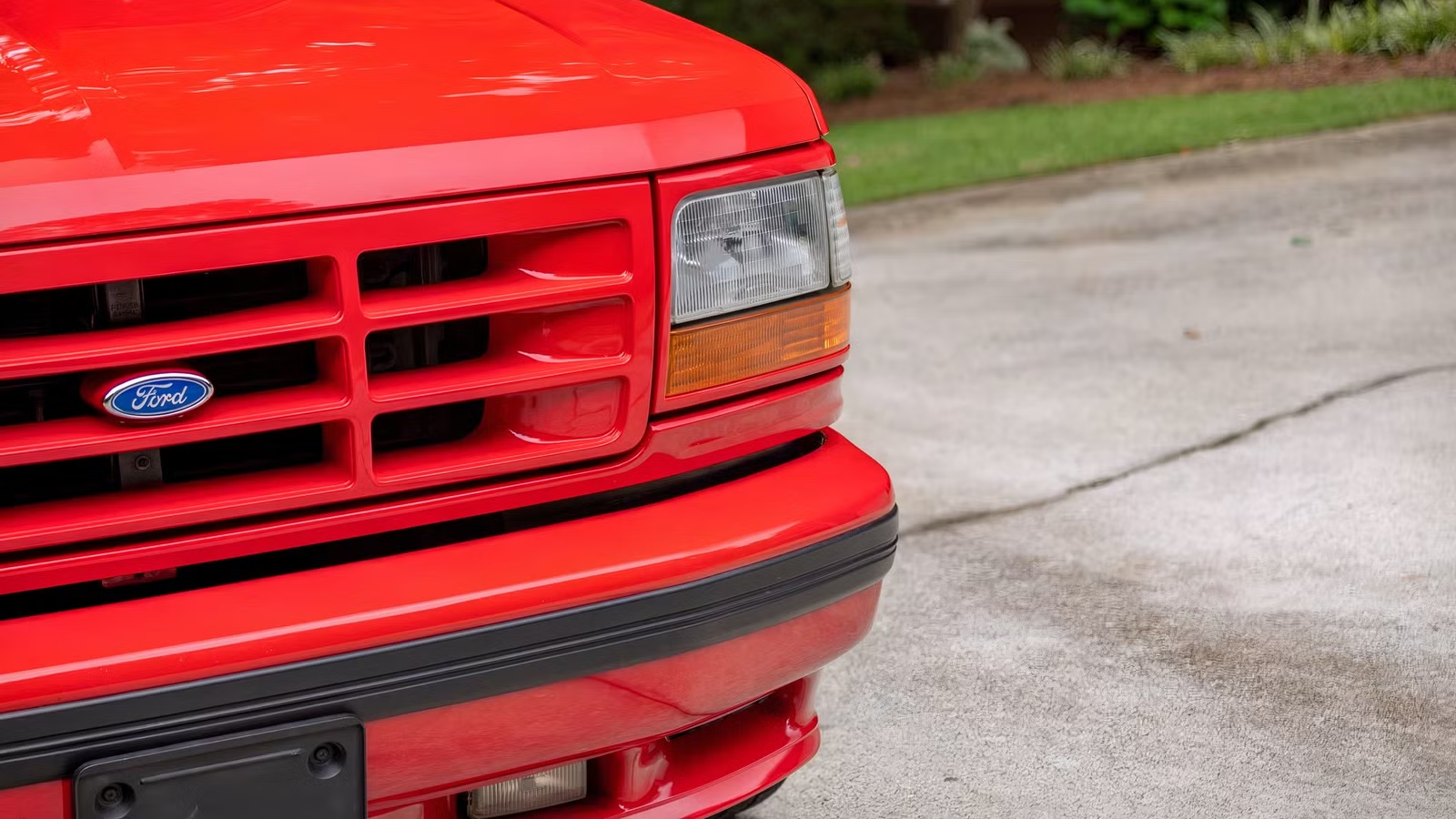
A 7.4-liter V8 under the hood of a pickup sounds like a pretty convincing way to settle an argument about performance. Chevrolet thought so too. But Ford had a different idea about what made a truck quick, and that idea put the big-block establishment in check without matching its displacement, horsepower, or torque. The fascinating part is how close these two machines came to the road despite taking different routes to get there. And a third truck, packing a turbocharged V6, made the whole argument a lot more complicated.
Chevrolet’s 454 SS Set A High Bar For Performance Trucks

In the early 1990s, American automakers rediscovered that pickups weren’t just for hauling lumber or towing boats. Chevrolet got there first with the 454 SS, launched for 1990 as a blacked-out, rear-wheel-drive half-ton with a big-block V8 where a regular pickup carried something far smaller.
From 1991, the 7.4-liter 454 V8 made 255 hp and 405 lb-ft of torque. A four-speed automatic and a 4.10:1 rear axle ratio helped the truck put all that twist to work. For an early-1990s pickup, those were mind-blowing numbers. Chevrolet simply dropped the classic American formula into a workhorse, and it worked. The catch was that displacement alone couldn’t decide how well a truck put its power down, carried speed through a corner, or stopped. Ford needed something that could reach Chevy’s benchmark without copy-pasting the formula.
Ford Had A Different Plan For Its Performance Pickup


Ford built a special ops team for this. Its Special Vehicle Team had one job, turning ordinary production vehicles into punchy performance machines. Instead of chasing engine size like Chevy, SVT planned a complete package where gearing, tires, and suspension mattered as much as the engine.
Racing legend Jackie Stewart lent a hand with chassis and suspension development, giving the truck a handling focus that went beyond a lowered ride height and bigger wheels. The idea was a pickup that felt deliberate and responsive, rather than one stuffed with enough power to move an airplane. Chevy held the upper hand in torque, and Ford wasn’t going to pretend a considerably smaller engine could close that gap everywhere. But a truck can have plenty of torque and still struggle to use it, and Ford was betting the rest of its package could make up the difference against Chevrolet’s big-block bruiser.
The Ford F-150 SVT Lightning Took On The 454 SS

The truck was the 1993 Ford F-150 SVT Lightning, SVT’s first pickup. Under the hood sat a naturally aspirated 5.8-liter (351 ci) Windsor V8 making 240 hp and 340 lb-ft of torque. That left it roughly 1.6 liters, 15 hp, and 65 lb-ft behind Chevrolet’s 454. This wasn’t a stock F-150 V8 in a fancy suit. SVT fitted high-flow GT40 cylinder heads, hypereutectic pistons, a tuned tubular aluminum upper intake, and tubular headers, all aimed at helping the old Windsor breathe.
Power went through a specially calibrated E4OD four-speed automatic and an aluminum driveshaft to a limited-slip 8.8-inch rear axle with, yes, the same 4.10:1 ratio as the Chevy. The chassis changes weren’t cosmetic extras. A lowered stance, retuned shocks and stabilizer bars, and 17-inch wheels on wide Firestone Firehawks cut body roll and added grip, so a truck weighing more than two tons felt far less like a pickup when the road got twisty. There were trade-offs. The lowered, stiffened suspension gave away some workhorse practicality, and the Lightning still couldn’t match the Chevy’s low-speed grunt. Ford had picked handling over hauling.
The Smaller Ford Could Match The Chevy On The Road

Period road tests back up the headline, but they don’t crown a universal winner. MotorTrend’s June 1993 comparison clocked both trucks at 7.2 seconds to 60 mph, a genuine dead heat. It also recorded the Lightning’s quarter-mile at 15.6 seconds at 87.4 mph, against 15.8 seconds at 84.7 mph for the 454 SS.
Car and Driver’s test flipped the drag race. The Chevy hit 60 mph in 7.1 seconds and ran the quarter in 15.7, while the Ford needed 7.2 and 15.8. The Lightning got its revenge in the corners and under braking, holding 0.88 g on the skidpad and stopping from 70 mph in 184 feet, a whopping 33 feet shorter than the Chevy’s 217. Results shift with truck, driver, and weather, and some later sources quote high-16-second quarter-mile runs. What holds up is a smaller, less powerful truck running within a tenth or two of a big-block in a straight line, then pulling clear once the road bends or the brakes come on. The Chevy won the spec-sheet fight hands down. The Ford made a pretty convincing case that the spec sheet wasn’t the whole fight.
Ford Showed That Displacement Was Only Part Of The Equation

Then there was the elephant in the room. GMC’s 1991 Syclone paired a turbocharged and intercooled 4.3-liter V6 making 280 hp and 350 lb-ft with full-time all-wheel drive. Period testing clocked it at 5.3 seconds to 60 mph and 14.1 seconds in the quarter-mile, leaving both full-size trucks in its mirrors. But comparatively, the Syclone was a compact two-seater with limited carrying ability. Chevy’s big-block, GMC’s boost, and Ford’s balanced full-size package were really three different answers to the same question.
Ford’s next chapter is where its philosophy really paid off. When the Lightning returned for 1999, a supercharged 5.4-liter V8 gave it 360 hp and 440 lb-ft, rising to 380 hp and 450 lb-ft for 2001. SVT kept the chassis-first thinking and stacked forced induction on top. That combination underpins supercharged super-trucks like the F-150 Raptor R and Ram 1500 TRX, though as off-road brawlers they’re spiritual successors rather than direct descendants. The original Lightning proved something subtler: that a performance pickup could compete without matching its rival’s displacement if the engineering around the engine was up to the job. It didn’t settle the argument over how to build a fast truck. It made the argument far more interesting.
Sources: Bring A Trailer, Mecum

Related posts



Latest Post


No Comments