
10 Fastest Six-Cylinder Cars That Make V8s Look Slow
Six cylinders. That’s all it takes — if you know what you’re doing. The record books may be crowded with monstrous V8s, V10s, and V12s, but a growing number of the world’s fastest production cars have proven that displacement isn’t everything. Whether it’s a twin-turbocharged flat-six screaming out of a rear-engine Porsche or a bespoke Italian V6 channeling Formula 1 combustion technology, the six-cylinder engine has quietly become one of the most potent configurations in the supercar world. The cars on this list are proof — and they’ll make a lot of V8 owners uncomfortable.

For this list, we’re not including hybrid V6 powertrains (click here for a list of the fastest hybrid cars money can buy), but otherwise, any six-cylinder configuration is fair game. By the way, you’re about to see a lot of RUFs.
In this article, factory specifications are sourced from each car’s respective manufacturer. Top speed figures are sourced from reputable testing outlets when not available from the featured car’s manufacturer.
Maserati MC20
202 MPH

David Alpert / HotCars / Valnet
This historic Italian brand made a major statement when it debuted the successor to the iconic MC12 supercar, dubbed the MC20. It marked Maserati’s first halo car in more than 16 years, but this time, instead of a Ferrari-derived V12, the new MC20 was brought to life with a bespoke, Maserati-built twin-turbocharged V6.
Dubbed “Nettuno,” this engine is a 3.0-liter twin-turbocharged V6 featuring Maserati’s pre-chamber combustion technology, derived from Formula 1. This system uses a small pre-chamber with its own spark plug to ignite a richer air-fuel mixture, which then ignites the main chamber for improved efficiency and power. Technical wizardry aside, the MC20’s V6 produces 621 horsepower and 538 pound-feet of torque, delivered through an eight-speed dual-clutch automatic transmission to the rear wheels. According to Maserati, the MC20 can reach a top speed of 202 mph.
And in case you didn’t know, Maserati has since introduced a facelifted MC20-based supercar called the MCPura as the model’s next evolution.
Porsche 911 Turbo S (992)
205 MPH

If you strictly followed internet lore about the Porsche 911, you’d probably come away expecting the GT3 RS to be the fastest of the bunch. That may be true on a timed lap around a racetrack, but on a long stretch of open road, the faster Porsche is actually the 992 Turbo S, which, according to Porsche, can reach up to 205 mph.
This death-defying velocity is possible thanks to a twin-turbocharged 3.7-liter flat-six that, in Turbo S trim, puts down 640 horsepower and 590 pound-feet of torque. Similar to the MC20 above, the only transmission option in both the Turbo and Turbo S models is an eight-speed dual-clutch automatic gearbox.
RUF CTR “Yellowbird”
211 MPH

That’s right — for the next rung up the ladder, we have to go back nearly 40 years. But first, a quick explanation. RUF is a German manufacturer that starts with bare Porsche shells and builds its cars from the ground up, complete with their own VIN numbers. This means two important things: no, they aren’t just a Porsche tuner, and yes, their cars are street legal, which qualifies them for this list.
Okay, now the Yellowbird. Introduced in 1987, this was the company’s second-ever production car with its own VIN number, built on a heavily modified G-body 3.2 Carrera platform. Mounted at the rear axle was an upgraded twin-turbocharged 3.4-liter flat-six conservatively rated at 469 horsepower and 408 pound-feet of torque — though realistic estimates put actual output well into the high-500s.
The Yellowbird basically put RUF on the map, and in 1987, its top speed was verified at 211 mph, making it the fastest production car in the world at the time. It’s also the same car you may have seen in the now-infamous Nürburgring video, where this bird and its driver put on the most majestic and visceral display of car control ever witnessed around the Nordschleife.
And no, this is not the last RUF you’ll see on this list. In fact, not even the last Porsche. It’s not our fault they’re so good at six-cylinder cars.
Porsche 911 GT2 RS (991.2)
211 MPH

Earlier, we mentioned how the 911 Turbo S and its impressive 205 mph top speed were faster than the 992 GT3 RS’s. We weren’t lying, but we also didn’t say it was faster than all GT-division Porsches, now did we? That’s because the 991.2 Porsche 911 GT2 RS is the undisputed king. Hiding beneath all that track-tested sheetmetal is a 3.8-liter twin-turbocharged flat-six that produces Detroit levels of power — 700 horsepower and 553 pound-feet of torque.
This 3,200-pound lightweight isn’t really meant for top speed runs like your Bugattis or Koenigseggs. It’s built to set fast lap times around the Nürburgring, but when you put 700 horsepower into a street-legal racecar, 211 mph comes naturally. The GT2 RS carried a sticker price approaching $300,000 when new, but for that money, buyers received a machine that set the production car lap record around the Nordschleife.
Ford GT (2nd-Gen)
216 MPH

Debuting in 2017, the second-generation Ford GT arrived after more than a decade-long wait since the iconic first-generation GT hit the streets. In controversial fashion, the team at Ford Racing ditched the old V8-and-manual-transmission layout in favor of a twin-turbocharged V6 paired with an automatic gearbox.
It was no slouch, though. The 3.5-liter EcoBoost V6 was closely related to the engine found in the Le Mans class-winning racecar from 2016, and in road-going form it produced 660 horsepower and 550 pound-feet of torque by the end of its production run in 2022. That was enough to push the Ford GT to an impressive 216 mph.
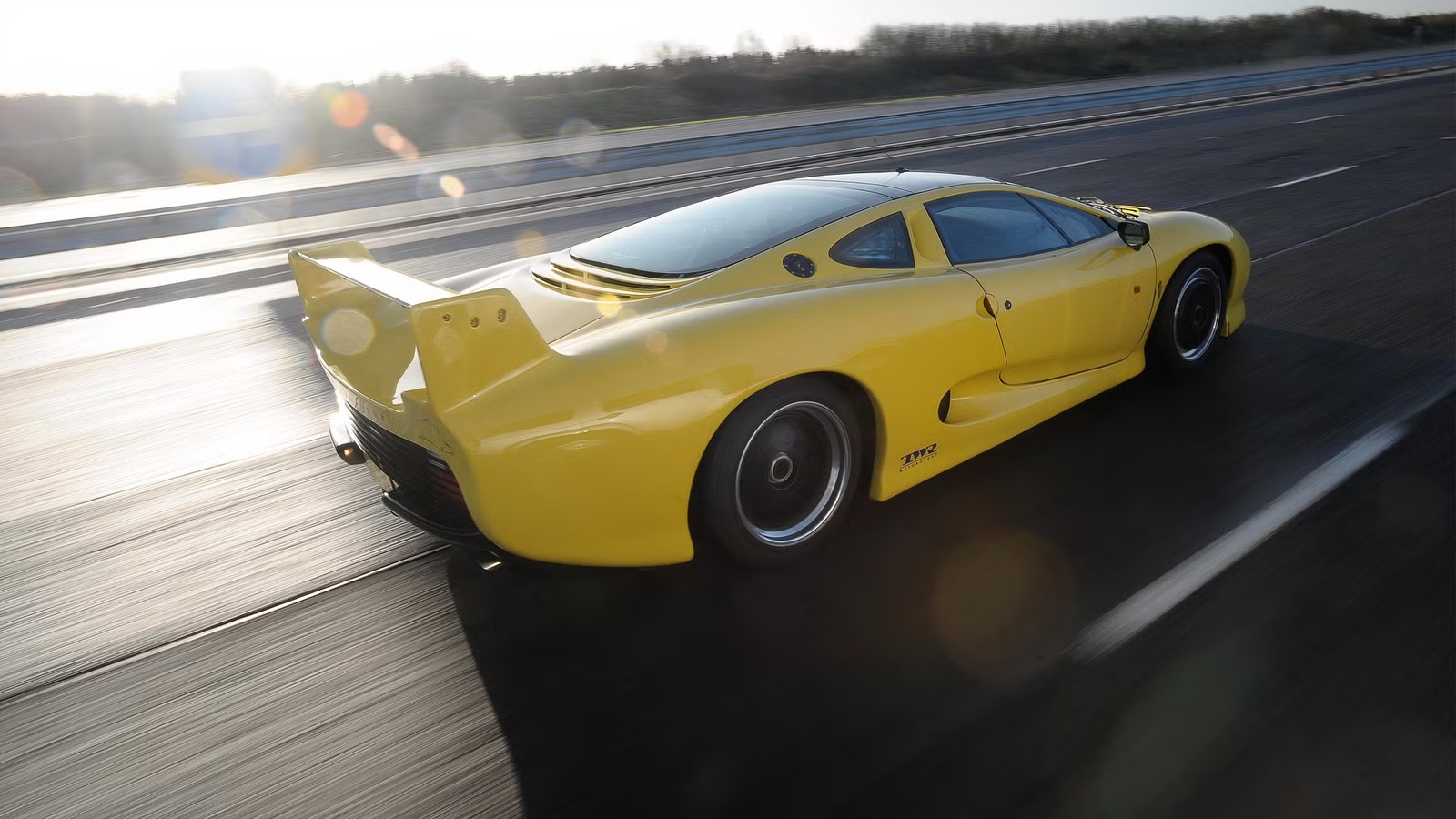
Jaguar XJ220
217 MPH

Once again, we go back in time. The year is 1992, and Jaguar just unleashed a spaceship — the XJ220. It was originally conceived as a Group B GT racecar (yes, Group B was a classification for more than just rally cars) with all-wheel drive and a V12, but after regulations changed and Jaguar needed to cut costs, the concept was simplified considerably.
That meant replacing the V12 with a 3.5-liter twin-turbocharged V6 developed with the help of Tom Walkinshaw Racing, Jaguar’s de facto racing subsidiary at the time, along with a switch to rear-wheel drive. The production engine, dubbed the 64R, produced a wild 542 horsepower and 475 pound-feet of torque, propelling the car to 217 mph at the Nardo test track in 1993 — briefly making it the fastest production car in the world until the McLaren F1 claimed that title.
2015 RUF RTR
218 MPH

We all know RUF likes to push the envelope, but when they unveiled the 991-based RTR, things got downright diabolical. The RTR used a 3.8-liter twin-turbocharged flat-six producing a titanic 802 horsepower and 750 pound-feet of torque. The engineers at RUF also kept it as a six-speed manual, with customers able to choose between all-wheel drive and rear-wheel drive.
When all was said and done, the RUF RTR could reach speeds of around 218 mph — roughly 13 mph faster than the Carrera GT — and sprint from 0 to 60 mph in 3.2 seconds. Production was extremely limited: from 2013 until the end of the run, only 10 individual cars were commissioned and built.
RUF CTR Anniversary
224 MPH

The cultural phenomenon that was, and still is, the CTR Yellowbird deserved a proper successor — at least that’s what RUF thought when they built the CTR Anniversary to mark 40 years since the original. Painted in that gorgeous canary yellow, the Anniversary car is a completely carbon fiber masterpiece fitted with a 3.6-liter twin-turbocharged version of the legendary Metzger flat-six.
The engine produces 710 horsepower and 649 pound-feet of torque, channeled through a seven-speed manual gearbox. Only 50 examples were made available for purchase — 30 with the manual and the remainder as dual-clutch variants. According to Classic.com, the two that have sold at auction have both fetched more than $3.1 million.
RUF RT 12 S
225 MPH

RUF produced the RT 12 S from 2009 to 2011 as a more extreme variant of their RT 12, which had debuted in the mid-2000s. The RT 12 S takes the 3.8-liter twin-turbo flat-six from the standard RT 12 and adds a more aggressive ECU tune along with an upgraded exhaust, lifting output from the original 650 horsepower up to 685, with torque rated at 650 pound-feet.
The car is based on a Carrera 4S platform, making this an all-wheel drive RUF — and if we ever drove one, we’d probably be grateful they didn’t route all that power through just the two rear wheels. This one also came with a six-speed manual transmission geared to reach 225 mph.
2023 RUF CTR3 Evo
236 MPH

This is the most extreme RUF yet: the CTR3 Evo. This mid-engined machine is powered by a 3.8-liter twin-turbocharged flat-six capable of a whopping 800 horsepower and 730 pound-feet of torque, all sent to the rear wheels via a seven-speed dual-clutch transmission.
Much like the RT 12 S succeeded the RT 12, the CTR3 Evo is the latest and most unhinged successor to the CTR3 and CTR3 Clubsport, the first of which debuted in the mid-2000s. Both earlier iterations were wild in their own right, but nothing prepared the world for the Evo’s staggering claimed top speed of 236 mph.
Sources: RUF, Porsche, Ford, Jaguar, Maserati, Road and Track, MotorTrend, Car and Driver, Classic.com

Related posts


Latest Post


No Comments