
The Japanese Cruiser That Forced Harley To Kill Its Own 500cc V-Twin
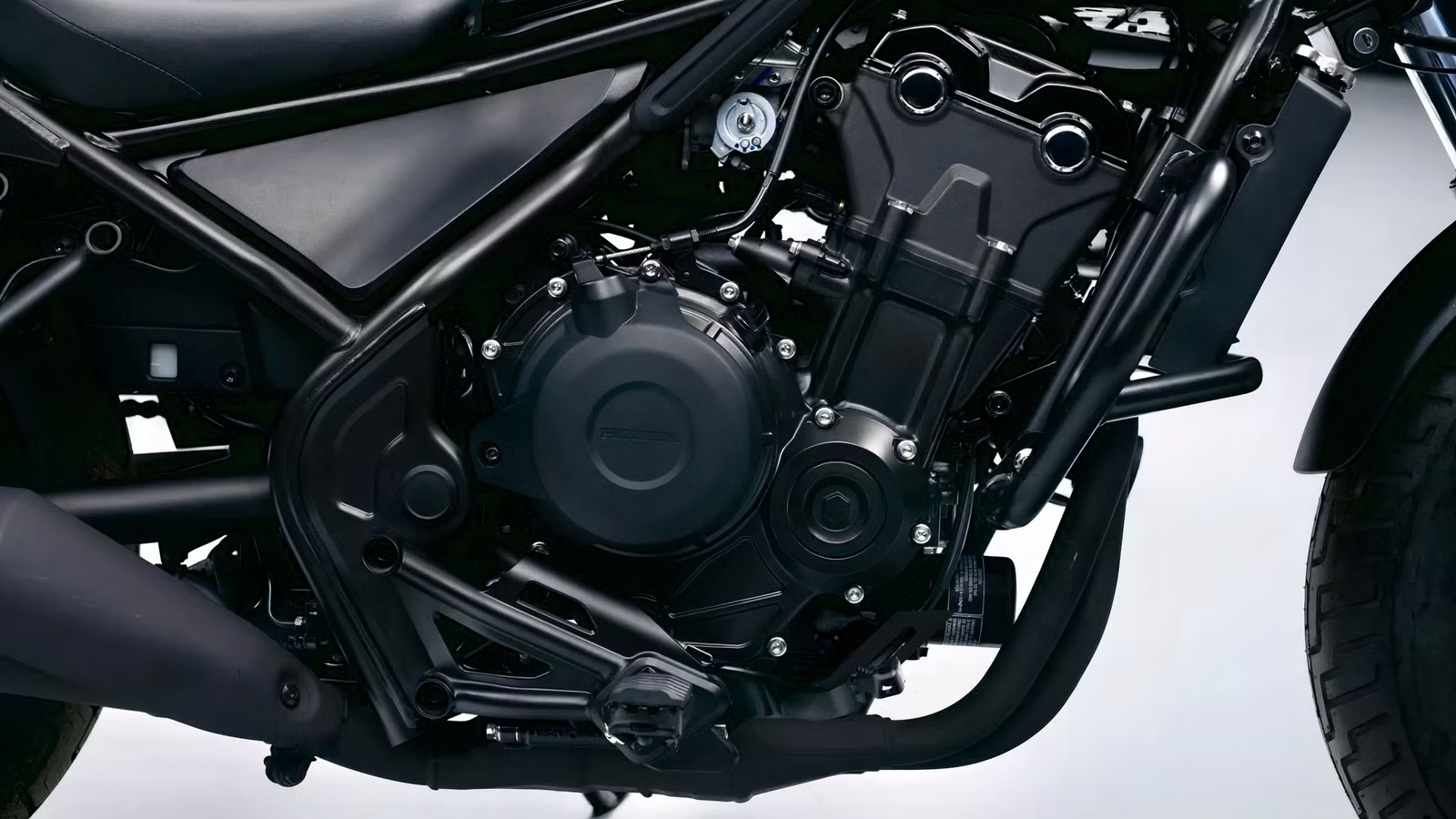
Harley-Davidson had slightly more displacement and the V-twin badge that should’ve owned this comparison in America. Once the engines were measured, though, the expected hierarchy crumbled.

The rival Japanese cruiser used a smaller engine, made substantially more horsepower, and carried way less weight. That’s where this matchup gets uncomfortable for Milwaukee.
Harley Built A Smaller V-Twin For A Much Bigger Job
The Harley-Davidson Street 500 was created to make the Motor Company less intimidating to newer riders. Instead of asking someone to start with one of Harley’s heavyweight cruisers, the Street 500 packaged the company’s familiar V-twin formula into a smaller motorcycle. Its 494cc, or 30ci, Revolution X engine worked through a six-speed transmission and sent power to the rear wheel through a belt.

For an entry-level Harley, that was a sensible pitch. The Revolution X used liquid cooling and a 10.5:1 compression ratio, giving the Street 500 a more modern engine layout than Harley’s traditional air-cooled machinery. Its 28.3-inch seat height also helped make the bike approachable for shorter or less experienced riders looking at their first American cruiser.
Promises Aplenty

All this was important in the USA motorcycle market because a beginner cruiser has a different job from a big touring Harley. Easy low-speed manners matter more than chest-thumping displacement, while the engine still needs enough strength that a rider won’t feel trapped on slower roads once confidence starts growing.
The Street 500 seemed to understand that assignment right up until the horsepower figure entered the conversation. Its badge promised authentic Harley-Davidson character, but the numbers underneath that badge left the little Revolution X with a lot to explain.
More Displacement Somehow Meant Much Less Muscle

The Street 500’s V-twin displaced 494cc, giving Harley a 23cc advantage over the Japanese engine it would inevitably face in comparisons. Yet the Harley’s been quoted at roughly 29.5 hp, while peak torque sits at 29.5 lb-ft at 3,750 rpm. For a liquid-cooled 500cc-class motorcycle, that horsepower figure isn’t exactly the sort of number that makes a dyno operator spill his coffee.
The torque peak arriving at 3,750 rpm at least fits the cruiser brief. Harley clearly wanted the Street 500 to feel useful without forcing a newer rider to wring its neck every time traffic opened up. Around town, an early torque peak can make a modest engine feel more cooperative than the horsepower number suggests.
What Advantage?

Then the smaller Japanese twin enters the spreadsheet. Its 471cc engine was rated at roughly 46 hp at the crank, while independent dyno testing recorded 40.83 hp at the rear wheel. Even before discussing weight, that’s a sizable gap for two motorcycles sitting in the same broad beginner-cruiser conversation.
Crank horsepower and rear-wheel horsepower aren’t measured at the same point, so the figures shouldn’t be treated as perfectly matched lab data, mind. Even with that caveat, the Japanese motorcycle’s measured wheel output still clears the Harley’s quoted 29.5 hp figure by more than 11 hp. That’s where the displacement advantage stops looking like an advantage at all.
Honda’s Rebel 500 Made Harley’s Displacement Advantage Irrelevant

The 471cc engine behind those stronger numbers sits inside the Honda Rebel 500, one of the most familiar Japanese cruisers in North America. Rather than copying the American V-twin formula, Honda uses a liquid-cooled parallel twin tied to its broader 500cc family. On paper it looks less theatrical than the Harley setup. On the dyno, theater doesn’t count for much.
Testing measured the Rebel 500 at 40.83 hp at 7,880 rpm and 29.91 lb-ft of torque at 6,300 rpm. Honda’s claimed crank figure sits around 46 hp. More importantly, the Rebel already has roughly 26 lb-ft available shortly after 2,000 rpm, so Honda didn’t trade away low-speed usefulness simply to chase a stronger headline number.
That broad torque spread is what makes the engine comparison especially awkward for the Harley-Davidson Street 500. The Rebel can behave like a friendly beginner motorcycle at low speeds, then keep pulling as the tach climbs. The Street 500 reaches its torque peak sooner, but it runs out of horsepower way earlier.
For American riders comparing the Honda Rebel 500 vs Harley-Davidson Street 500, it’s all pretty straightforward. Harley had the slightly larger V-twin and the more traditional cruiser image. Honda got more useful performance from less displacement. The dyno, as ever, has no loyalty program.
The Horsepower Gap Was Only Half Of Harley’s Problem

The engine numbers already favored Honda, but the weight difference widened the gap. One direct comparison lists the Harley-Davidson Street 500 at roughly 514 pounds and the Honda Rebel 500 at about 414 pounds. That’s around 100 pounds separating two motorcycles aimed at many of the same newer cruiser riders in America.
The rough power-to-weight math makes the mismatch even clearer. Using 514 pounds and the Street 500’s quoted 29.5 hp works out to about 17.4 pounds per horsepower. Using the Rebel’s 414-pound figure and its measured 40.83 rear-wheel hp gives roughly 10.1 pounds per horsepower. The horsepower measurements aren’t identical in method, so this isn’t a clinical comparison, but the basic picture is obvious.
That lower Honda weight is crucial even when the engine is off. New riders feel every extra pound while pushing a motorcycle around a garage or catching a slow-speed wobble in a parking lot. The Rebel’s roughly 27.2-inch seat height is also lower than the Harley’s 28.3-inch figure, strengthening Honda’s case as an accessible beginner cruiser for the North American market.
One 500cc Cruiser Survived And The Other Didn’t

The Harley-Davidson Street 500 disappeared after 2021. Honda’s Rebel 500 continued long after the smallest Revolution X model had left Harley’s lineup, and Honda was still selling the same basic 471cc Rebel formula for the 2025 model year.
One thing needs to be clarified here: it doesn’t prove Honda directly forced Harley-Davidson to kill the Street 500. There’s nothing out there to prove that cause-and-effect relationship, and Harley’s internal product decisions can’t be reconstructed from horsepower figures alone. Still, the competitive context is kind of hard to ignore when one bike was heavier and significantly weaker on power.
History Was Kind To Only One

The Honda Rebel 500 and Harley Street 500 comparison shows why the outcome feels so lopsided in hindsight. Harley entered the small-cruiser fight with slightly more displacement and a liquid-cooled V-twin wearing one of America’s most recognizable motorcycle badges. In response, Honda answered with a smaller parallel twin that had more horsepower and roughly 100 fewer pounds to move.
That makes the Street 500 an interesting chapter in Harley-Davidson history and the Rebel 500 a useful lesson in engine efficiency. Cubic centimeters tell you how large an engine is, not how effectively the motorcycle uses them. Harley brought the bigger V-twin to this 500cc cruiser fight, but Honda brought the stronger package, and history was much kinder to the Japanese bike.
Sources: Motorcycle Specs, Cycle World, Viking Bags.

Related posts



Latest Post


No Comments