
The Ambitious American V12 That Would Have Conquered Europe’s Hypercar Segment
In the early 2000s, the supercar market underwent a major evolutionary shift. Pure analog engineering began merging with carbon-fiber construction and early paddle-shift gearboxes. High-volume luxury groups acquired legacy marques, driving enhanced manufacturing standards and usability.

Italian powerhouses dominated the landscape. Ferrari led the mid-engine sector with the 360 Modena and the flagship Enzo. Lamborghini, bolstered by Audi ownership, launched the Murciélago and Gallardo. Porsche asserted German dominance with the V-10 Carrera GT. Meanwhile, boutique constructors like Pagani gained traction alongside corporate partnerships like the Mercedes-Benz SLR McLaren. There was one American brand that tried to enter this sphere with a compelling mid-engined platform.
GM Pushed The Boundaries Of Performance In The Early 2000s
During the early 2000s, General Motors established itself as a premier provider of accessible, high performance, leveraging its pushrod V-8 architecture to challenge foreign exotics. Chevrolet served as the tip of the spear with the C5 Corvette Z06, introduced in 2001. Equipped with a lightweight titanium exhaust, stiffened chassis, and the high-output LS6 engine, the Z06 delivered exotic-rivaling track capabilities at a fraction of European price points.

GM simultaneously democratized this engineering across its portfolio through its dedicated performance division. The debut of the 2004 Cadillac CTS-V transplanted Corvette powertrains into a luxury sport sedan chassis, initiating a direct assault on established European performance rivals. Meanwhile, Pontiac revived muscle heritage by importing the Australian Holden Monaro as the V-8-powered GTO. Underlying these efforts was the small-block LS engine platform, which provided high power density, remarkable reliability, and massive aftermarket flexibility.
The Cadillac Cien Would Have Changed The American Supercar Game

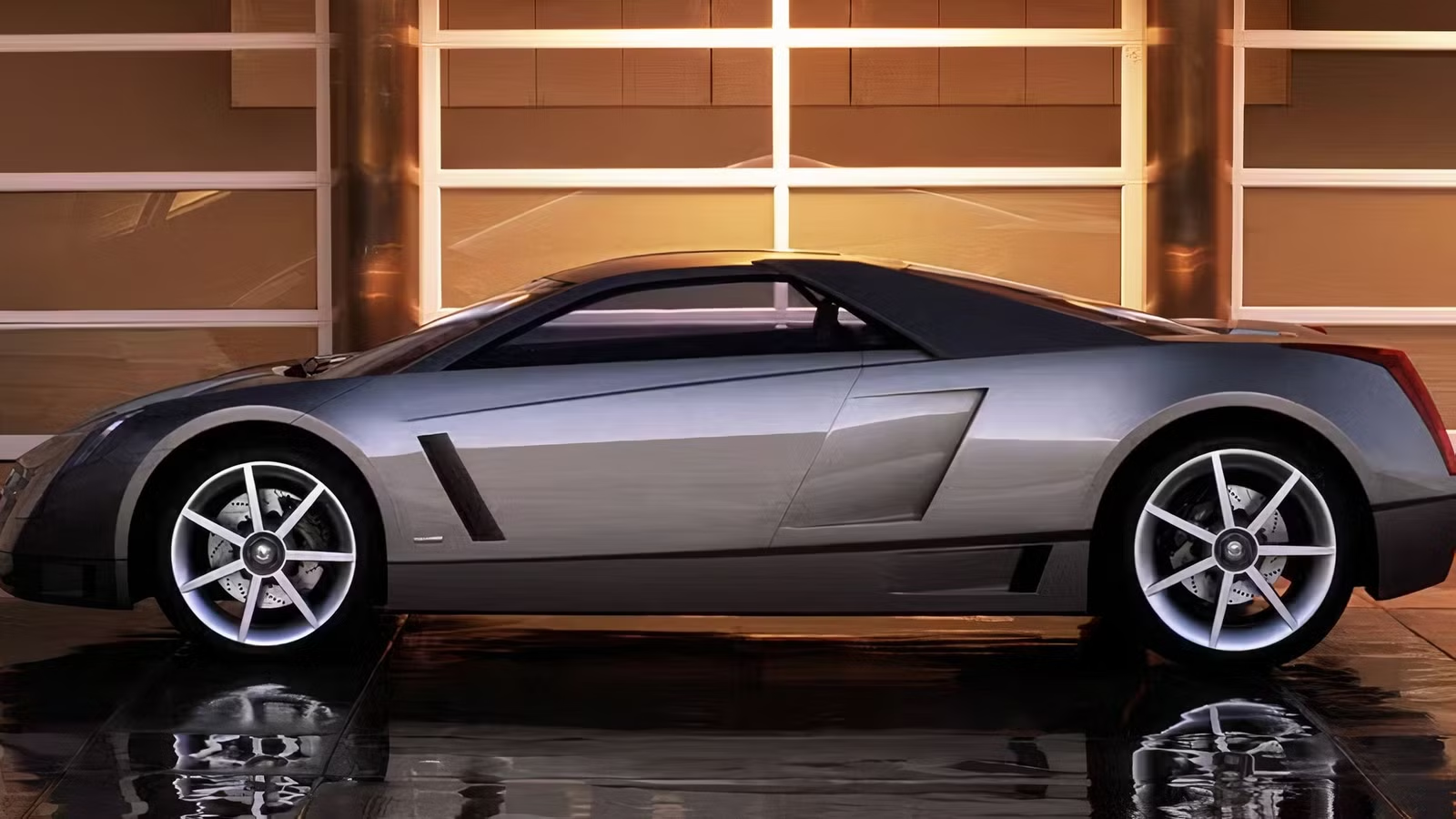
The Cadillac Cien project originated to celebrate Cadillac’s centenary milestone in 2002. Cien takes its name from the Spanish word for “one hundred”. General Motors initiated the flagship concept to dramatically reshape global perception of the brand, signaling a total departure from traditional American luxury cruisers toward a modern, high-performance aesthetic.
British designer Simon Cox executed the sharp exterior styling at GM’s Advanced Design Studio in England. Drawing heavy inspiration from the stealth geometry of the F-22 Raptor aircraft, Cox crafted a low-slung, angular carbon-fiber monocoque featuring aggressive air intakes and scissor doors, defining Cadillac’s emerging Art and Science design vocabulary.
GM intended the Cien as a halo vehicle to showcase cutting-edge technical capabilities. Underneath the rear deck lid sat an experimental 7.5-liter Northstar XV12 engine, paired with direct injection and displacement-on-demand technology. GM evaluated the supercar for limited serial production to directly challenge European hypercar manufacturers. Although financial constraints and high development costs ultimately shelved production plans, the Cien successfully established the aggressive design language and engineering philosophy that underpinned Cadillac’s future V-Series performance lineup.
GM’s Bold Northstar-Based V-12 Design

The experimental Northstar 7.5-liter XV12 engine served as the mechanical centerpiece of the Cadillac Cien concept. The naturally aspirated seventy-five-degree V-12 is based on an aluminum block and heads, dual overhead camshafts, and four valves per cylinder. The powerplant delivered 750 horsepower and 750 pound-feet of torque. A semi-automatic transmission with steering-wheel-mounted paddle shifters managed output, sending drive directly to the rear wheels. The transaxle layout optimized weight distribution across the lightweight carbon-fiber chassis.
Claimed acceleration benchmarks included a 0 to 60 MPH time of 3.9 seconds. Independent automotive estimators projected a low 12-second quarter-mile pass. General Motors stated the vehicle achieved a theoretical top speed exceeding 270 MPH during internal aerodynamic testing.
A Bespoke Platform To Match GM’s Crazy Engine

The Cadillac Cien utilized a lightweight carbon-fiber composite monocoque chassis engineered in collaboration with Prodrive. This layout provided good torsional rigidity and low overall mass. Engineers mounted the double-wishbone suspension directly to the composite tub at all four corners, utilizing aluminum control arms, adjustable coil-over dampers, and anti-roll bars. Active aerodynamics further augmented mechanical grip, as the rear spoiler adjusted electronically to optimize downforce and stability under high-speed cornering.
To manage performance, GM fitted the mid-engine platform with massive vented carbon-ceramic brake discs clamped by multi-piston aluminum calipers. The braking package sat inside nineteen-inch front and twenty-inch rear alloy wheels wrapped in custom Michelin performance tires.
The vehicle showcased genuine supercar architecture through its mid-engine layout, extreme power-to-weight ratio, and carbon monocoque design. By eliminating front weight bias, balancing mass distribution, and integrating race-derived chassis technology, GM created a dedicated mid-engine platform. Unlike front-engine American sports cars of the era, the Cien matched the structural principles, suspension geometry, and dynamic stopping hardware of top-tier European hypercars.
Merging Luxurious Materials With Race-Grade Interior Components

The interior design of the Cadillac Cien mirrored its aggressive stealth-fighter exterior, establishing an ultra-modern, driver-centric cabin layout. Cox organized the two-seater cockpit around a prominent, high-mounted center console that integrated a minimalist digital instrument array.
General Motors utilized premium materials to match European competitors, blending structural dark carbon fiber with polished aluminum accents and supple Bridge of Weir leather upholstery. Carbon-fiber structural elements remained visible along the door sills and central tunnel, reinforcing the raw, lightweight nature of the platform.
The driver monitored vehicle telemetry and engine diagnostics through a central liquid crystal display screen linked to GM’s Night Vision thermal imaging system. An OnStar telematics module, satellite navigation, and a customized Bose audio system provided everyday usability.
To emphasize the performance focus, engineers installed custom racing bucket seats with integrated eight-point safety harnesses. Paddle shifters mounted directly behind the leather-wrapped steering wheel completed the interface, giving drivers instant manual control over the automated transaxle.
Cadillac’s Motorsport Division Influenced The Final Design

In the early 2000s, Cadillac made a high-profile return to top-tier motorsport through its Northstar LMP prototype program. Competing in the American Le Mans Series and the 24 Hours of Le Mans, the carbon-fiber prototype relied on a twin-turbocharged 4.0-liter V-8 engine derived from Cadillac’s Northstar architecture.
This racing campaign heavily influenced the development of the 2002 Cien concept. This includes the carbon-composite construction, aerodynamic balance, high-rpm heat management, and mid-engine weight distribution. GM even partnered with race constructor Prodrive to build the Cien’s chassis and six-speed paddle-shift transaxle, directly transferring endurance-racing structural principles to the concept.
Today, Cadillac maintains a major global presence in professional motorsport. The brand competes in the IMSA WeatherTech SportsCar Championship and the FIA World Endurance Championship using its V-Series.R LMDh hypercar. Powered by a naturally aspirated 5.5-liter V-8 coupled with a standardized hybrid system, the program secures top-class overall victories at elite events, including the 24 Hours of Daytona and the 24 Hours of Le Mans. Through ongoing endurance racing initiatives, Cadillac continuously validates advanced hybrid technology and chassis dynamics for its production road cars.
How Cadillac Uses The Cien Today

Today, General Motors utilizes the Cadillac Cien as an enduring historical artifact, a brand ambassador, and an intellectual benchmark for its design and engineering divisions. Maintained within the GM Heritage Center collection, the concept frequently appears at prestigious automotive exhibitions, including high-profile displays at the Petersen Automotive Museum.
Beyond physical public exhibitions, GM leverages the Cien’s foundational philosophy to inform its contemporary performance strategy. The concept’s mid-engine carbon-composite layout provided early structural reference points that eventually materialized in GM’s mid-engine production vehicles.
Furthermore, the Cien’s geometric, razor-sharp bodywork remains the ideological root of Cadillac’s modern Art and Science design language, directly influencing current flagship models like the ultra-luxury Cadillac Celestiq luxury EV. GM also preserves the Cien’s cultural footprint through media licensing, retaining its presence in racing games like the Gran Turismo series. Rather than remaining a forgotten prototype, GM treats the Cien as a pivotal historic milestone that forever validated Cadillac’s capacity to compete against high-performance global rivals in both aesthetic design and advanced mid-engine engineering.
Sources: Cadillac, GM Authority, and J.D. Power.

Related posts


Latest Post


No Comments