
Facel Vega HK500: Stirling Moss’ Forgotten French GT
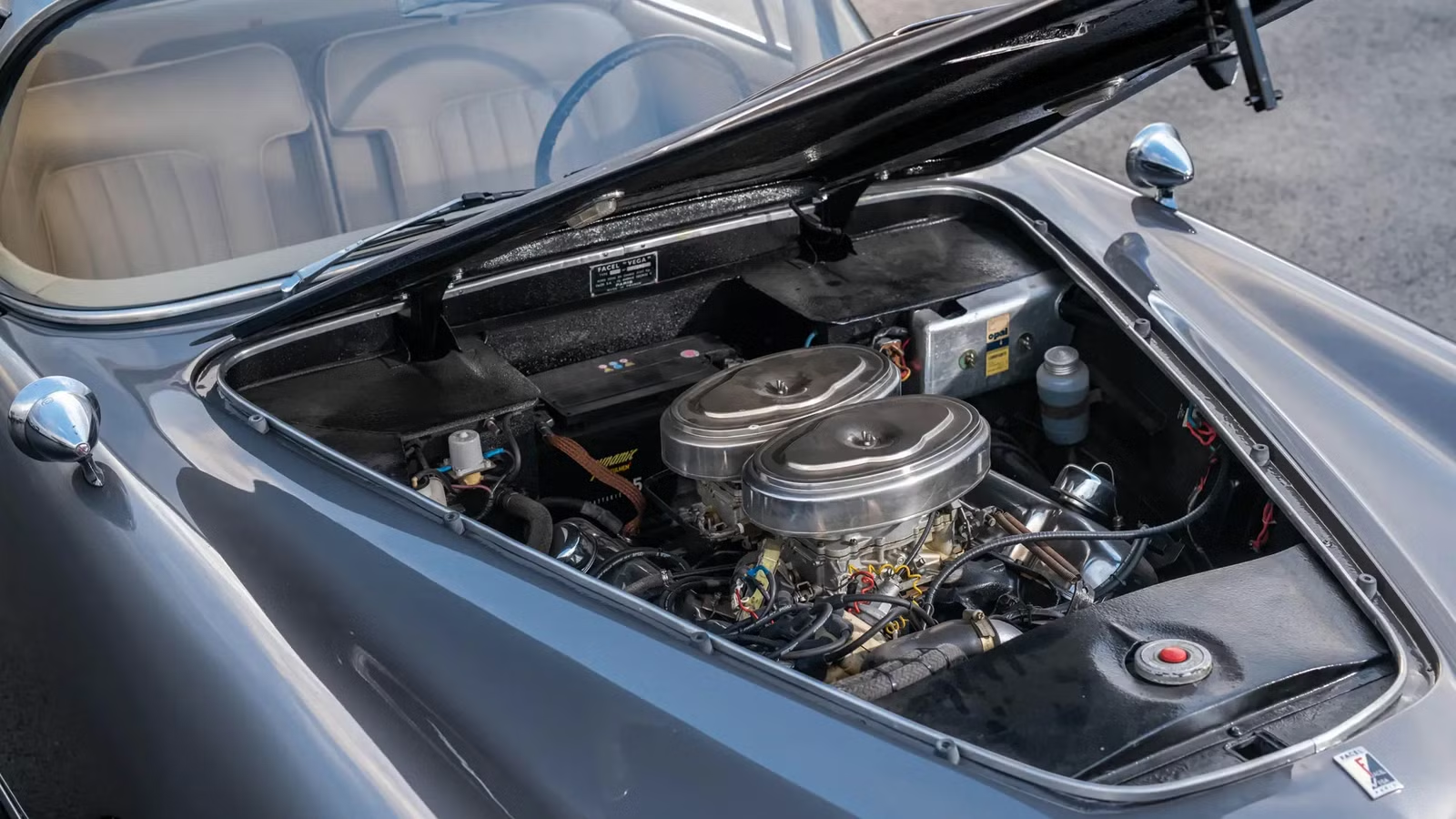
Grand Tourers have long been the choice of the affluent: cars designed for those who want to cross continents in both style and speed, with powerful engines housed beneath elegant bodywork. And while most can think of GT cars from countries like the UK, Italy, and Germany, you’d be hard-pressed to remember one from France. You’d be even less likely to remember a French GT that had a Chrysler engine, and perhaps more surprised to learn that it was Sir Stirling Moss’ preferred method of getting from race to race.
The Gentleman Racer Era: When Grand Tourers Ruled Europe

Motorsport in the 1950s wasn’t what it is today. The cars were different, the circuits were vastly different, and the drivers were a different breed altogether. And nowhere was it more different than in Formula 1. Far from being the sole occupation of drivers like it is today, in the 1950s and 60s it was just one of a number of events that drivers would contest as traveling professionals. 1958 wasn’t just the year that Mike Hawthorn would win his first, and only, F1 championship, for example, as he also raced in the 24 Hours of Le Mans, 12 Hours of Sebring, the Targa Florio and the 500 Millas de Monza in that same year.
For these globe-trotting racers, a Grand Tourer was more than just transportation. At a time when commercial air travel was still developing, a GT offered a comfortable and rapid way to cross Europe between events while providing the performance these drivers were accustomed to. And for one driver in particular, there was a French GT so appealing that he often chose it over flying.

The Coupe With Lexus Reliability And Aston Martin Presence
This grand tourer delivers exotic styling, refined V8 performance, and exceptional long-term reliability.
Grand Tourers Were Nationalistic Endeavors, But Some Embraced Cross-Border Collaborations

In the post-war world, Grand Tourers became billboards for a country’s national identity. Great British brands like Aston Martin and Jaguar prioritized bespoke craftsmanship, gentleman-racer sensibilities, and effortless speed. Italian brands like Ferrari and Alfa Romeo chased stunning, artistic aesthetics and high-revving engines, while German manufacturers such as Mercedes-Benz emphasized technical sophistication and engineering excellence, helping re-establish the country’s reputation for automotive innovation in the post-war era.
France’s contribution to the GT market was smaller. While companies like Facel Vega and Talbot-Lago produced luxurious high-speed touring cars, French manufacturers generally focused on innovative family cars, luxury sedans, and lightweight sports cars rather than the traditional Grand Touring formula embraced in Britain and Italy. But while some brands created cars entirely from parts sourced within their home countries to instill national pride, others used this peacetime opportunity to use parts from around the world to create cars greater than the sum of their country’s parts.
The Facel Vega HK500 Was Sir Stirling Moss’ Commuter Of Choice

|
Engine |
Power |
Top Speed |
|
6.3-Liter Chrysler V8 |
360 HP |
140+ MPH |
Produced between 1958 and 1961, the HK500 was a stunning Grand Tourer straight from the streets of Paris. Intended to compete with Europe’s finest GTs, it mixed unique Art Deco styling with copious power to create the ultimate in luxurious continent-eating machinery.
To start, there was the front of the car. It had a wide, flat grille filled with chrome and headlights, with a trapezoid-shaped hood holding a modest scoop. From here, the car did away with the usual pillars, as the windshield wrapped around the front corners and gave more visibility to the driver. The rear of the car had a sloping trunk flanked by two fins, hinting at the car’s transatlantic nature hidden underneath the hood. That’s because rather than having a French engine up front, it used a Chrysler V8 (most commonly the 383-cubic-inch 6.3-liter, which was the standard HK500 engine throughout its production run).
The interior was similarly opulent, with leather upholstery meeting polished wood trim and hand-painted, aircraft-inspired dials. It was every bit the trans-continental palace it was designed to be and, as such, it quickly gained a celebrity following. Owners included artist Pablo Picasso, singer Frank Sinatra, actress Ava Gardner, and actor Tony Curtis. And while the car’s artistic owners helped bring the car fame, arguably its most notable former owner was former F1 driver Sir Stirling Moss.

Moss was perhaps the ultimate gentleman driver. He plied his trade in everything from hillclimbs to Formula 1, and while he never won the F1 championship (despite taking sixteen wins across 67 entries), he did win the Mille Miglia, 12 Hours of Sebring, 12 Hours of Reims, and a class win in the 24 Hours of Le Mans during his career. The man loved to drive, and his Facel Vega HK500 was his weapon of choice.
Rather than flying from race to race, as some did, Moss instead drove his Facel Vega HK500 across Europe from race to race. Such was his love for the car that he became an honorary Vice President of the Facel Vega Car Club in 1997, some 36 years after the car had ceased production.
8 Factory Sleepers That Came With Engines From Supercars
These carmakers shoehorned their very powerful supercar engines into average family haulers.
An American Engine At A Time Of French Excellence

While the HK500 was a French machine on the outside, it had an American engine at its heart. That’s because few French manufacturers offered a modern high-output engine suitable for the kind of effortless high-speed GT that Daninos envisioned (arguably the closest would have been Talbot-Lago’s 2.5-liter, which made around 130 hp), so founder Jean Daninos turned to America instead. What he eventually got was a Chrysler V8 more typically found in cars like the Chrysler 300E or New Yorker, but which suited Daninos’ vision of high power and exceptional durability.
The 376-HP Pontiac Nobody Raced Because It Looked Like A Luxury Car
This overlooked coupe packed 376 horsepower but was dismissed as just another luxury car instead of the track dominator it could have been.
Why The Vega HK500 Deserves To Be Remembered Today

Only around 490 HK500s were made, which makes the model a relative rarity today. Yet despite the car’s aim of beating contemporaries like the Aston Martin DB4 and Ferrari 250 GTE, it never reached the same lofty heights.
Part of this was due to its competitors’ racing endeavors. By 1959, both Aston Martin and Ferrari had 24 Hours of Le Mans victories under their belts, proving their Grand Touring capabilities, while Facel Vega remained a relatively new and unknown quantity. At a time when heritage mattered, Facel Vega had none.
Then there was the engine. European engines were seen as more sophisticated than those coming from the US, which prioritized straight-line power over all else. It was also another brand’s engine, detracting from the overall image of the car, since not everything had been made in-house. The Chrysler V8 ensured the car was fast, but did nothing for the handling or agility. Whether it was ever intended to be agile, given it was made for highway speed, is another question entirely, though it played a part.

And, ironically, in the world of GTs today, the limited quantity also hampered its popularity. Facel Vega made roughly half of the cars that Aston Martin and Ferrari were able to, preventing them from getting that recognition a brand needs. The HK500 might have offered what its prospective buyers wanted — speed, comfort, space, and style — however, it failed to convince enough people that it was worth it. That impacted the price today, as the HK500’s price is vastly outpaced by its much more recognizable counterparts. Examples have sold for as little as $70,000 and even concours-level HK500s are in the $180,000 region, while at the same time Ferrari 250 GTEs are around $333,000 on average and Aston Martin DB4s are over $630,000. It makes the HK500 a very attractive prospect for getting into the classic 140 mph Grand Touring market for comparatively little, assuming you’re able to find one.
The HK500 remains an exquisite car for those in the know. Fast, comfortable, and unique, it embodied everything a Grand Tourer should. While it never got the attention it deserved, it remains arguably one of the most underrated Grand Tourers of its time.
Sources: Classic.com, Facel Vega CC,

Related posts




Latest Post


No Comments