
Pontiac OHC Six: The Overhead-Cam Sprint Engine Detroit Forgot
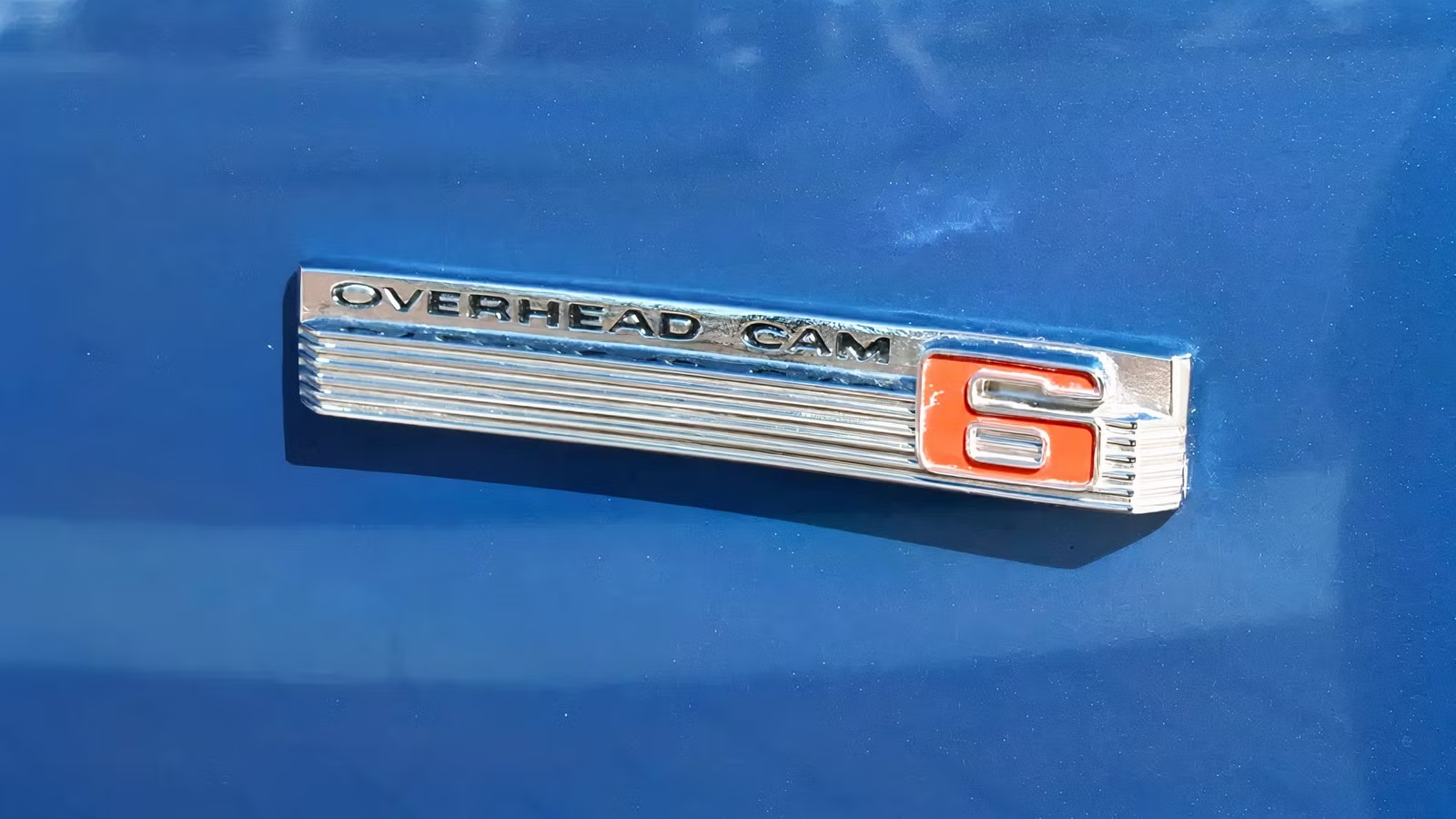
European engines are suave and sophisticated, and American engines are gigantic and silly. That’s the official narrative about the 1960s, anyway. Whether that’s really true 100 percent of the time depends on whether you’re familiar with what Pontiac was busy doing during the latter half of the decade. Around that time, Pontiac had its hands in far more than just the GTO and its companion V8. They also tried to mimic European-style refinement whenever they were able to. When they did, they were often overshadowed by other, flashier engines.
Pontiac: The Perfect Brand to Push Back Against the Pushrod Establishment

The first dual-overhead cam engine with four valves per cylinder traces its origins back to 1912, when a 7.6-liter four-cylinder Peugeot motor was developed for the period’s Grand Prix and Indy 500 racing circuit. Its first application in a road car came from Great Britain in the form of the two-valve Sunbeam 3-litre. On a broader note, Fiat introduced the legendary Lampredi Twin Cam engine, used across a range of Fiats, Lancias, and SEATs. But in America? You’d be forgiven for thinking they paid no mind to twin-cam engines whatsoever.
The official retelling of the muscle car warscertainly never mentions tech more in line with sporty European drop-tops. Given the sheer amount of cubic displacement being thrown around in those days, that’s certainly understandable. Mixed right in with early development for the GTO, the proprietary motor, and the brand refresh to be more youthful, shot-caller John DeLorean had another trick up his sleeve.
Long a fan of European sports car driving dynamics, DeLorean had sought to bring a similar layer of refinement to the brand GM entrusted him to shepherd. Far from the low-strung docile motors the mainline Pontiac V8 became, DeLorean wanted something reasonably sized, eager to rev, and that provided all the feedback to the driver imaginable. You know, the way a well-sorted British, German, or Italian sports car does with ease.

9 Dirt Cheap V8 Pontiacs On The Used Market Right Now
The Pontiac name lives on in the used market. You can find some dirt-cheap V8-powered Pontiac cars that deliver style, excitement, and fun.
DeLorean Leads the Way, With Spectacular Results

John DeLorean’s plan to bring Euro-style refinement and class to the Pontiac brand was simple in principle, but endlessly complicated to execute. To start, DeLorean knew he couldn’t divert much capital away from the V8-addicted top brass at GM. Knowing that looking those men in the eye and requesting funding for a sporty six-pot might get him laughed at or even fired, DeLorean could at least use existing hardware, plus whatever else was at hand.
What DeLorean did have at his disposal was a 230-cubic-inch straight-six block from Chevrolet, sporting overhead valves, and called the Turbo Thrift. Seen as fairly advanced for the day by non-V8 standards, the biggest downsides were the heavy cast-iron block and cylinder heads. The only piece of lightweight aluminum on the whole engine was the valve covers. Now, with John DeLorean and his legendary team longing for something more, they’d soon get what they wanted.
For starters, they took the pushrod architecture inside and promptly threw it away, giving it a single overhead camshaft and a 6,500 rpm redline on the dyno stand. In its flagship configuration, you got beefed-up pistons, a more aggressive camshaft profile, and a Rochester Quadrajet four-barrel carburetor that wouldn’t look out of place on a big block. Of course, that’s because they most certainly were there in abundance. Rather than existing inside the cylinder head like most overhead-cam motors, the camshaft was contained inside a cast aluminum carrier that replaced traditional valve covers.
The 1970s Muscle Car That Scared Detroit Into Canceling It
Pontiac almost unleashed a Super Duty 455 in a mid-size package for 1973, then corporate fear shut it down.
Pontiac 230 Sprint Straight-Six: The Ultimate 60s American Six-Pot

Compared to other American straight-sixes, the overhead-cam Pontiac 230 might as well have been NASA hardware. The Sprint package made its debut in the Tempest for the 1966 model year. Riding the same A-body hardware as the Chevy Chevelle, Oldsmobile Cutlass, and the Buick Skylark, the Tempest had some real grunt. Output ranged anywhere between 165 and 215 hp, depending on the year and options package. Depending on whether it was tuned for fuel economy or for speed via the Sprint package, figures could vary wildly.
Through the next few years, Pontiac refined and tweaked the formula, adding it as an option not just for the Tempest, but the Mustang-fighter Firebird pony car in 1967. By then, the engine had been bored and stroked to 250 cubic inches. In this setup, DeLorean’s six-pot churned out 230 gross hp. That’s officially encroaching on small block V8 territory, and at the height of the muscle car wars no less.
Stacked up against a 350-cubic-inch Pontiac V8 and the 250 or so hp its more pedestrian setups produced, the 230-ish-hp 250 OHC straight-six was lighter and very nearly as powerful. Though it would lose a quarter-mile drag race to a V8 Firebird, modern hindsight tends to agree the six-pot was considerably better in the handling department. It wasn’t all sunshine and roses, however. The complex composite timing belt and short production history meant spare parts were limited and expensive. Meanwhile, you could fix a 350 V8 with the same tools you could fix a tractor with.
A Passing Curiosity, But an Important One

In truth, an overhead-cam Pontiac straight six was far closer to a Jaguar or a BMW motor than anything that came from the US. In the unique case of American roads, where there are more roads, highways, and interstates than one knows what to do with, perhaps the big V8 made marginally more sense in the late ’60s. Being as unique of a period as it was, such a dynamic wasn’t bound to last.
The Pontiac straight-six was sunset outright in 1969, just in time to wait out the peak muscle car years, and then watch the thing come crashing down after the 1973 gas crisis. All the while, European straight-sixes, later followed by examples from Japan, continued to develop into flag carriers for entire brands abroad. While American V8s choked themselves to death with catalytic converters, the emissions-regulation plague stateside was barely even a blip elsewhere. Simply put, most engines abroad were already small, responsive, and relatively fuel efficient, so adapting to new emissions standards wasn’t a concern. For the rest of the 20th century, and even most of the 21st, the straight-six was a curiosity on the American market. Something you’d find under the hood of a full-sized truck or SUV, or some foreign sports coupe. Simply put, there wasn’t room on the marketing stage for much else but V8s in those days. At least, that was the overarching belief in Detroit at the time. Whether they were wrongheaded or not should be fairly obvious.
A Rare and Special Engine, With a Price

Anywhere from 130,000 to 140,000 overhead-cam Pontiac straight-sixes were built during its run. All were members of the Tempest, the LeMans, or the Firebird family, and a considerable percent didn’t pack the Sprint package. By some estimates, only ten percent or so were configured as such. Knowing this, it should come as no surprise that folks on the internet demand $30,000 or more for a Firebird in good condition with the same motor. Considering the technology under the hood, that’s really not a bad deal. Just imagine how much more one with a 400 V8 would cost. Sometimes, name value alone really does add real value.
Source: Hagerty, GM, Hemmings

Related posts





Latest Post


No Comments