
The Forgotten Buick V8 That Weighed Less Than A Chevy II Four-Cylinder
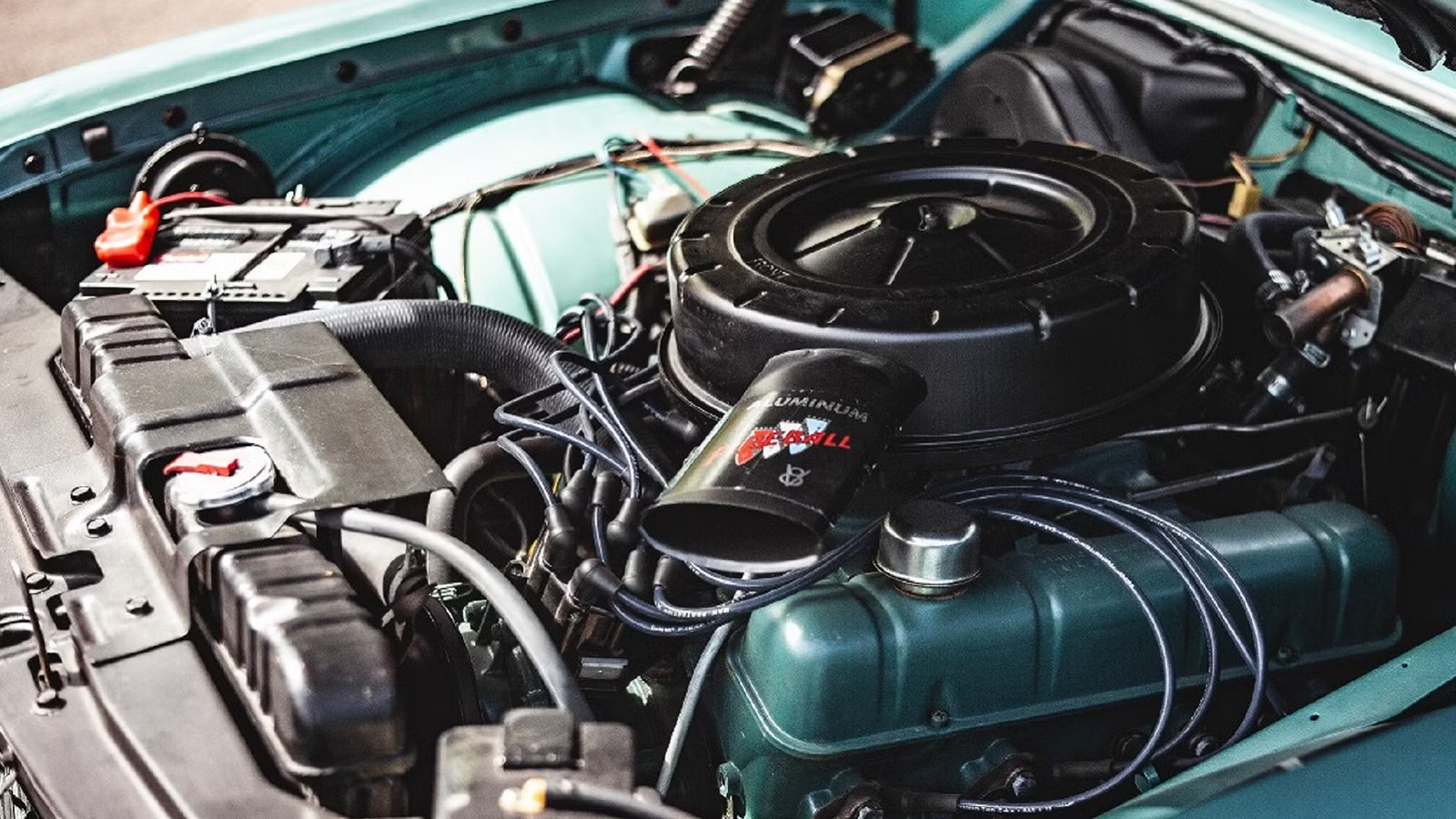
British engines and American engines are like yin and yang: one is oversized and brutish, the other is pint-sized and anemic. Never the two shall meet, at least, that’s the propaganda. But people who aren’t tribal about such things know something important: that line of thinking doesn’t hold up. Why? Because the most iconic British V8 of all time was once one of Detroit’s most advanced power plants to date. In their basic architecture, there wasn’t much difference between them at all. It was a sports car engine through and through, but it had the capability to do a great deal more.
Buick in the ’60s, A Pretty Cool Place to Be

People like to credit Oldsmobile as GM’s de facto Skunkworks in the early 1960s. With cars like the Toronado and the Jetfire driving around in those days, they do have a point. But this doesn’t always account for what Buick was up to around the same time. Buick had already cemented itself as an aspirational brand the decade prior, thanks to the efforts of GM Lead Designer Harley Earl and the powerful Nailhead V8.
Buick carried that good grace into the early ‘60s by pumping up every stat imaginable in the engine refinement department. In the days immediately before the muscle car wars, that didn’t always require throwing cubic displacement at the problem and calling it a day. After all, this particularly simple way of adding engine power was as much a marketing exercise as genuine OEM development.
Clearly, it had to be a V8; there wasn’t any getting around that. But on top of that, Buick’s new engine had to push the limits of material sciences for General Motors on the whole. Sixty years ago or more, the ways that GM could push those boundaries were limited. But they did have a couple of tricks up their sleeve, one of which was a change to the engine block.

Aluminum Engine Blocks: A Tricky Beast Back in Those Days

Engineers had bemoaned for years how heavy an internal combustion engine’s iron block was, particularly by the early 1960s. With a decent mix of durability and resistance to thermal shock, iron was the easiest and cheapest way to cast a block that would last. But refined they were not, those iron blocks of the time. Not only were they heavy, but iron held on to heat for longer after the engine turned off. Over time, and especially in high-revving V8s, this was bound to limit the life of an American V8 before a complete teardown and rebuild was necessary.
In the era before composites, the next best thing — and objectively a much lighter alternative — was cast aluminum alloy. Over 60 percent lighter than iron, aluminum dissipated thermal load far better as a result. They could also be made with thinner wall sections, allowing engineers to integrate more effective cooling passages.
In theory, this means you can crank up the compression and add forced induction or fuel injection, and an aluminum block is far more likely to remain stable under those conditions. Of course, it was nowhere near that cut and dry to manufacture. Casting aluminum is an entirely different proposition than casting iron, and GM had its work cut out developing the semi-permanent molds and custom tooling needed to make it happen. To their credit, GM, and more specifically Buick, got it mostly right in the end. When they did, the results should have been earth-shattering for them. Instead, it benefited someone else entirely.
Pontiac’s Forgotten OHC Six-Cylinder Was Decades Ahead Of Its Time
This forgotten engine bridged American muscle and European sophistication, introducing innovations still used in modern cars today.
Buick 215 V8: One of the Coolest Engines of the 60s, Lighter Than Most Four-Pots

It took GM over a decade to figure out cast aluminum block production before it debuted in 1961. Their first attempt came in 1951 via a follow-up to Harley Earl’s Y-Job concept, the LeSabre. Sporting a wild supercharged aluminum V8 transaxle, this engine was something of an early development of what became the Buick 215 small block. The engine once again appeared in the 1953 Roadmaster concept, proving the aluminum block gimmick was more than a passing fancy.
|
Buick 215 V8 |
Block Weight: apx 320 lbs |
155-200 hp |
|
Chevy II I4 |
Block Weight: apx 350–360 lbs |
Power: 90 hp |
As the first passenger cars to get the new engine, the Buick Special and its range-topping variant, the Skylark, probably should have been global ambassadors not just for the brand, but for American cars in general. At 318 lbs dry, the 215’s bare block encroached on half the size of an iron small block Buick engine. Coming in at just over 20 pounds lighter than a Chevy II’s straight-four engine, it is easy to understand the envy. As should come as no surprise, Oldsmobile and Pontiac immediately took notice and wanted their own slice of the pie. As such, icons like the Pontiac Tempest saw the option of an aluminum Buick engine under their hoods, albeit in relatively small numbers.
In the case of the Oldsmobile Jetfire, its design team contracted Garrett AiResearch to fit one of its turbochargers to the engine, producing 215 hp. At one hp per cubic inch, that was genuinely impressive in the early 1960s. Considering anything below 350 cubic inches would soon be seen as small, that is remarkable. But make no mistake: building an engine closer to a European or Japanese-market creation stateside wasn’t the instant success it would have been in 2026. Instead, it was the 215’s undoing in the United States.
The Hand-Built Buick Coupe That Had A Touchscreen In 1988
This hand-built coupe had a touchscreen in 1988, but its biggest problem may have been arriving before buyers knew they wanted one.
In Come the Brits, and They’re All Too Eager

If you think about it, British Leyland and General Motors weren’t too far off in the ‘60s. Both were giant conglomerates of smaller automakers absorbed over time. Both brought thousands of high-skill jobs to their neck of the woods, and both were known for periods of profound hardship not long after the time period in question. In the case of Leyland, they didn’t make it out of the 20th century at all. But that didn’t mean there weren’t considerable highlights along the way.
British Leyland’s introduction to the Buick 215 V8 was a complete chance encounter. In 1964, a man named William Martin-Hurst, Managing Director at BL’s linchpin automaker, Rover, happened upon a marine-optimized Buick 215 on a visit to the US. Martin-Hurst came to the United States to try to sell Rover engines to Mercury Marine. But catching the eye of a Rover exec, even for just a few moments, was enough to change the course of British Leyland entirely.
After Buick grew weary of the coolant leaks, casting issues, and premature warranty work caused by aluminum-incompatible coolant, GM did not hesitate to sell the rights to the 215 small block to Rover. From there, development moved swiftly.
The Cornerstone of British Leyland

BL proper was founded in 1968, just as Rover was getting to grips with the engine they’d bought from Buick. From there, the group was free to mount it in whichever sports car, off-roader, or general runabout it pleased, and it duly did so. For starters, its first application, the Rover P5B coupe, used the B in its name to designate “Buick.” A plush, leather-and-wood-wrapped luxury coupe, the P5B’s 160 hp and lighter curb weight made it a night-and-day improvement over earlier P5s.
Elsewhere, the Rover SD1 sports car was designed to look like a Ferrari Daytona, but made a legit icon all its own when an aluminum V8 was installed. Triumph’s TR line of sports cars, long bemoaned as underpowered despite being a great driver’s car, benefited tremendously from the aluminum 215 V8 in the TR8. Even the diminutive MGB GT found itself with a Rover V8 under the hood starting in 1973. Want a Morgan Plus 8? Well, they used Rover V8s for the better part of 35 years, and people in the know will tell you the best TVRs used them as well. TVR even increased the bore and stroke to a substantial 5.0 liters, making it almost a British equivalent of the Boss 302.
Above all else, the Rover V8 made its mark most of all in the original Range Rover. In tandem with some of the most robust 4×4 hardware in the world, and tempered with just enough refinement to impress, these original Range Rovers set the standards that modern ones often fail to meet. When the Range Rover went further up-market in the mid 1990s, the Rover V8 came right along for the ride. In every sense imaginable, Rover, British Leyland, and every small-scale operation that used Buick’s old engine made the most of Buick effectively giving it up.
Four Decades of Excellence

39 years came and went between the first and the last Buick 215 V8 built under license in the UK. That’s eight US Presidencies, nine British Prime Ministerships, and enough low-production shed operations to fill a textbook. Meanwhile, Buick, the very brand that started it all, barely survived past the Rover V8’s discontinuation in 2006. Sure enough, a stark lack of the very innovation that produced the 215 V8 in the first place is commonly cited as the impetus for its downfall. Nowadays, the vast majority of engine blocks are aluminum. Save for a few holdouts like SRT’s Hellcat engine, the lighter weight and the benefits of modern thermal management mean Buick’s work really did pay off in the end.

Related posts





Latest Post


No Comments