
The Real Difference Between Toyota And Lexus
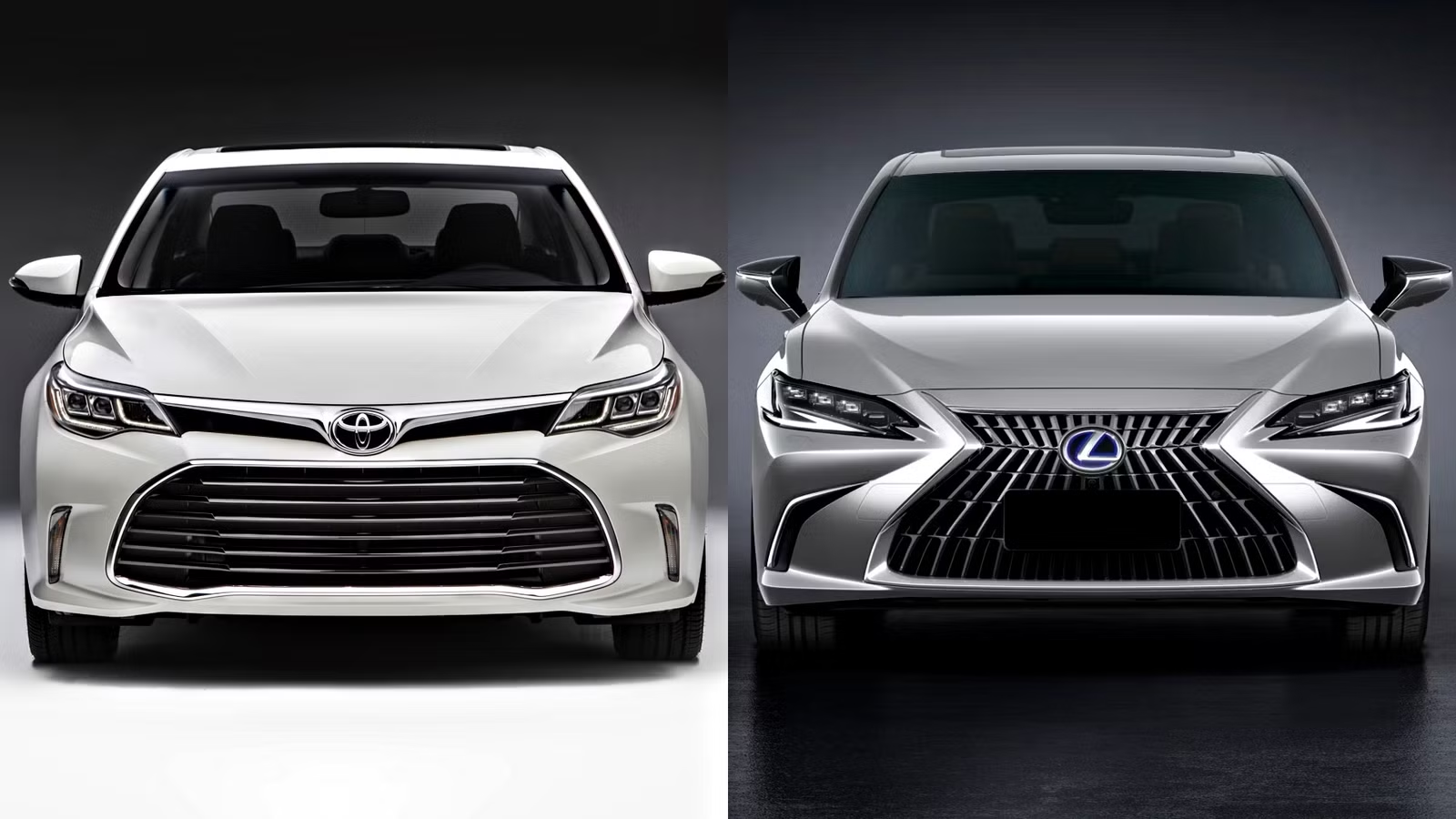
Everyone is well aware that Lexus vehicles are Toyota derivatives that focus on offering a more luxurious and premium ownership experience. For years, just like their Toyota counterparts, Lexus cars have been praised for their reliability, dependability, attention to detail, and comfort.

Lexus cars are a mirror of the Japanese way. A way that requests perfection in the product. It requires that the car put on sale will serve its owner well for years to come hence the slogan of the company “The Relentless Pursuit of Perfection.”
However, amongst the praise, as is the case with everything, there have also been some criticisms. Criticisms mainly focus on the suggestion that Lexus vehicles are just glorified Toyotas with a higher price tag. Is that really true? Well, in this article we are going to find out.
How Lexus Came To Be

In the early to mid-80s, Toyota was working on an inside project dubbed the “F1” project. The aim of this exercise was to penetrate the American luxury market. Back then, American consumers were starting to move out of the domestic land yachts and were getting increasingly interested in European luxury vehicles mainly from Mercedes and BMW.
Toyota was aware of this and wanted to put effort into grabbing a portion of the luxury market on American soil and even further afield. This led to Project F1 becoming the legendary Lexus LS400.
Upon release of the LS400 in 1990, Lexus was just a small side brand that enabled Toyota to sell high-end vehicles with a different badge in order to remove brand-based biases from the buying decisions of customers. However, a year later, the attention to detail of the Lexus LS400 grabbed sales from its German rivals and began turning Lexus into the incredibly popular brand it is today.

The LS400 was everything a Lexus should be. Firstly, It was extremely reliable. In fact, it can be characterized as one of the most reliable sedans ever made. There have been cases of these cars lasting over a million miles. Then, we have the fact that it was an extremely plush and luxurious drive. The LS400 didn’t focus on performance, it focused on comfort, and this made it an incredibly pleasant vehicle.
This, in fact, was the company’s point of differentiation. Lexus produced extremely reliable and dependable cars that were comfortable to drive, at a price far lesser than the competition. This is sadly a reputation that might be getting ruined today.
Are Lexus Cars Really Glorified Toyotas?

Lexus cars are glorified Toyotas, but is that a bad thing? Well, no, it isn’t. Toyota’s are well known as some of the most reliable and dependable vehicles out there. If you look after a Toyota (which means getting it serviced on time) then you can be sure it will look after you for years to come.
In most cases, people buy a Toyota knowing that they won’t need to spend money and time dealing with issues. Especially as the vehicle gets older. So, the fact that Lexus vehicles are so closely associated with Toyota models is actually a good thing.
How JD Power’s Most Recent VDS Proves This Logic

According to JD Power’s 2026 Vehicle Dependability Study (VDS), Lexus is the most reliable brand, luxury or not, even ranking ahead of its parent company, Toyota. The 2026 average problems per 100vehicles, or PP100, is 204 PP100, which is an increase from the 2025 study, which produced an industry average of 202 PP100. Lexus models average 151 PP100, which is not only well below the industry average, but the lowest of any car brand in 2026. Toyota sits in eighth place, with 185 PP100 – still well below the industry average.
Toyota’s lower position doesn’t mean its models are less reliable; it’s simply a product of very vast production, whereas Toyota put 2,147,811 cars on the road in 2025, Lexus only put 370,260. And more cars on the road equals more instances of failure. Regardless, both names in the top ten show a clear formula that lasts, a formula that starts with Toyota. But, as we know, Lexus doesn’t stop at reliable.
Lexus Takes Everything A Step Further
The underpinning of Toyota and Lexus vehicles is generally the same. For example, the structure, engines, transmission, and suspension are, in many cases, nearly identical. However, Lexus takes everything a step further. Firstly, there are the things we can see. The design of Lexus cars is much more interesting and premium.
On the inside, customers get more technology and materials that feel luxurious. However, there are also differences in the areas customers can’t see. For example, a Lexus derivative of a Toyota platform will have more sound insulation. This means that the car will be much quieter when going down the road. But for all its luxury upgrades, it still faces a struggle when it comes to dominating the luxury space against its German rivals.
Lexus Is Currently Facing Problems

The ongoing restrictions of governments regarding vehicle emissions have led to smaller engines that are paired with hybrid systems. This, in turn, leads to more complicated mechanical components that aren’t as reliable as the simple models of the past. So, in some sense, new Lexus models aren’t as reliable as they once used to be.
If the Lexus is stacked up against a Mercedes or a BMW, the conclusion will generally be that the BMW and Mercedes drive much better and that the Lexus is boring. However, no one ever talks about the fact that the Lexus will last far longer and can in many cases be more comfortable. Sadly, this has made Lexus take some questionable decisions which have led to sportier cars that are jarring, uncomfortable, and not as reliable as they should be.
When you add sporty suspension, big wheels, and bucket seats to a sedan you are ruining its on-road comfort. Lexus vehicles were never focused on performance, they were focused on reliability, affordability, and comfort. Brands like Genesis are doing what Lexus did to the luxury car market over three decades ago. And, at the end of the day, in a world filled with speed cameras and traffic, who drives a sedan fast anyway? If you want to go fast, get a track car.
Why Lexus Models Are Perfect If You Prefer Poise To Performance

It is important for people to understand the following. A car has three things to fulfill, but in most cases, it only achieves two. They are performance, reliability, and price. German cars offer great performance at a competitive price but don’t have the best reliability.
Lexus cars are the opposite. The only way to achieve all three aspects is with an insanely expensive car. A prime example of this is the Lexus LFA. Thankfully, Lexus hasn’t gone all-out on becoming a sportscar maker and still offers plenty of luxury sedans and SUVs. Therefore, you can still find a lot of non-performance-oriented Lexus models which should serve you well with their comfort and reliability.
Sources: Lexus, Toyota, iSeeCars, JD Power

Related posts





Latest Post


No Comments