
5 Bench-Seat Muscle Cars Rarer Than Any Bucket-Seat Trim Left
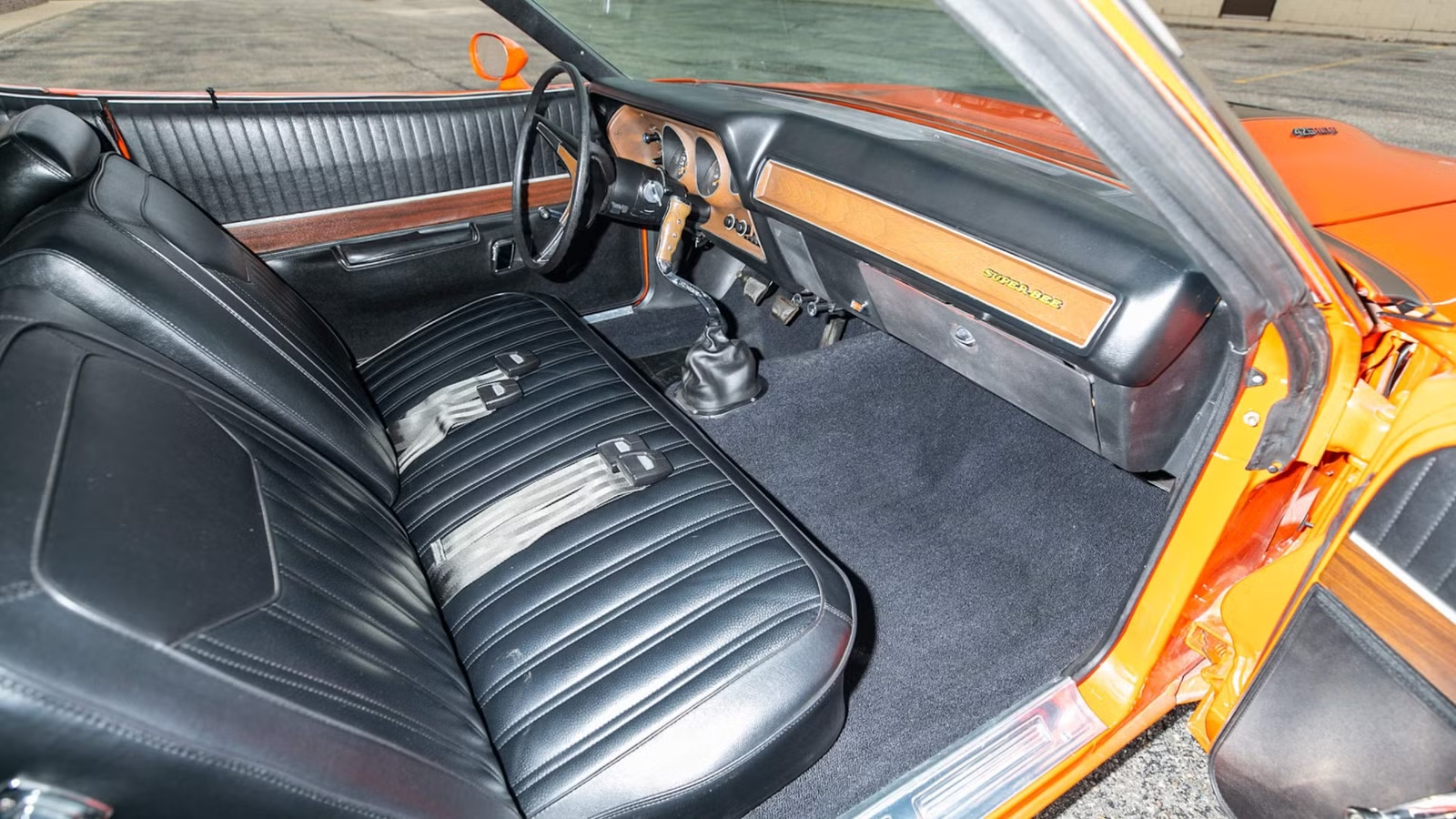
We tend to take things like front bucket seats as the norm because they are pretty much standard on all vehicles, but there was a time when they were luxury options. Back in the day, most base model cars came with a bench front seat, which was kind of like having a sofa in your car, and that’s not necessarily a bad thing. With Golden Age muscle cars, however, buckets were the way to go for a street machine, with the notable exception of the no-frills Plymouth Road Runner and Dodge Super Bee, which were equipped with benches from the factory. For almost everything else, it was two buckets up front, so finding a classic muscle car with a bench front seat is nearly impossible, but we managed to track down some of these ultra-rare examples.

5
1970 Oldsmobile 442 W-30
Estimated Value: $84,700
1970 is the year that GM finally ended its over-400 engine ban for muscle cars, and Oldsmobile celebrated by dropping a 455 Rocket V8 into the 442, which, with the W-30 performance package, cranked out 370 horsepower and 500 lb-ft of torque. In 1970, Olds built 3,100 442s with the W-30 option broken down by 2,574 Holiday coupes, 262 Sports coupes, and 264 convertibles. Of the total production, just 1,032 came with four-speed manual transmissions, so they are the rare and more desirable variety. Even rarer, is a ’70 442 W-30 with a bench front seat, which sounds weird but is actually true.
The 442 came standard with Strato bucket seats, but there was an RPO A52 option that allowed for a bench front seat. The question before us is why anyone would option a bench, even if it was free, and the answer is we don’t have a clue. It’s impossible to tell how rare a ’70 442 W-30 is with a factory bench front seat, because no manufacturer kept track of stuff like that, but we can dig through auction listings and see that they are virtually non-existent. That yellow car pictured above has a build-sheet-confirmed bench front seat, and it is literally the only one we could find.

4
1971 Buick GS 455 Stage 1
Estimated Value: $99,000
Buick also went 455-crazy after GM’s big-engine ban was lifted, but its version was extra-special and actually rivaled the Chrysler 426 Street Hemi that dominated the streets during the Golden Age. Made with thin-wall architecture, Buick’s 455 was considerably lighter than most big-blocks, and while its 360 hp, with the Stage 1 performance upgrade, wasn’t particularly impressive, its 510 lb-ft of torque was a revelation across the country. A 1970 Buick GS 455 Stage 1 could run a quarter-mile in 13.38 seconds, making it the quickest accelerating classic GM muscle car, but more importantly one that could hang with the Hemis and even beat a few. For 1971, it was a couple of ticks slower, but still a beast on the streets.
Here is where things get interesting, especially since we’re talking about the rarity of bench seats, because the ’71 GS 455 Stage 1 came standard with a bench front seat. Buick built a grand total of 882 Stage 1 cars in 1971, split between 801 hardtops and 81 drop-tops, all of which, outside of special orders, allegedly left the factory with bench seats, but again there are no hard numbers confirming this. Once again, we took a look at auction listings and found that almost everyone who bought a ’71 GS 455 Stage 1 splurged on the buckets option, as we could find only a single example of a bench front seat car.
3
1969 Chevelle SS 396 L78
Estimated Value: $110,000
The 1969 Chevelle SS 396 L78 was the last great Chevy muscle car of the GM big-engine ban era, and for many enthusiasts it’s a favorite. With the 375 hp, 415 lb-ft 396 L78 V8, the ’69 Chevelle was a 14.07-second car from the factory, and with a better set of tires, was running in the 13s. With a little bit of wrenching, it was running in the 13s in a way that made Dodge and Plymouth owners nervous, and it was an exceptionally aggressive-looking car, which is why it is so coveted today. This is another car that actually came standard with a bench front seat that is now a super-rarity.
The SS package, including the 396 L78 upgrade, was quite expensive in ’69, adding another $600 to the price of the car, which doesn’t sound like a lot today, but was a significant sum back then. It’s tempting to think that anyone who could afford that, could also drop a few extra dollars for buckets seats, but that’s not why bench seats are so rare for this model. It would seem that almost everyone who has restored a ’69 Chevelle SS 396 L78 chose to install buckets, because they look better and doing so does not affect the car’s numbers-matching status. Original bench cars are few and far between, with only two or three of them ever having been listed for auction.
2
1970 Plymouth GTX
Estimated Value: $110,000
This is the most unusual entry on the list because the GTX was the antithesis of the stripped-down Road Runner, coming standard with every feature and option that Plymouth had to offer. You could actually get some serious deletes on a Road Runner, like the back seat, carpet, and radio to save money, but a GTX, which had the exact same sheet metal, was loaded with every feature and option in the catalog, including bucket seats. Part of that premium package was the fact that the GTX started out with a 440 big-block as the base and went up to a 440 Six-Barrel or 426 Street Hemi, which meant it was a performer straight from the dealer that was upgradable to a factory drag car.
Whether it be the stock 440, 440 Six-Barrel, or 426 Hemi, all 1970 GTXs had bucket seats when they left the factory. There was, however, a bench option that actually cost additional money, as opposed to the cost-cutting deletes of the Road Runner. It is genuinely difficult to understand why anyone would have paid extra for a less desirable seating arrangement, but it happened at least twice. That red ’70 GTX V-Code 440 6BBL pictured above has a vinyl/cloth front bench with armrest, verified by its fender tag, and is a true Mopar rarity.
1
1971 Dodge Charger Super Bee
Estimated Value: $209,000
Introduced mid-model year in 1968, the Super Bee was Dodge’s version of the stripped-down Plymouth Road Runner. It was based on the Coronet R/T which, along with the Super Bee, was discontinued in 1970. For 1971, the Super Bee was revived as a trim on the third-gen Charger with its radical “fuselage” body style. While more dynamic looking than the boxy Coronet-based version, the ’71 Super Bee was still a bare-bones street brawler that prioritized performance over perks, in order to keep the price in the affordable range. A base ’71 Charger Super Bee came with a 383 V8, manual steering and brakes, as well as a bench front seat. Exactly 5,054 Super Bees were produced in 1971, which isn’t exactly a smash hit, but the rarest of the bunch is as stunning as a sucker punch.
Conventional wisdom tells us that if a particular budget car came standard with bench front seats, most, if not all, should still have that configuration, but finding a ’71 Super Bee that doesn’t have buckets is an arduous task. It may be the same situation as the ’69 Chevelle, in which restorers installed buckets because it has no effect on the car’s originality status, but there are hardly any bench-seat examples to be found. This is one, however, with a remarkable story, because one of the top-selling cars of all time has a factory bench. That Hemi Orange ’71 Hemi Super Bee 4-speed that was delivered to Mr. Norm’s Grand Spaulding Dodge sold for $209,000 at Mecum Indy 2023, and it has a factory bench front seat.
Sources: Bring a Trailer, Mecum

Related posts



Latest Post


No Comments