
10 Fastest ’60s Muscle Cars Over The Quarter Mile
Few eras in automotive history produced machinery as single-mindedly quick as the muscle cars of the 1960s. Automakers were locked in an all-out horsepower war, and the quarter-mile drag strip was the battlefield where reputations were made or destroyed — though plenty of those battles also played out on the emptiest stretch of public road a driver could find.

The stakes were high enough that muscle cars evolved rapidly to maximize straight-line speed, producing some genuinely fearsome machines in the process. Here are the ten fastest muscle cars to complete the quarter mile during the 1960s.
How we made our model selection: HotCars focused on road-going muscle cars from the 1960s to populate this list, with vehicles of all prices considered. The cars were ordered from the slowest quarter-mile times to the fastest, with tie-breaks being decided by either which car had the most power, or failing that, their current value on the used market using Hagerty’s Valuation Tool.
1968 Shelby GT500 KR: 13.9 Seconds
1968 GT500 KR Specs
 12 autotech Engine |
428 ci V8 |
|
Power |
335 hp |
|
Torque |
440 lb-ft |
|
Quarter Mile Time |
13.9 seconds |
(Source: Barrett-Jackson, 0-60 Times)
First up on the list is the ultra-rare 1968 Shelby Ford Mustang GT500 KR, of which just 1,571 were produced that year according to Barrett-Jackson. The KR — standing for King of the Road — was built around its 428 ci Super Cobra Jet V8, which delivered 335 hp and 440 lb-ft of torque.
Engineering details like staggered rear shocks to prevent wheel hop on hard launches, along with suspension bracing for a more stable platform, gave the car a genuine performance edge. These tweaks helped the GT500 KR run the quarter mile in 13.9 seconds — a thoroughly respectable effort, but only enough to place it tenth on this list.
1969 Pontiac GTO Judge: 13.9 Seconds

1969 GTO Judge Specs
|
Engine |
400 ci V8 |
|
Power |
370 hp |
|
Torque |
445 lb-ft |
|
Quarter Mile Time |
13.9 seconds |
(Source: Barrett-Jackson, 0-60 Times)
The 1969 GTO Judge was Pontiac’s halo muscle car of the era, with the most powerful variant being the revered 400 ci Ram Air IV V8. That engine produced a meaty 370 hp and 445 lb-ft of torque, while a three-speed Hydra-matic transmission let the driver focus on getting the car off the line cleanly.
A Saf-T-Track rear differential helped put the power down effectively. The engine consumed so much real estate under the hood that air conditioning wasn’t available — giving its driver the full, sweaty racing experience.
1968 Chevrolet Camaro Z28 RS: 13.8 Seconds

1968 Camaro Z28 Specs
|
Engine |
302 ci V8 |
|
Power |
350 hp |
|
Torque |
330 lb-ft |
|
Quarter Mile Time |
13.8 seconds |
(Source: Mecum Auctions, Hemmings, 0-60 Times)
The 1968 Chevy Camaro Z28’s 302 ci V8 may have lacked the outright displacement of some rivals, but it more than compensated with 350 hp and a lightweight, SCCA-derived engine package that kept the nose from being weighed down.
A limited-slip differential and stiffened suspension made it an effective launcher from a standing start, helping it record a strong 13.8-second quarter-mile time. That puts it level with more powerful cars of the period, though its relative lack of displacement places it toward the lower end of this ranking.
1969 Plymouth Cuda 440: 13.8 Seconds

1969 Cuda 440 Specs
|
Engine |
440 ci V8 |
|
Power |
375 hp |
|
Torque |
480 lb-ft |
|
Quarter Mile Time |
13.8 seconds |
(Source: Mecum Auctions, 0-60 Times)
It’s difficult to run a quarter mile in less than 14 seconds without a massive engine, and the 1969 Plymouth ‘Cuda 440 delivered exactly that. The 375 hp machine stopped the clock at 13.8 seconds, making it one of the fastest Plymouths ever built.
The mighty 440 ci V8 was installed by Hurst, with only 358 examples ever produced. A four-speed automatic transmission sent power to the rear wheels, while a limited-slip differential ensured the massive powerplant’s output could be fully utilized.
1968 Pontiac GTO Royal Bobcat: 13.8 Seconds

1968 GTO Royal Bobcat Specs
|
Engine |
428 ci V8 |
|
Power |
425 hp |
|
Torque |
465 lb-ft |
|
Quarter Mile Time |
13.8 seconds |
(Source: Mecum Auctions, 0-60 Times)
While a stock 1968 Pontiac GTO was already a potent machine, brand tuner Royal Pontiac believed it had more to give. By slotting a larger 428 ci V8 under the hood and reworking the front and rear suspension for more effective launches, Royal transformed the GTO into something even more formidable.
Fitted with a four-speed manual transmission, the GTO Royal Bobcat could thunder down a quarter-mile stretch in 13.8 seconds. Keen to keep it street-ready, Royal left the standard vinyl and wood interior untouched, making it a surprisingly comfortable drag racer.
1969 Hurst Oldsmobile 442: 13.7 Seconds

1969 Hurst Olds 442 Specs
|
Engine |
455 ci V8 |
|
Power |
390 hp |
|
Torque |
500 lb-ft |
|
Quarter Mile Time |
13.7 seconds |
(Source: Mecum Auctions, 0-60 Times)
Convinced the 1969 Olds 442 was capable of greater things, renowned drivetrain specialist Hurst stepped in with an upgrade package. Utilizing Oldsmobile’s largest available engine — the gargantuan 455 ci V8 — the Hurst 442 put 390 hp and a blazing 500 lb-ft of torque to the road.
This was mated to one of Hurst’s four-speed transmissions and a 3.23 rear end housing a limited-slip differential. All these refinements allowed the 442 to clear the quarter mile in 13.7 seconds, while its iconic white and gold livery made it arguably one of the most striking muscle cars to emerge from the ’60s, as well as one of the fastest.
1969 Dodge Charger R/T HEMI: 13.5 Seconds

1969 Dodge Charger HEMI Specs
|
Engine |
426 ci V8 |
|
Power |
425 hp |
|
Torque |
490 lb-ft |
|
Quarter Mile Time |
13.5 seconds |
(Source: Mecum Auctions, 0-60 Times)
The 1969 Dodge Charger R/T was available with the legendary 426 ci Hemi V8, which endowed the Charger’s iconic body with 425 hp and a tire-shredding 490 lb-ft of torque. Beefed-up suspension and a revised rear end — including a Dana 60 axle and a limited-slip differential — helped transform it into a genuine drag strip weapon.
It could cover a quarter mile in just 13.5 seconds, placing it among the very quickest muscle cars of the entire 1960s.
1969 Plymouth GTX 440: 13.5 Seconds

1969 Plymouth GTX 426 Specs
|
Engine |
426 ci V8 |
|
Power |
425 hp |
|
Torque |
490 lb-ft |
|
Quarter Mile Time |
13.5 seconds |
(Source: Mecum Auctions, 0-60 Times)
Next up is the mighty Plymouth GTX, which shares the same legendary 426 ci Hemi V8 as its Charger cousin, again producing 425 hp. Translating that power to the road required specialist suspension components reserved exclusively for Hemi-equipped models, along with a dual four-barrel carburetor setup.
Combined with a limited-slip differential, the GTX Hemi could complete a quarter mile in just 13.5 seconds. The GTX ranks higher than the Charger here based on its greater collector value, as assessed by Hagerty’s Valuation Tool.
1969 Chevrolet Camaro ZL1: 13.2 Seconds

1969 Camaro ZL1 Specs
|
Engine |
427 ci V8 |
|
Power |
430 hp |
|
Torque |
450 lb-ft |
|
Quarter Mile Time |
13.2 seconds |
(Source: Mecum Auctions, 0-60 Times)
The 1969 Camaro ZL1 was a special breed. Its all-aluminum 427 ci ZL1 V8 — developed from the Can-Am racing program — made 430 hp and 450 lb-ft of torque. Thanks to its aluminum construction, the engine itself weighed roughly the same as a conventional iron small-block, dramatically improving the car’s front-to-rear balance.
That reduced weight, combined with stickier tires, a limited-slip differential, and heavy-duty suspension, made the Camaro ZL1 a formidable drag strip competitor. It clears the quarter mile in a rapid 13.2 seconds, putting it well clear of most other muscle car challengers of the era — though not quite all.
1969 Plymouth Road Runner A12: 13.0 Seconds
1969 Road Runner A12 Specs
|
Engine |
440 ci V8 |
|
Power |
390 hp |
|
Torque |
490 lb-ft |
|
Quarter Mile Time |
13.0 seconds |
(Source: Mecum Auctions, Hemmings)
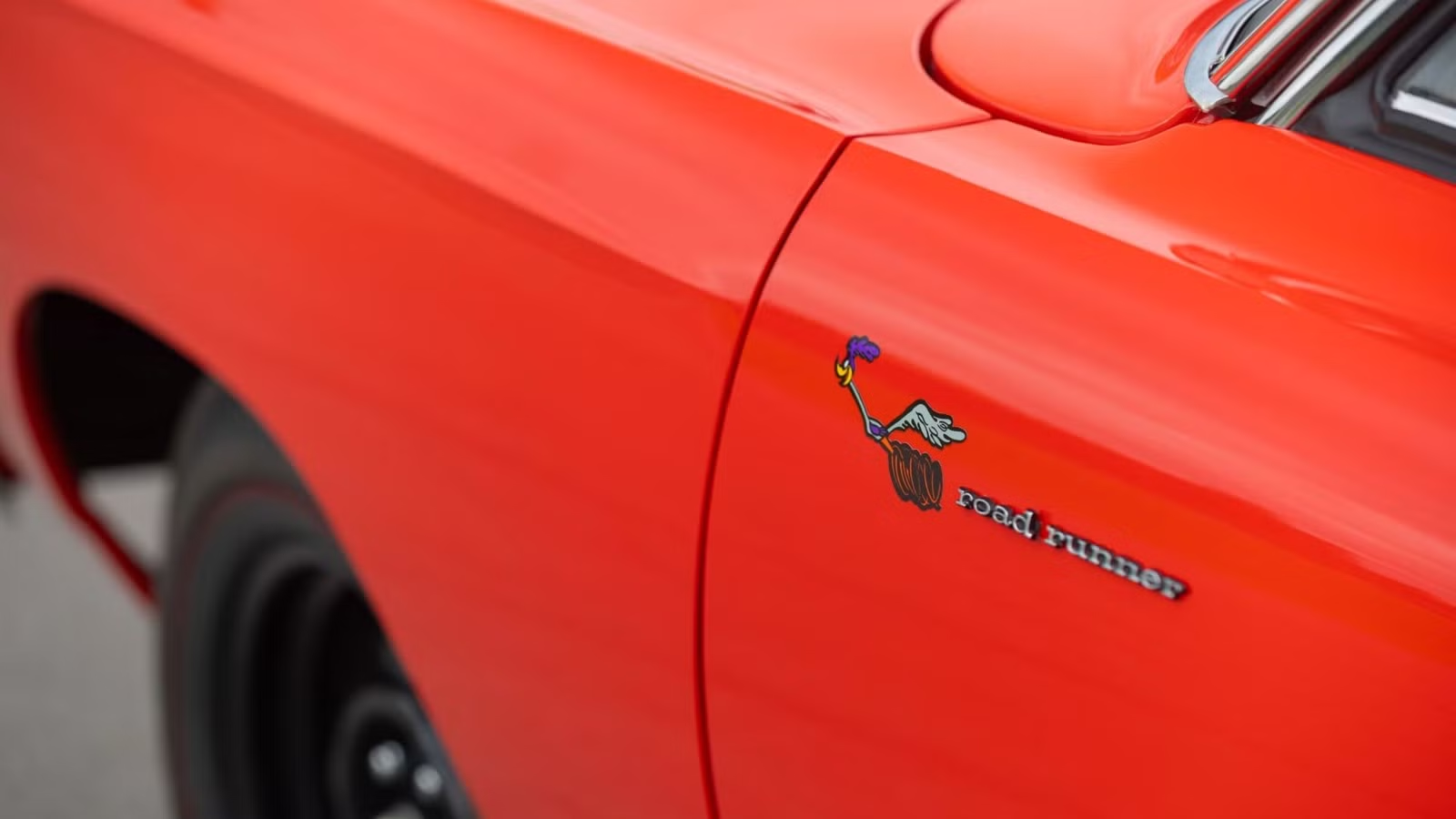
Taking the top spot as the fastest 1960s muscle car over the quarter mile is the ultra-valuable 1969 Plymouth Road Runner A12. Equipped with a specially tuned 440 ci Six-Pack engine — fitted with components borrowed from the 426 Hemi, including a chrome intake, flat-face hydraulic tappets, and Hemi valve springs — it produced 390 hp.
The A12’s modifications went further still: a 4.10:1 rear axle with a limited-slip differential, uprated suspension, and wide 15-inch Goodyear tires all worked together to maximize traction. The result was a quarter-mile time of 13.0 seconds flat.
That commanding pace makes the Road Runner A12 the fastest muscle car to clear the quarter mile in the 1960s — as long as you can bring yourself to rev the life out of a very expensive V8.
Sources: 0-60 Times, Hemmings, Mecum Auctions, Barrett-Jackson

Related posts
Latest Post


No Comments