
GM EVs Are Now Under Federal Investigation For Brake Failures — Here’s What Owners Need To Know
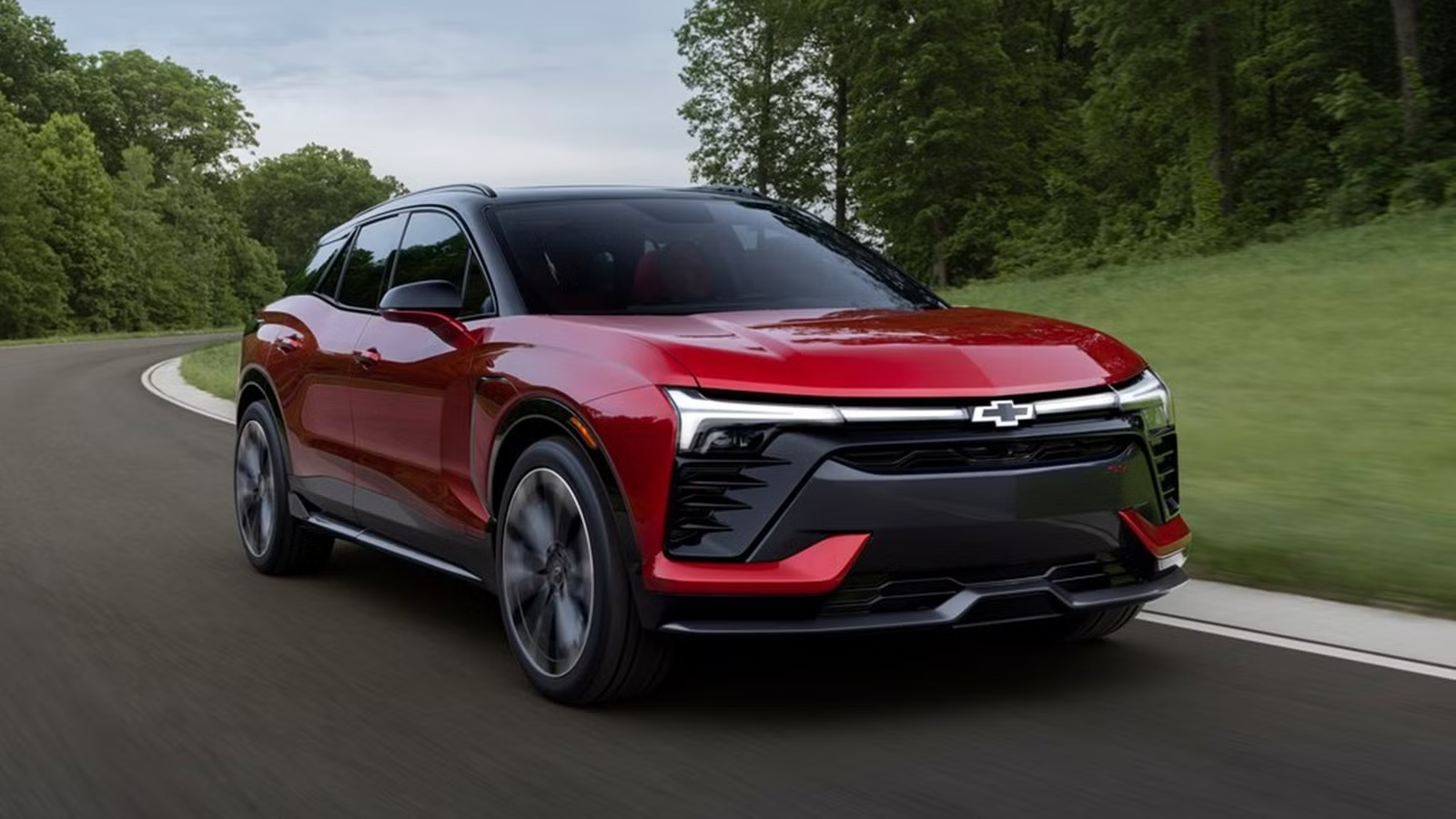
A 2024 Chevrolet Blazer EV driver, facing a complete loss of braking power, made a split-second decision to steer deliberately into a concrete curb rather than risk plowing through a busy intersection. That incident is now at the center of a federal safety investigation that has escalated to its highest level — and it affects more than one million GM vehicles.

NHTSA’s Office of Defects Investigation upgraded its probe into GM’s eBoost brake system to an engineering analysis on August 24, 2026. That designation — the agency’s most serious investigative tier — covers an estimated 1.16 million vehicles across 14 model lines spanning the 2023 through 2026 model years, and it typically precedes a formal recall order. Federal investigators have logged 745 unique failure reports, 22 crashes or fires, and six injuries. No fatalities have been reported.
Which GM Models Are Affected by the eBoost Investigation
The investigation centers on GM’s eBoost system, an electro-hydraulic brake-by-wire setup first introduced in 2019 and gradually deployed across a wide range of GM vehicles. Rather than a traditional mechanical link between the brake pedal and the braking hardware, eBoost uses an electronic connection — which allows GM to tune brake feel across different driving modes and enables tighter integration with regenerative braking on EVs.

The affected lineup is broader than most owners likely realize. On the EV side, the probe covers the Chevrolet Blazer EV, Equinox EV, Cadillac Lyriq, Optiq, and Celestiq, along with the Honda Prologue and Acura ZDX — both built by GM under a joint venture with Honda. Non-EV models are also in scope: the Chevrolet Colorado, Traverse, GMC Canyon, Acadia, Buick Enclave, and Envision all use eBoost as well. Model years 2023 through 2026 are included.
What the Failure Mode Actually Looks Like — and Why It’s Alarming

GM’s own internal investigations initially pointed to a hardware culprit: a metallic spindle inside the eBoost assembly that can fracture during anti-lock braking events. GM’s position was that secondary systems — ABS, electronic stability control, traction control — remain functional until the vehicle stops, at which point the system enters a fail-safe mode capping speed at 43 mph.
Federal investigators aren’t satisfied with that explanation. The complaints they’ve continued to receive describe something different and more dangerous: an immediate loss of brake assist while the vehicle is actively decelerating — not after it has come to a stop. When power assist drops suddenly during a braking event, the driver must apply significantly more pedal force to achieve the same stopping effect. Stopping distances extend. Reaction time shrinks. That’s the scenario the 2024 Blazer EV driver faced, and it’s also what a 2025 Cadillac Lyriq driver experienced when their vehicle drove over a curb and through the front of a store.
Automotive safety consultant Michael Brooks described the likely culprit as a software integration problem. “Modern EVs have incredibly complex brake systems that blend regenerative and friction braking,” he said. “Getting that coordination right is critical.” Brake-by-wire technology itself has a solid track record across Tesla, Rivian, and other legacy automakers — which points to something specific in GM’s implementation rather than a fundamental flaw in the technology.
What the Investigation Timeline Means for a Recall

An engineering analysis is the final investigative step NHTSA performs before it can compel a manufacturer to issue a recall. Investigators will now examine vehicle data logs, eBoost system hardware, and software code to determine whether the failure constitutes an unreasonable safety risk. If they conclude it does, GM will face a recall order covering potentially all 1.16 million vehicles in the investigation population.
GM has stated it is cooperating with NHTSA and that it has deployed over-the-air software updates to its EV fleet in recent months, though the company did not confirm whether any of those updates specifically addressed the eBoost braking system. The automaker maintains that the condition “does not present an unreasonable risk to motor vehicle safety” — a position that puts it directly at odds with the pattern of complaints federal investigators have documented.
What Current Owners Should Do Right Now

If you own any of the affected vehicles and have experienced a stiff or unresponsive brake pedal, a “Brake System Failure” warning, or any unexpected change in braking behavior, NHTSA urges you to file a complaint directly at safercar.gov. Those reports feed the agency’s investigation and can influence both the timeline and the scope of any eventual recall.
NHTSA has also advised owners who don’t feel safe driving their vehicles to consider alternative transportation until the investigation concludes. That’s an unusual step for the agency to take before a recall is formally ordered, and it reflects the severity of the failure mode involved. If your vehicle shows any brake warning messages, do not dismiss them — bring the car to a GM dealer and document everything.
For GM, the path forward requires more than regulatory compliance. Consumer confidence in its EV lineup — the Blazer EV, Equinox EV, and the broader Ultium-based family — depends on a fast, transparent resolution. The investigation is active and ongoing. Watch for NHTSA updates at safercar.gov and GM service bulletins through your dealer.

Related posts




Latest Post


No Comments