
Why The Ford Maverick Is The Only Truck Small Enough To Smuggle Into A Boeing 737’s Belly
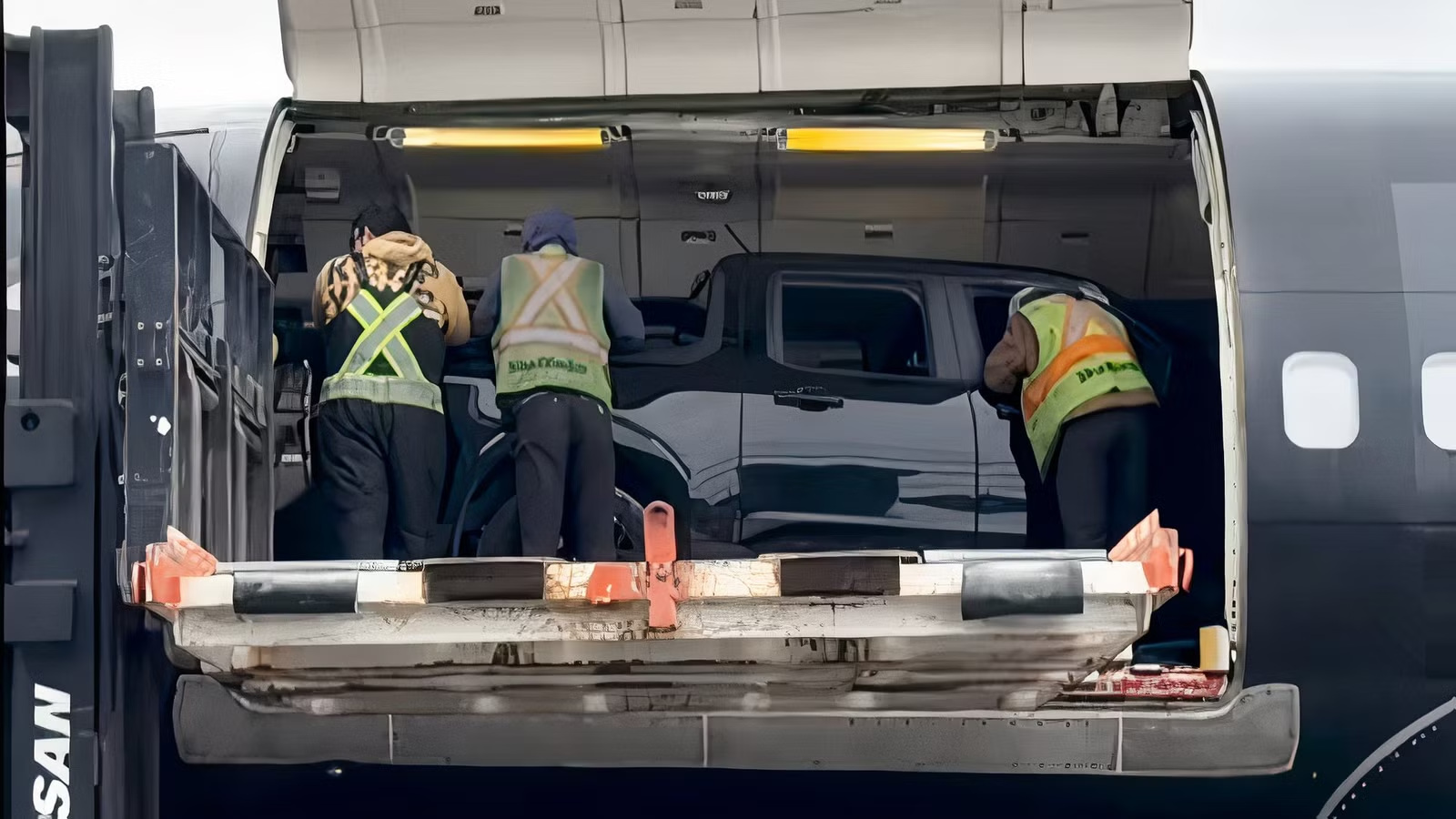
A Ford Maverick owner in Yellowknife, Northwest Territories just got their new truck delivered the hard way: inside the cargo hold of a Boeing 737-200. Buffalo Airways, the family-run bush airline based out of the Canadian Arctic, flew the compact pickup to the remote Kitikmeot region because the area’s only car-carrying ship makes the trip once a year, and the owner couldn’t wait that long.

That said, the real story here is the truck more than the airline. The Maverick pulled off a delivery method that would be flatly impossible for Ford‘s own Ranger or F-150, and the reason comes down to inches. Ford’s smallest truck rides on a unibody platform shared with the Escape and Bronco Sport, not a traditional body-on-frame layout, and that architecture is the only thing that let it clear a narrow-body airliner’s overhead bins and cargo deck.
The Maverick’s Dimensions Are The Whole Story
At 199.7 inches long and 72.6 inches wide, the Maverick is small enough for a job no other Ford truck can do. Buffalo Airways general manager Mikey McBryan mentioned that length, not width, was the first problem: the Maverick doesn’t fit on the standard ‘cookie sheet,’ the flat metal cargo pallet the airline normally uses to load vehicles. Width still mattered too, since the 737-200 still has its passenger-era overhead bins installed inside the cargo hold, narrowing the usable space even further.

The fix wasn’t structural. Buffalo Airways simply removed the slash guards, Ford’s term for the mud flaps mounted behind each wheel, to shave off the extra width needed to clear the bins without modifying anything mechanical. That’s a small compromise for a truck whose entire body sits on a car-derived platform instead of a separate ladder frame. A Ford Ranger measures 210.6 inches long and 75.5 inches wide, enough extra length and width that McBryan admitted he isn’t sure it’ll clear the same hold without bigger changes. An F-150, at 227.7 inches long and 95.7 inches wide, isn’t in the conversation at all.
Volume, Not Weight, Decides How Many Trucks Fly

The 737-200 cargo plane Buffalo Airways flies can carry 40,000 pounds of payload, enough in theory to haul roughly 10 Mavericks per trip. In practice, the airline can only fit four. Cargo volume, not the plane’s weight limit, is what caps every run, and that’s a direct function of the Maverick’s footprint relative to the hold’s fixed internal space.
Once a Maverick lands, it gets rolled onto a slave deck, a flat, roller-equipped platform that a front-end loader with long forks can pick up and move without needing a ramp or a dock. The whole system is built around compact dimensions clearing tight, fixed geometry, which is exactly the box the Maverick’s unibody shape happens to fit inside.
What This Means For Truck Buyers In Remote Areas
Shipping a vehicle this way isn’t cheap. McBryan put the average cost at roughly $10,500 USD (about $15,000 CAD) per vehicle, with small trucks like the Maverick adding another $1,400 USD on top. Customers can book the airline directly, or dealers can arrange it and roll the cost into financing, which matters in places like the Kitikmeot region that get one car-carrying ship a year and little else.
Buffalo Airways has already shipped Ford Bronco Sports this way before, but the Maverick was a tighter fit by the airline’s own account. The company is reportedly attempting a Ranger shipment next, and given the three extra inches of width and 10 extra inches of length, that flight will tell us whether the Maverick’s unibody dimensions were a fluke of good timing or the actual ceiling for what a Boeing 737 can swallow.

Related posts


Latest Post


No Comments