
The Touring Bike That Feels Just As Comfortable In The City As On The Highway
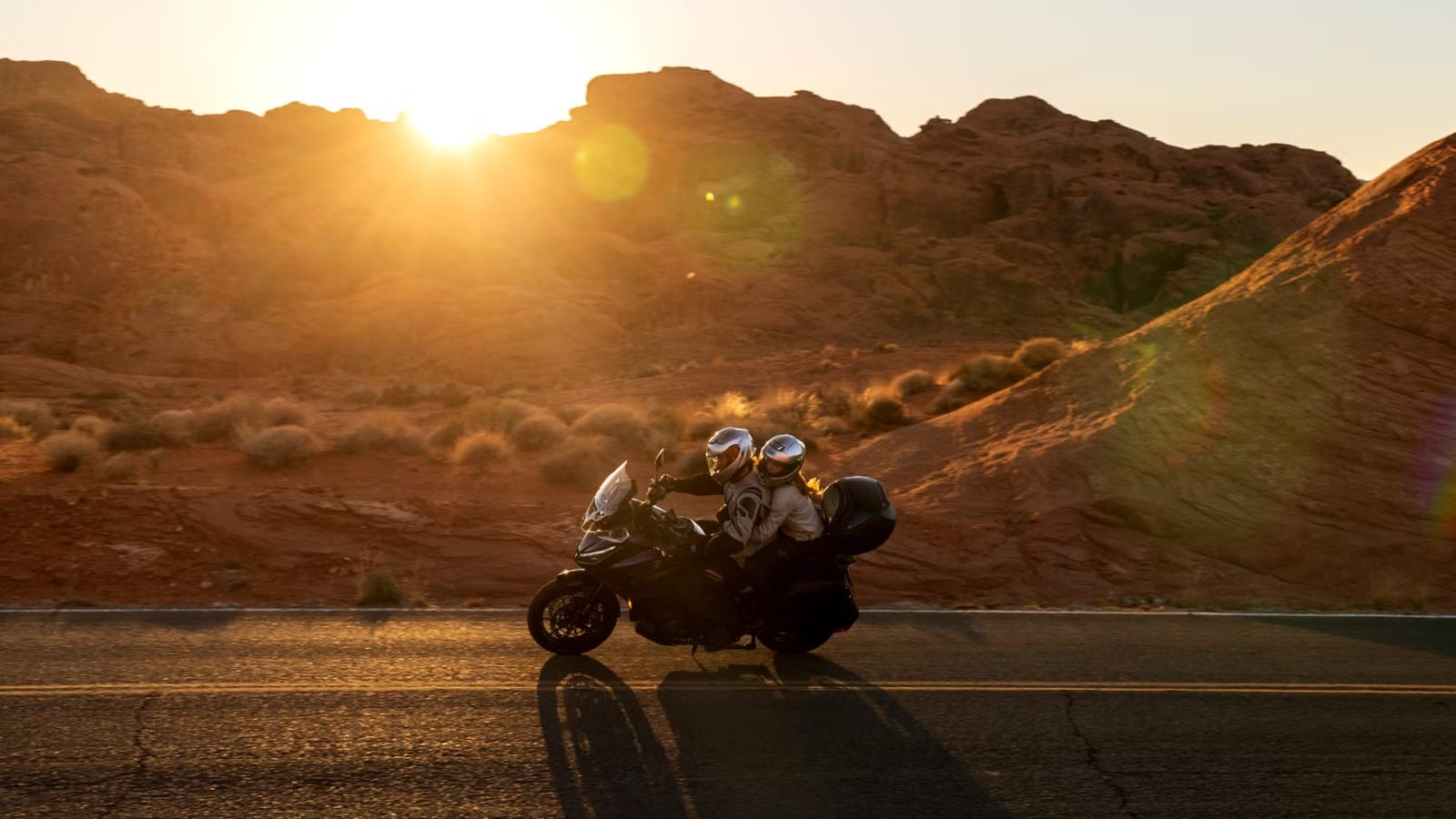
Most touring bikes pick a side. Some are built for the interstate and merely tolerate your commute, while others are nimble in traffic but wear you out after a few hundred miles. Real life doesn’t split so neatly. A 400-mile day often starts and ends in stop-and-go traffic, with the open road sandwiched in the middle, and most bikes are only good at one of those three parts. Spec sheets rarely tell you which camp a bike belongs to; you find out at the first red light, or around mile 250. So here’s the question worth asking: can a single motorcycle handle both jobs without a trade-off? The answer is yes, and it comes from the world’s largest bikemaker.
Why Most Touring Bikes Struggle Once The Traffic Gets Thick

Touring bikes have long split into two camps. Luxury tourers are tuned for highway comfort, while sport-tourers lean toward canyon roads and quick direction changes. Both formulas work just fine, but most owners never ride in either environment in isolation. The typical week is a mix of city streets, a highway stretch, and a parking garage at both ends.
The Honda Gold Wing Tour DCT is the segment’s highway benchmark, and it’s genuinely impressive. It’s also 848 lb wet and starts at $30,500. The 29.3-inch seat is low, which helps, but that much mass still announces itself the moment you stop moving. Even BMW’s R 1300 RT, a relative lightweight in this company, weighs 620 lb wet. At speed, you forget the weight exists. In a parking lot, mid-U-turn or crawling through gridlock, you feel every pound, and your back keeps the receipt.
The Compromises Riders Learn To Live With

Everyone has a workaround. Tall seats and wide screens make long days easier, but they turn red lights into balancing acts and narrow lane gaps into guesswork. A clutch lever, barely noticeable on an open road, becomes a daily workout in stop-and-go traffic. So riders either keep a second, smaller bike for the commute or just put up with it. There’s a third option, though: a Honda touring bike that claims it can cover both jobs without asking for either compromise.

The Honda NT1100 DCT Feels Equally Comfortable In City And Highways
Base Price: $11,999

That motorcycle is the Honda NT1100 DCT, a road-focused sport-tourer based on the Africa Twin platform. It uses the same 1,084cc Unicam parallel-twin and related chassis architecture, but Honda tailored the package for paved roads with 17-inch wheels and sport-touring ergonomics. Honda lists the 2026 NT1100 DCT at $11,999, and only the Gray Metallic shade is available.
The NT1100 also had a useful head start when Honda launched it in Europe for the 2022 model year, with more than 12,000 units sold there before the bike reached the American shore. For context, the 2026 BMW R 1300 RT starts at $22,645, Kawasaki’s Versys 1100 SE LT ABS at $19,499, and Yamaha’s Tracer 9 at $12,599. The Honda therefore sits near the accessible end of the sport-touring market despite its 1,084cc engine.
A Compact Chassis That Feels Smaller Than The Spec Sheet

The NT1100 isn’t a tiny bike, as it is 33.9 inches wide, has a 60.4-inch wheelbase and a 32.3-inch seat. But Honda deliberately keeps the seat-and-tank junction narrow to boost accessibility. Suspension helps, too. A 43mm Showa SFF-BP inverted fork provides 5.9 inches of travel, matched by a Pro-Link Showa rear shock with the same travel. Honda says the 17-inch radial tires keep steering responsive on asphalt.
The 2025 redesign also tightened the upper fairing and reworked the aerodynamics. Its five-position windscreen can be moved one-handed, while upper and lower deflectors are standard. The result is useful protection without the physical scale of a flagship tourer. However, there’s one big catch: the panniers are optional. Finally, the curb weight is 547 pounds. Not featherweight, but not a handful, either.
Engine Is Borrowed From Africa Twin That Makes Easy Torque

The 1,084cc engine is the Africa Twin’s SOHC Unicam parallel-twin, retuned here for touring, with a claimed 101 hp and 86.2 lb-ft of torque. Its 270-degree crankshaft gives it a thumpy character, and two balance shafts cancel enough vibration that Honda solid-mounts the engine to stiffen the chassis. That matters in two places. In the city, it’s happy low in the rev range, with no sulking. On the highway, a quick downshift gives you plenty to pass with. Honda itself calls the powerband excellent for sport-touring.
The DCT That Does The Clutch Work

There’s no clutch lever and no shift lever. Instead, you choose Drive, Sport (with three levels), or manual mode, which uses paddle triggers on the left grip. In stop-and-go traffic, that’s a real relief for your left hand. The latest DCT also uses the six-axis IMU to adjust shifting on uphill grades. Another interesting feature is the bike dropping into neutral when the engine is shut off, so it comes with a handlebar-mounted parking brake lever to keep it from rolling on an incline.
Touring Gear That Comes Without The Touring Bulk

The five-position windscreen moves through about 6.5 inches of adjustment and can be changed with one hand while seated. Upper and lower deflectors protect the arms and lower body, while the thick seat and standard multi-level heated grips are built around long days in the saddle. Cruise control is standard, too, useful once the miles become repetitive and equally handy on long expressway commutes. The rest of the cockpit is easier to love. The heated grips are adjustable, and Honda points out that you can ride with thinner gloves on cold mornings for a better feel. The seat has almost three inches of padding, which should ideally provide a comfortable experience on long journeys.
Range And Electronics For The Long Haul

The fuel tank holds 5.4 gallons. Honda describes it as a long-distance asset when paired with the efficient twin, while European figures have put a potential range around 400 km (approx. 250 miles) under WMTC conditions. Real-world U.S. range will vary with speed, traffic, load, and riding style. The electronics are generous for the money. Cruise control is standard, though it isn’t adaptive. Honda Selectable Torque Control comes with integrated wheelie control, and there are three preset modes — Tour, Urban and Rain — plus two customizable User modes. A 6.5-inch TFT touchscreen supports Apple CarPlay and Android Auto, so navigation and music run through the dash. USB and 12-volt outlets keep your devices alive.
Overall, this isn’t the lightest or most luxurious motorcycle in this class. Its DCT calibration has quirks, its panniers cost extra, and some riders may want more windscreen. However, the underlying package is unusually coherent. It does not treat city riding as the unpleasant part before the real trip begins, and it does not make the highway feel like an afterthought once traffic clears. For riders who want one motorcycle for the commute, the weekend escape and the occasional multi-state trip, the Honda NT1100 DCT makes a strong case for being the rare touring bike that feels comfortable at both ends of the journey.
Source: Honda Powersports

Related posts

Latest Post


No Comments