
The Motorcycle You’ll Appreciate More Every Year
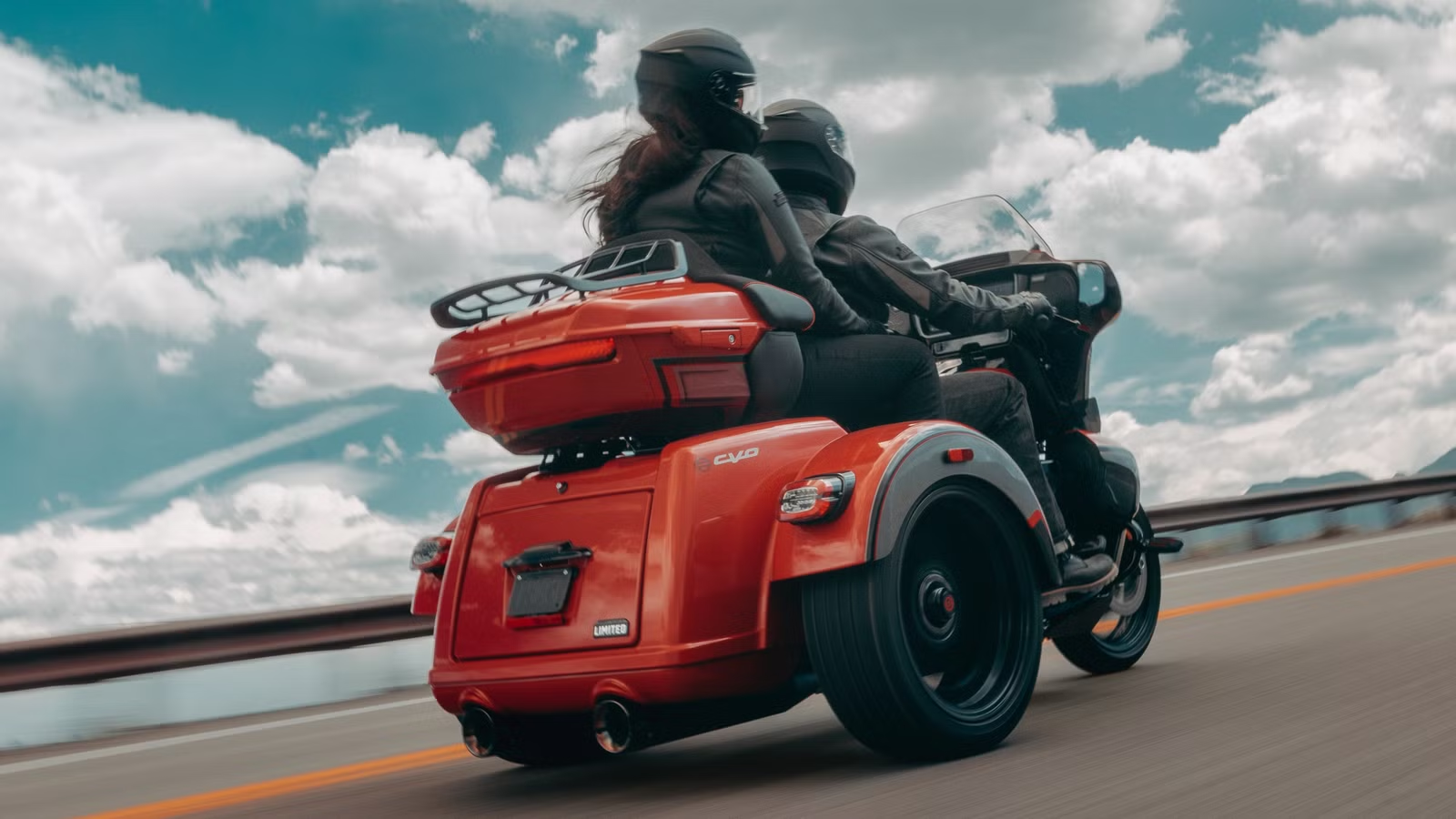
For decades, touring motorcycles have represented freedom in its purest form. However, ask riders who’ve spent years crossing states on heavyweight touring machines, and they’ll tell you that freedom isn’t always effortless. A fully-loaded bagger can weigh close to half a ton with a passenger and luggage aboard, making every gas stop, hotel parking lot, and uphill turnaround a reminder that gravity never takes a day off.

That’s one reason premium trikes have steadily gained popularity in the United States. They aren’t simply attracting older riders or people looking for extra stability. Increasingly, they’re appealing to seasoned touring enthusiasts who want to keep covering hundreds of miles without worrying about balancing a massive motorcycle at walking speeds. Three wheels remove much of the stress while preserving the long-distance experience that makes touring so rewarding. Yet there’s something many buyers don’t realize until they start shopping: the V-twin trike market has become surprisingly small.
The Three-Wheel Market Has A Surprising V-Twin Shortage
Anyone who’s spent a full day in the saddle on a loaded touring bike knows the real challenge isn’t the highway — it’s the last five minutes. Rolling a fully-dressed bagger into a gas station at walking pace, exhausted, is where confidence withers. A third wheel solves that instantly. No balance to manage, no death grip on the bars at three mph, no held breath while backing out of a parking spot. The last mile of the day ends up feeling as good as the first. That’s exactly why the trike segment has grown into something more than a retirement niche. Riders have realized that a premium three-wheel platform isn’t a downgrade from a touring motorcycle.
Almost The Entire Segment Of V-Twin Trikes Belongs To Harley


Here’s where things get interesting, though. Look past Harley-Davidson’s own lineup, and V-twin trikes basically disappear from the market. Can-Am’s entire three-wheel range — Spyder, Ryker, all of it — runs on Rotax triples, not V-twins. Polaris’ Slingshot isn’t even classified as a motorcycle in most states; it’s an autocycle powered by a four-cylinder engine, built for a completely different kind of rider chasing a completely different kind of thrill.
That leaves Harley-Davidson standing almost alone with the Freewheeler, Tri Glide Ultra, Road Glide 3, and Street Glide 3 Limited. If you want the traditional American V-twin trike experience — that low-rev rumble and unmistakable pulse through the floorboards — this is where the entire conversation happens.
The Harley-Davidson CVO Street Glide 3 Limited Will Be Appreciated More Every Year
Base Price: $54,999

Meet the 2026 CVO Street Glide 3 Limited, Harley’s answer to what a V-twin trike looks like when nothing gets left on the table. It rides on the brand’s second-generation trike platform, and this isn’t a mild refresh with fancier paint bolted on top — it’s the CVO treatment applied to a genuinely re-engineered machine. The headline numbers tell you where this bike sits: the most powerful engine Harley has ever fitted to a factory trike, an entirely new rear suspension design, and CVO-exclusive paint and trim you won’t find anywhere else in the lineup.
At $54,999, it isn’t cheap. It’s also not pretending to be anything other than the top of the mountain. For context, the standard Street Glide 3 Limited starts at $39,199, and the Road Glide 3 comes in at $35,399. The CVO version asks for a real premium over both — north of $15,000 over its closest sibling — but that gap buys a genuinely different engine, an exclusive suspension tune shared only across the newest trike platform, and finish work the regular lineup simply doesn’t offer at any price.
The Milwaukee-Eight VVT 121 Gives It Real V-Twin Muscle
The Numbers Behind The Most Powerful Factory Trike Engine Ever

Power comes from the Milwaukee-Eight VVT 121, a massive 121-cubic-inch (1,977cc) V-twin that introduces variable valve timing to Harley’s touring trike lineup. This motor makes 114 horsepower at 4,500 rpm and 138 pound-feet of torque at 3,750 rpm. Those aren’t superbike numbers, and they were never meant to be. What matters is the variable valve timing, which widens the usable powerband compared to the non-VVT Milwaukee-Eight engines found lower in Harley’s range.
Why That Torque Matters More On Three Wheels Than Two

On a heavyweight touring trike, torque is far more valuable than chasing high horsepower figures. Between the extra chassis weight, a passenger, luggage, and touring accessories, there’s often well over half a ton of machine moving down the highway. That kind of mass rewards abundant low-end pulling power rather than peak horsepower delivered high in the rev range. The Milwaukee-Eight VVT 121 feels perfectly suited to that task.
Its broad torque curve means fewer downshifts on steep grades, stronger acceleration when merging onto freeways, and smoother progress through winding mountain roads with a full touring load. Variable valve timing also sharpens throttle response at lower engine speeds, making parking lots, campgrounds, and slow-moving traffic easier to negotiate without abrupt power delivery.
A Second-Generation Chassis That Fixes What Owners Complained About For Years
Out With The Solid Axle, In With De Dion-Style Suspension

For years, Harley-Davidson trike owners praised the platform’s long-distance comfort and confidence, but one criticism surfaced repeatedly: the rear suspension could feel busy and harsh over broken pavement. Expansion joints, uneven highways, and rough secondary roads often reminded riders that the rear axle was carrying a tremendous amount of weight. Harley-Davidson didn’t simply tweak the suspension for 2026 but re-engineered the entire rear chassis.
The headline change is the replacement of the previous live solid axle with a modern De Dion-style rear suspension. That may sound like an engineering detail, but the benefits are immediately noticeable on the road. Rear wheel travel has increased from 2.3 inches to five inches, giving the suspension far more room to absorb bumps instead of transmitting every impact directly to the rider. Harley-Davidson also removed 68 pounds of unsprung weight, allowing the rear wheels to react more quickly and independently to changing road surfaces.
Dual Emulsion Shocks, Watts Linkage, And A Sway Bar

The redesigned rear suspension incorporates dual emulsion shocks, a Watts linkage, and a stabilizer (sway) bar, all working together to keep the trike flatter and more controlled through sweeping curves. Instead of feeling unsettled when the road begins to twist, the CVO Street Glide 3 Limited remains composed, reducing the amount of steering correction needed throughout the day. That translates directly into less rider fatigue.
Harley also made ownership easier by relocating the tool-free preload adjuster beneath the passenger footboard. Whether you’re traveling solo one weekend or loading up for a two-up cross-country adventure the next, adjusting the suspension no longer feels like a chore. It’s exactly the kind of thoughtful improvement that may seem minor at first but becomes increasingly valuable over years of ownership.
An Electric Reverse System That’s Actually New, Not Just Refined

Backing a fully-loaded touring trike uphill has never been anyone’s favorite part of the ride. Recognizing that, Harley redesigned the reverse system from scratch. Rather than relying on a separate axle-mounted electric motor, the new system uses the motorcycle’s starter motor to power reverse. The redesign reduces weight, simplifies the mechanism, and delivers smoother, quieter, and more predictable low-speed control.
Comfort And Convenience Built For Riders Who Plan To Keep This One A While
The Grand Tour-Pak And Trunk Combo

Storage is one of the defining advantages of Harley’s latest trike platform. The redesigned rear trunk works together with the all-new Grand Tour-Pak to provide an impressive 7.1 cubic feet of total luggage capacity. That’s enough space for two riders to pack comfortably for an extended vacation without resorting to additional luggage strapped across the passenger seat. The luggage system also receives premium touches expected from a CVO model, including power-locking storage compartments, integrated LED lighting, a passenger backrest liner, and redesigned trunk and Tour-Pak integration for a cleaner appearance.
Heated Everything, Dialed For Long Ownership

Long-distance comfort isn’t about one spectacular feature but about dozens of thoughtful ones working together. The CVO Street Glide 3 Limited comes standard with dual-zone heated seats, allowing both rider and passenger to select their preferred temperature independently. Heated hand grips help extend the riding season into cooler months, while an adjustable rider backrest and highway pegs make it easier to stay comfortable during back-to-back 400- or 500-mile riding days.
A 12.3-Inch TFT Display Built To Outlast The Bike’s Lifespan

Up front, the Skyline OS infotainment system runs through a 12.3-inch TFT display, with wireless Apple CarPlay, embedded navigation, and over-the-air software updates. The Rockford Fosgate Stage II audio system uses six speakers and delivers 100 percent more amplifier power than Harley’s previous trike audio setup, providing clearer sound at highway speeds without distortion.
Why Limited-Run CVO Builds Tend To Age Well

Harley’s CVO models are produced in far smaller numbers than the standard Street Glide 3 Limited, and that scarcity doesn’t fade with time — if anything, it compounds as model years roll on and fewer of these specific bikes remain on the road. The paintwork backs that up. Harley’s CVO shop leans on hand-applied techniques like metallic fades, precision pinstriping, and PVD detailing that simply don’t show up on mainstream trims. It’s the kind of finish that reads differently depending on the light, and not something a dealer can replicate with an aftermarket wrap.
Mechanical Simplicity Ages Better Than Complexity

The Milwaukee-Eight’s pushrod, air-cooled-adjacent architecture is mechanically straightforward compared to the increasingly electronics-dense platforms showing up across the industry. A simpler engine tends to be a more serviceable one ten or fifteen years down the road, when parts availability and a mechanic’s familiarity with the platform are almost guaranteed. Put it all together — a shrinking pool of genuine V-twin trikes, limited production numbers, hand-finished paint, and an engine architecture that doesn’t punish long-term ownership — and the CVO Street Glide 3 Limited starts to look less like a purchase and more like a long-term relationship.
Source: Harley-Davidson

Related posts



Latest Post


No Comments