
The Last Edsel Built For Just Over a Month Before Ford Gave Up
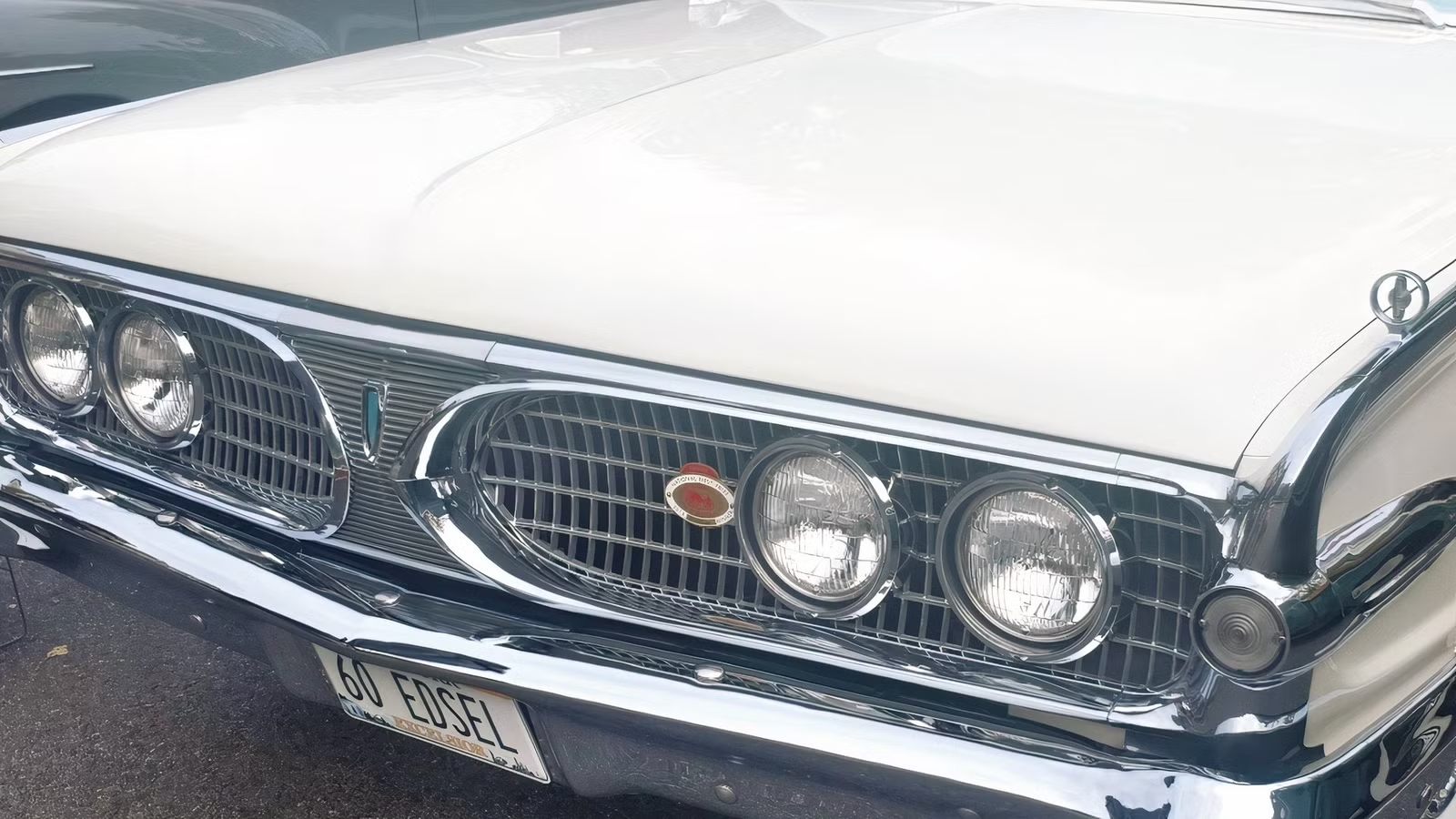
Edsel, a name associated with failure and not much else, and a line of cars associated with looking so darn ugly, it’s laughable how they even got off the drawing board. For decades, it was thought that no matter how disastrous a car launch turned out to be, it could never top Edsel in terms of catastrophe. Well, that doesn’t account for the Tesla Cybertruck. Yet, unlike a Cybertruck, you could argue that Edsel managed to figure it out in the end. The only problem was that Ford pulled the plug on it as soon as this happened.
Edsel: A Neat Idea, Executed Badly

On the face of it, the Edsel project had philosophical intentions that seemed sound enough. Founded to piggyback off the mid-range Mercury brand in hopes of bolstering Ford’s mid-range offerings, Edsel debuted in 1957, named for Henry Ford’s tragically deceased son. It was Old Man Ford’s grandson, Henry II, who collected a group of executives in the immediate aftermath of World War II, called the “Whiz Kids.”
The group included future Ford President Arjay Miller and the future head of the US Department of Defense, Robert McNamara. While this consortium didn’t include any automotive designers or engineers, they were business savvy in a way Henry II figured would come in handy as Ford became a public IPO in early 1956. The plan was simple: found a new sub-brand ostensibly aimed at a section of the market that wasn’t entry-level by any means, but not a luxury brand either. Effectively, Edsel was targeting the Oldsmobiles, Buicks, and DeSotos of the market, and it did so with a unique brand of marketing that looked markedly un-Ford-like in its execution.

The launch of Edsel was marketed like national news, with its debut day hilariously christened “E Day.” No, that’s not a lie, and yes, that made it past Ford’s marketing department without someone bemoaning the hubris of comparing the launch of a car brand to the storming of Normandy. Boy, did that come back to bite Ford where it hurt, because the Edsel project was the exact opposite of triumphant. Instead, it was the quintessential automotive catastrophe, one that gets laughed at even decades later.

A Comedy of Errors, Bad Timing, and Worse Styling

Even without taking the questionable design language into account, the launch of the Edsel brand coincided with one of the worst economic downturns since the Great Depression. Dubbed the Eisenhower Recession, a general downturn in industrial demands and tight monetary policy meant average working-class Americans didn’t have the savings to splurge on mid-tier cars they way they did even a few years earlier. Even if Edsel cars were desirable, the public at large was unwilling, or in many cases unable, to buy them.
The Edsel lineup was not all that nice to look at, and as we break down the model lineup, it’s not hard to see why. For 1958, buyers were confronted by an overwhelming hierarchy of trim levels split into Ford-based 118-inch wheelbases and Mercury-based 124-inch wheelbases. The smaller footprint underpinned the entry-level Ranger and up-market Pacer, while the massive Mercury architecture supported the premium Corsair and top-tier Citation, plus three smaller station wagons based on the 116-inch Ford wheelbase. If that makes your head spin, imagine what it did to the utterly confused buyer base that Ford hoped would make the Edsel a hit. In truth, perhaps the public at large would have bothered to wrap their heads around it if the Edsel had looked the part. Sadly, that was another swing and a miss. That trademark front end penned by Ford designer Roy Brown Jr. was supposed to invoke the flair of a ’30s-vintage Packard or Alfa Romeo — a stylish and more slender opening in the front grille.

Yet, when it was determined the arrangement wouldn’t let enough airflow through to the FE-series V8, what we got instead was “an Oldsmobile sucking on a lemon,” aside from other, far less safe-for-work analogies. The combination of horrendous styling and a recession meant Edsel sales were abysmal: just 63,000 units sold in 1958, and 44,000 the following year. Considering Ford hoped to sell 200,000 Edsels in its first model year, it actually wound up losing hundreds of millions on the project overall. Yet, by 1960, Ford wasn’t ready to throw in the towel just yet, and depending on who you talk to, they might’ve solved most of the issues with it.
The 1960 Edsel: Far Less Ugly, But a Dead Car Driving

For the 1960 model year, Ford’s designers threw out the ugly original styling playbook and rushed to sanitize things as best as they could. For starters, they finally ditched the infamous vertical “horse collar” for a more conventional front fascia that integrated dual headlights into a traditional horizontal arrangement. Trimmed with chrome lines running down the fenders and a flattened hood, an Edsel actually looked, dare we say, like a normal, respectable automobile for the first time. The only problem was that the brand was already a dead man walking.
By this stage, the American public had already written off the Edsel brand as a joke. All the while, Robert McNamara, poised to become Ford’s President and a man who had always hated the project from the beginning, was set to bring it to an end at the conclusion of the 1960 model year. Never mind that 1960 Edsels could be optioned with power steering, power brakes, power windows, and power seats, a remote trunk release, electric wipers, and tinted glass. The writing was on the wall for the brand, and a pragmatist like McNamara couldn’t care less how much the brand had improved by the time the first facelift was at hand.

By the end of the run, Ford had lost the modern equivalent of over $2.7 billion on the Edsel initiative. With that in mind, it didn’t matter that the model’s refresh had only launched 36 days ago when the brand was shut down for good. Money is money at the end of the day, and the Edsel brand was an endless money pit in every sense of the word. Knowing this, the 1960 Edsel is a phenomenally rare car, one that makes you do a complete double take if you see it driving by in traffic.
One of 76 Drop-Tops in the Entire World

Because Ford put the hammer down and shut Edsel for good after just a little over a month, output numbers for the 1960 model year were remarkably low. Only 2,846 total Edsels were built before Ford mercifully pulled the plug. Within that minuscule final run, the convertibles are practically automotive unicorns. Out of those 2,846 units, a mere 76 convertibles were ever produced. They represented the absolute zenith of what the Edsel brand was capable of: luxurious, refined, and stylish enough that they didn’t resemble their questionable forebears in any meaningful way. They look far more similar to a Ford Galaxie or Fairlane than to an Edsel, and perhaps that’s why they worked stylistically.
They boasted a heavy-duty battery, a lever-operated heater and air conditioner, and an AM radio with a clock. It was absolutely stacked with premium add-ons, including the Light Group Package (glove box light, park brake warning, trunk light), the Visibility Group (windshield washers, day/night mirror, back-up lights), and the Safety Package featuring a padded dash and visors. Factor in the dual spotlights, rocker moldings, fender skirts, dual exhaust deflectors, a locking gas cap, and dual deck-mount antennas, and it becomes clear this car deserved a much better fate. Could the Edsel brand have evened out if Robert McNamara wasn’t such a ruthless pragmatist? Looking at its last convertible, it’s hard to argue that it didn’t at least have a shot. Ironically, a car nobody wanted back then is one most American car enthusiasts would gladly own today. As it happens, this particular Edsel Ranger convertible just won best in show at the 2026 Concours d’Elegance in Scarsdale, New York — a testament to its enduring appeal.
Source: Mecum Auctions, Ford, Bring a Trailer

Related posts
Latest Post


No Comments