
Carroll Shelby’s Personal 1967 GT500 Returns To Bring A Trailer
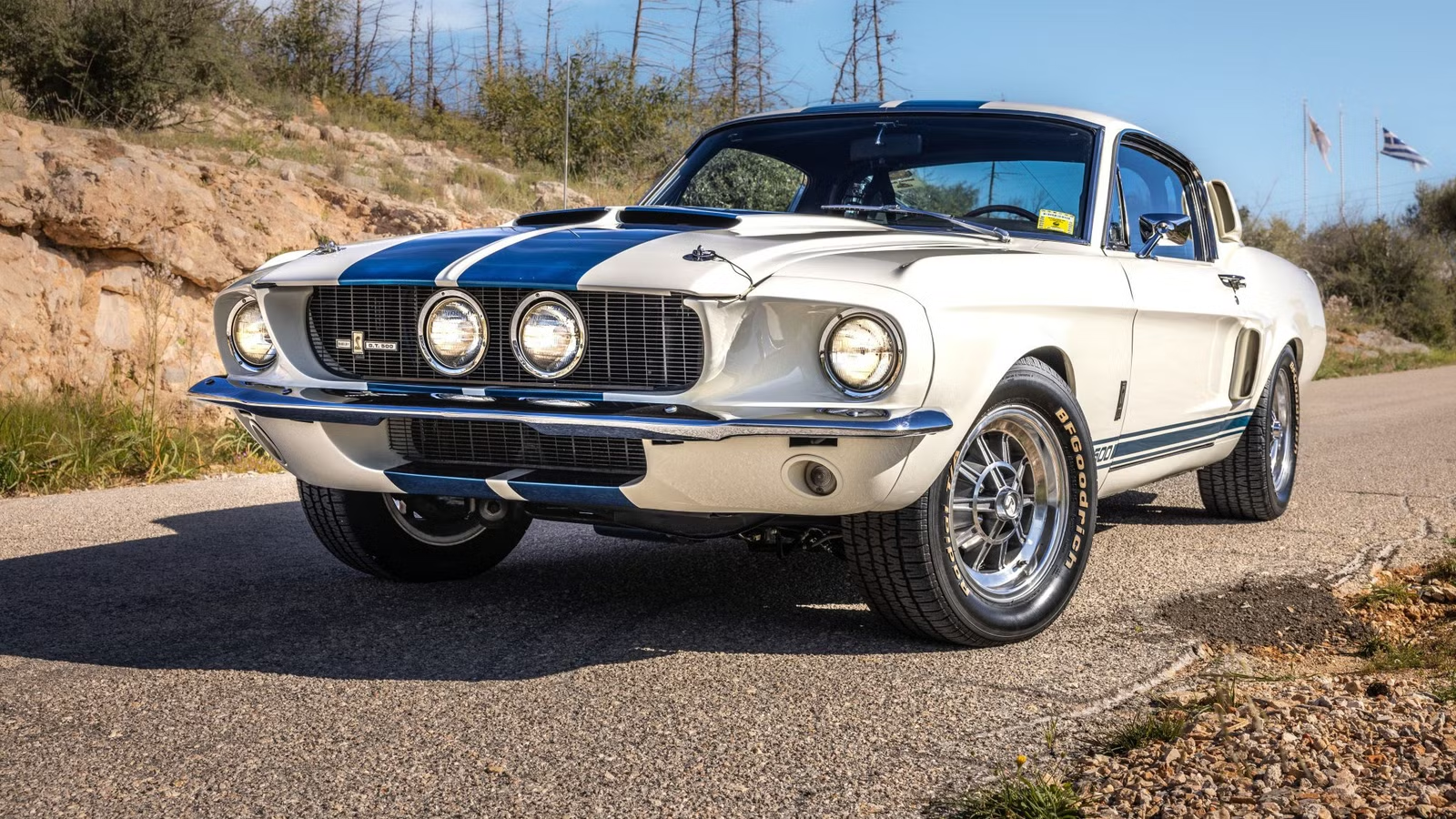
Carroll Shelby’s own 1967 GT500 fastback is back on Bring a Trailer, and this time the bidding feels like a referendum on whether his name still moves the needle in a cooling muscle-car market. As of Thursday, chassis 67402F4A00981 sat at €180,000, roughly $210,000, with the auction set to close Saturday at 1 p.m. ET. That number alone tells you something: this exact car already failed to sell in May, when bidders pushed it to €226,000 (about $265,000) and the seller still said no.

So the question isn’t whether Shelby’s ownership adds value to a 428-powered four-speed GT500. It’s whether it adds enough to clear a reserve that already turned down a quarter-million-dollar bid once this year. That’s the real drama here, more than the car itself.
Why The May No-Sale Still Haunts This Listing
Shelby and Stephen Becker bought this Wimbledon White fastback around 1999, well after its days as a contest-won street car and a stint with California racer Chuck Jones. Shelby had air conditioning installed and, at some point, headers went on the 428 Police Interceptor V8. The carburetors don’t even match each other, a 2804 unit paired with a 2105, and the car wears a repaint from the late 1980s rather than a fresh concours job.

None of that is disqualifying on its own. But it means this isn’t a numbers-matching time capsule. It’s a well-documented, well-loved GT500 that happens to carry Shelby’s signature on the glove box lid and trunk floor, plus a file of Becker-to-SAAC Registrar correspondence that reads like a small archive. The question the May auction answered, at least provisionally, is that the market priced all of that provenance as roughly equal to the modifications working against it.
What The Comps Say About Shelby’s Name On A Modified Car
Recent sales of good original four-speed GT500s without celebrity ownership have landed between about $235,000 and $325,000. The May bid on Shelby’s own car, around $265,000, sits squarely in the middle of that range. That’s the uncomfortable part for anyone betting on provenance premiums: a car Carroll Shelby personally owned, signed, and modified for his own use didn’t out-bid the field of unmodified, well-kept originals. It matched it.
That puts real pressure on this second attempt. If the reserve hasn’t moved since May, the car needs a bidder who genuinely values the Becker–SAAC letters and Shelby’s handwriting more than the last crowd did. If the reserve has dropped, this is the seller acknowledging the market already rendered its verdict.
Greece, Shipping, And Why The Buyer Pool Is Smaller Than It Looks

The car currently sits in Greece, and a sale means U.S. buyers, who make up the deepest pocket of Shelby money, have to arrange shipping and import on top of the hammer price. That friction trims the bidder pool at exactly the moment this car needs every possible bidder in the room.
A second no-sale would make the car tougher to move going forward; buyers tend to discount anything that’s publicly failed to clear reserve twice. If bidding closes somewhere in the low $200,000s, that’s consistent with the comps and suggests the reserve finally met the market. Anything clearing past $300,000 would mean two bidders decided Shelby’s own ownership really is worth a premium over a clean, unmodified original, something the May auction didn’t support.
Either way, Saturday’s close is the clearest data point yet on what collectors are actually willing to pay for a car with Carroll Shelby’s own fingerprints on it, modifications and all.

Related posts



Latest Post



No Comments