
This Forgotten American Supercar Deserves A 1,000-HP Comeback To Hunt The Corvette ZR1
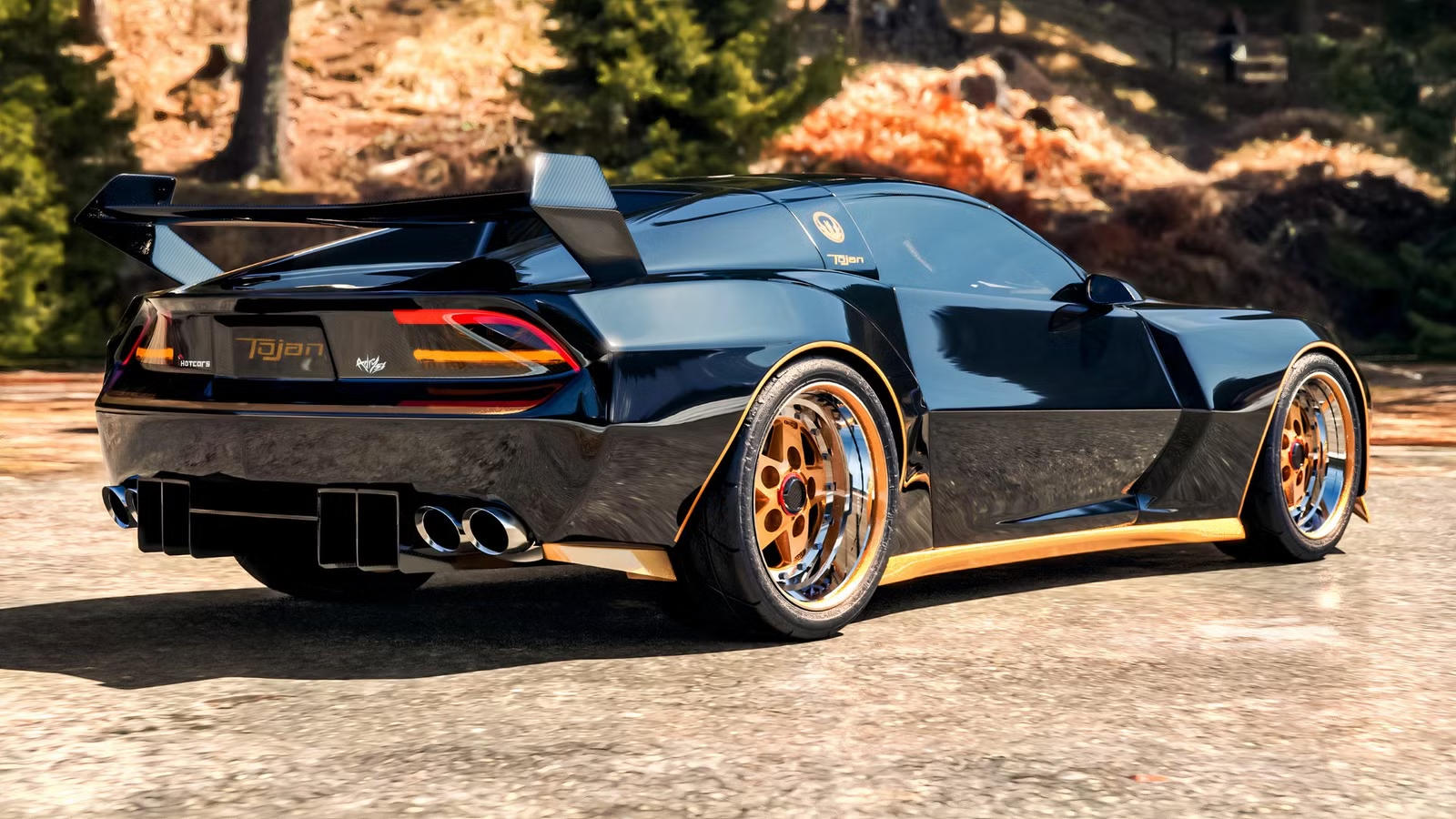
If Pontiac ever returned, another mildly nostalgic muscle car probably wouldn’t be enough. A comeback this overdue deserves something way more outrageous, and this imagined 2028 machine reaches into one of the strangest corners of Pontiac history for inspiration.

What you see is a low, wide American supercar with a huge rear wing, quad exhausts, mad proportions, and a name once attached to an 800-horsepower prototype that reportedly cracked 200 mph.
The Original Pontiac Tojan Was A 200-MPH American Supercar
The original Pontiac Tojan emerged during the 1980s, when Pontiac wanted something more exotic than the familiar third-generation Firebird and Trans Am. The project was handed to Nebraska-based Knudsen Automotive, which worked with designer Harry Bentley Bradley, a former General Motors stylist who also helped create some of the original Hot Wheels designs. The resulting Pontiac Tojan wrapped familiar F-body bones in dramatically wider fiberglass bodywork that looked more European supercar than Detroit pony car.

The most outrageous Tojan was the first prototype. Knudsen brought in turbocharging specialist Gale Banks, who installed a twin-turbo small-block V8 based on his marine-engine expertise. The engine could reportedly produce about 900 horsepower at maximum boost and a still-ridiculous 800 horsepower on pump gas. That was exotic car power at a time when American performance was only beginning to recover from the malaise era.
Then came the number that turned the Pontiac Tojan from an obscure coachbuilt Firebird into American supercar folklore. The prototype was reportedly driven to 206 mph on a long stretch of Nebraska road, several years before the Ferrari F40 became famous for crossing the 200 mph threshold. The Tojan run was illegal, unofficial, and apparently read from the car’s digital speedometer, so it cannot be treated like a certified record. Even with that giant asterisk, 206 mph in 1984 was awesome.
Unfortunately, customer-spec Pontiac Tojans were far tamer. Most used 5.0-liter or 5.7-liter GM V8s, while B&M or Paxton supercharging could raise output to around 400 horsepower. Roughly 136 examples were built, although some accounts put production closer to 150. A 1987 car with an L98 5.7-liter V8, WS6 suspension, four-wheel disc brakes, and a four-speed automatic sold for just $20,000 in 2024, proving that fascinating and expensive are not always the same thing in the collector car world.
This 2028 Pontiac Tojan Looks Ready To Hunt Modern Supercars

This rendered 2028 Pontiac Tojan takes the basic philosophy of the original and removes whatever restraint survived the ’80s. Instead of resembling a heavily modified Pontiac Firebird, this modern Tojan looks like a purpose-built American supercar. The windshield is pushed forward, the roof hugs the cabin, and massive rear haunches give the body a mid-engine silhouette even though there is no need to assume what might actually sit beneath the sheetmetal.
The front end is especially effective because it does not fall into the usual retro-car trap of photocopying old styling cues. There are no literal pop-up headlights or oversized Firebird nostrils. Instead, razor-thin LED lighting follows the edges of the nose while huge lower intakes dominate the bumper. The bronze front splitter and matching accents give the black version enough contrast to prevent all those curves from disappearing into one shiny blob.
Lot Going On

Move toward the rear and the 2028 Pontiac Tojan becomes far less interested in good manners. Deep side intakes cut into the bodywork behind the doors, giant multi-piece wheels are buried beneath swollen fenders, and the roof flows into a rear deck dominated by a towering fixed wing. The original Tojan could be ordered with a giant Countach-style rear wing, so going enormous here feels like respecting family tradition.
The rear view delivers the strongest connection between this futuristic Pontiac concept and modern American Performance Cars. A broad LED signature stretches across a carbon-fiber panel, four exhaust outlets flank an aggressive diffuser, and the tires appear almost cartoonishly wide. This is, in our humble opinion, what a Pontiac Tojan revival needs to be. The historical car was created to make an ordinary Trans Am look exotic, so a new one should make ordinary performance cars look apologetic.
A Modern Pontiac Tojan Needs 1,000 HP And Corvette ZR1 Pace

Styling alone wouldn’t be enough because the original Pontiac Tojan story ultimately revolves around horsepower. A 2028 Tojan worthy of that name should therefore revive the Gale Banks prototype’s philosophy with a modern twin-turbo V8 producing somewhere around 1,000 horsepower. That figure is… optimistic, but four-digit output would put the car into the conversation with today’s fastest American supercars rather than leaving it as another retro-styled curiosity with an expensive paint option.
Rear-wheel drive would preserve the madness, although all-wheel drive could make sense if the objective were maximum acceleration. A dual-clutch transmission, adaptive suspension, carbon-ceramic brakes, active aerodynamics, and serious cooling would also be expected at this level. More importantly, the new Pontiac Tojan would need to feel slightly intimidating. The original car’s appeal was built around the idea that somebody had handed a Firebird to people who thought 800 horsepower sounded about alright.
Left Field Choice

That positioning could also separate a revived Pontiac from Chevrolet. Instead of trying to rebuild an entire Pontiac lineup, GM could theoretically use the Tojan as an ultra-low-volume halo car, an American exotic aimed at Corvette ZR1, Ford Mustang GTD, and European supercar territory. A modern Pontiac Firebird revival would inevitably arrive with decades of expectations attached. The obscure Tojan badge, however, carries considerably less baggage, which gives designers and engineers much more freedom to behave silly.
More than anything, the 2028 Pontiac Tojan works because the history behind it is stranger than fiction. America really did get a dealer-sold, coachbuilt Pontiac whose first prototype packed an 800-horsepower twin-turbo V8 and reportedly reached a massive 206 mph. Reimagined as a 1,000-horsepower American supercar with the visual aggression shown here, the Tojan could be way more interesting than another predictable Pontiac revival.

Related posts



Latest Post


No Comments