
The Most Explosive Off-Road Toy Has 275 HP And Costs More Than A Ford Bronco
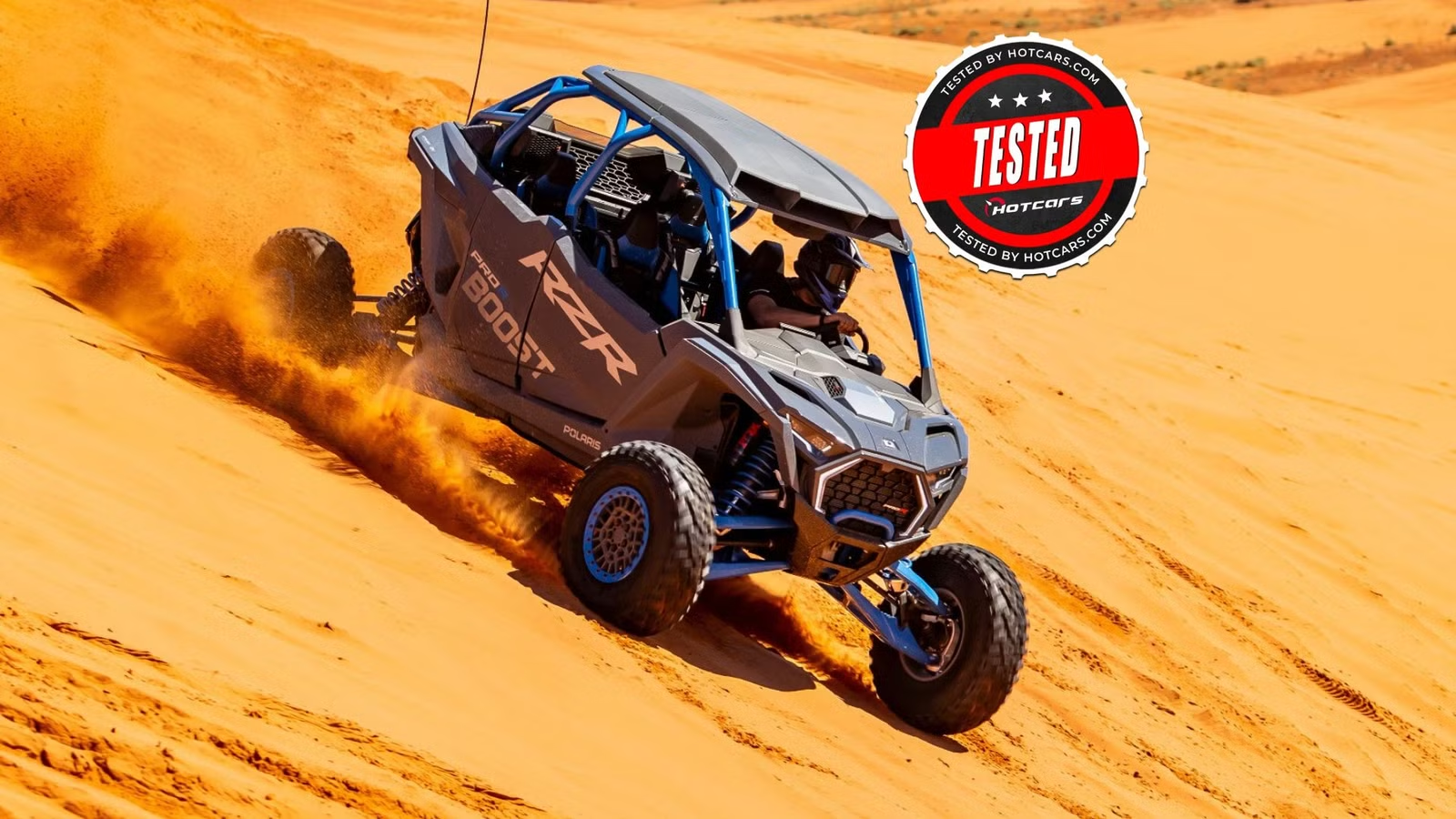
Polaris invited me to Sand Hollow in Utah to drive the all-new 2027 RZR Pro R Boost, and I couldn’t have imagined a better place to test something this ridiculous. Sand Hollow combines wide open desert, towering dunes, deep sand, fast trails, and spectacular red rock scenery that looks like another planet accidentally crashed into Utah.

More importantly, the terrain gave me enough space to push the RZR without ever worrying about crashing. The Pro R Boost is not meant to crawl politely along a gentle forest trail. It wants enormous sightlines, loose surfaces, and enough room for its turbocharged engine to inhale deeply and start rearranging the horizon. Putting it simply, this RZR attacks sand dunes as if they personally offended it.
Interestingly, the first surprise was not how fast it felt. Anyone looking at that huge roof scoop and angry bodywork already knows this thing is not arriving peacefully. What shocked me was how approachable all that speed became once I started trusting the chassis and suspension.
This Turbocharged Engine Is Completely Bonkers


The new ProStar Fury 2.0 liter turbocharged engine produces 275 horsepower at 7,000 rpm and 215 lb ft of torque at 4,000 rpm. That makes this the most powerful production RZR Polaris has ever built, with 50 hp more than the naturally aspirated Pro R. polaris.com
Those figures sound outrageous for a side by side, and they feel even crazier when the desert opens up. The power does not arrive as one unusable explosion that sends the driver directly toward the nearest expensive object. Instead, the engine delivers a thick wave of torque that makes the RZR feel relentlessly fast without becoming unnecessarily difficult to control.

Press the throttle and the Boost launches forward with the urgency of something being chased. Keep your foot down and it continues pulling hard as the turbo stuffs air into the 2.0 liter four cylinder. The CVT keeps the engine working in its strongest range, so there is no waiting for a gear change or searching for the correct ratio while a dune grows rapidly larger in the windshield.
Polaris has reinforced the drivetrain and improved cooling to support the additional performance. The Pro R Boost uses a dual radiator system, including a rear mounted high temperature radiator fed by that enormous roof scoop. This is functional engineering, although it also makes the RZR look like it escaped from a desert racing team before anyone could remove the sponsor stickers.
The Suspension Makes You Feel Far More Talented Than You Are

Straight line speed is only half the story. Sand Hollow revealed how well the chassis, four wheel drive system, and suspension work together when the surface stops cooperating. The RZR digs through soft sand, stays composed through fast corners, and allows the driver to place it with surprising accuracy for something this wide and powerful.

The suspension deserves much of the credit. Instead of beating the driver into submission, it controls the body while allowing the wheels to attack whatever happens to be underneath them. The faster I went, the more the machine seemed to settle into its job. That confidence is intoxicating because it starts convincing ordinary drivers that they have secretly possessed desert racing talent their entire lives. This was without a doubt the most insane thing I have driven off-road.
You have plenty of modes to toggle through to control suspension, steering, and which wheels the power gets sent to. Mostly though, the steering remains direct enough to make quick corrections, while the broad stance helps the RZR feel planted when changing direction. It can still slide and behave like an enormous turbocharged toy, but its responses are predictable enough that the fun does not immediately become panic.
The 74-inch stance gives the Pro R Boost tremendous stability, while the suspension absorbs the sort of impacts that would make a normal vehicle cough up its control arms. Sand that looked heavily rutted from behind the wheel often disappeared beneath the tires with one remarkably controlled hit. The RZR kept asking me to carry more speed, and my self-confidence kept getting stronger, the harder I pushed it.
This Much Insane Performance Comes With A Serious Price

Starting at $49,999, the two-seat RZR Pro R Boost Ultimate is one seriously expensive desert toy. That is $8,600 more than the range topping 2027 Kawasaki Teryx H2 Limited eS, and over $10,000 more than the 2027 Can Am Maverick R X.
The comparison gets even crazier when you look beyond side by sides. A 2026 Ford Bronco Badlands starts at $48,890, meaning the Pro R Boost costs slightly more than a road legal off-roader with air conditioning, doors, airbags, and a license plate. The 2026 Jeep Wrangler range starts at just $36,035. So, you get what I am saying, right?

Of course, nothing I mentioned above will chase the RZR across Sand Hollow with the same speed, suspension travel, or willingness to launch itself over a dune. You are not paying for practicality here. You are paying for 275 hp, outrageous desert performance, and the ability to get your adrenaline pumping higher than anything ever could do, all before lunch.
The price might be impossible to ignore, but so is the experience. The Pro R Boost is brutally fast, remarkably capable, and engineered to make hostile terrain feel like a private amusement park. Sand Hollow allowed us to push the RZR Pro R Boost hard, yet it never felt like the landscape had finally found its limit. The biggest danger, probably, is not crashing it. It’s driving one for a day and then trying to convince yourself that spending nearly $50,000 on a 275 hp desert missile would be a responsible financial decision.
This thing is now right at the top of my bucket list dream garage.

Related posts


Latest Post


No Comments