
Mopar Built The World’s Most Powerful V8 That Ford And Chevy Have Failed To Match For 60 Years
Today’s Top Fuel dragsters produce more than 11,000 horsepower from a supercharged V8, enough to blast from 0 to 60 mph in as little as 0.5 seconds, which equates to a literal blink of an eye. These purpose-built monsters represent the pinnacle of internal-combustion performance, with every component engineered around one goal: going incredibly fast, incredibly quickly. With numbers like that, you’d expect their engines to rely on some kind of alien technology or something developed in the last few years. The reality is even more remarkable.

Beneath the billet aluminum blocks and exotic fuel systems lies an architecture introduced 60 years ago during the golden age of American Muscle Cars. Born to win when “Win on Sunday, sell on Monday” was Detroit’s mantra, the V8 architecture proved so dominant that six decades later, it remains the foundation of the most powerful piston engines in professional motorsport.
When Manufacturers Had To Win On Sunday To Sell On Monday
By the early 1960s, America had become obsessed with speed. The hot-rodding movement that flourished after World War II had evolved from informal street races into organized competition, while a booming economy, inexpensive gasoline, and a growing population of performance-hungry baby boomers fueled demand for faster cars. Drag racing exploded under the NHRA’s leadership, NASCAR was drawing massive crowds, and Detroit quickly realized that success on Sunday translated directly into more showroom traffic on Monday.

Winning races gave automakers instant credibility, while the engineering lessons learned on the track often found their way into production cars, from bigger engines to stronger drivetrains and improved suspensions. Young enthusiasts wanted the same hardware driven by their racing heroes, and they flocked to dealerships selling proven winners. Pontiac, Ford, and Chevrolet all capitalized on the trend, leaving Chrysler determined to claim its own slice of the performance market.
Chrysler Built The Ultimate Weapon

Chrysler earned a reputation for building race-winning V8s in the 1950s. The company’s FirePower Hemi powered NASCAR champions throughout the decade, and when the Max Wedge took over in the early 1960s, it turned Dodge and Plymouth Super Stock cars into quarter-mile legends. But the horsepower war wasn’t standing still. Pontiac’s lightweight Super Duty Catalina “Swiss Cheese” cars were dominating drag racing, while Ford abandoned the industry’s self-imposed restraint on factory-backed racing with its ambitious Total Performance campaign in 1962, throwing resources behind everything from NASCAR to drag racing and endurance events.
Recognizing the threat, Chrysler tasked engine design manager Willem “Bill” Weertman in December 1962 with assembling a hand-picked engineering team capable of delivering a race-winning 426 cubic-inch V8 before the 1964 Daytona 500 and NHRA Winternationals. Tom Hoover, the driving force behind Chrysler’s Ramchargers program, believed the answer wasn’t an all-new engine but a better cylinder head. He proposed combining the rugged deep-skirt architecture of the Max Wedge with the superior airflow of the FirePower’s hemispherical heads. That straightforward concept gave birth to what would become the defining American racing engine of its era.
426 Hemi: The Most Dominant 1960s Engine That’s Still Terrorizing Drag Strips Today

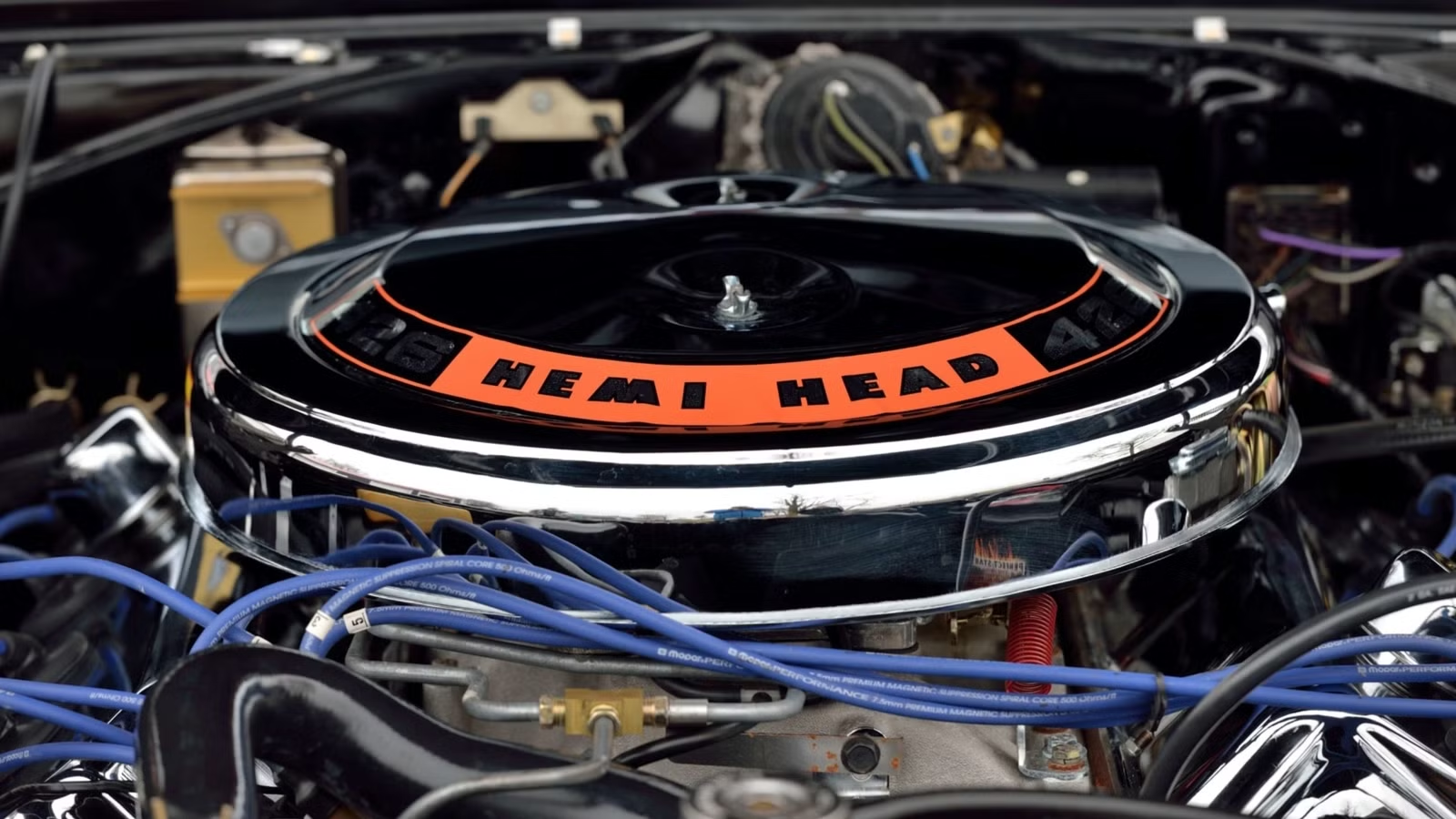
Tom Hoover’s idea became reality in 1964 with the debut of the 426 Hemi, the star of the show. The engine announced itself in spectacular fashion at the Daytona 500, where Hemi-powered Plymouths and Dodges overwhelmed the competition. Richard Petty led 184 of the race’s 200 laps, lapped the entire field, and headed a Chrysler sweep that immediately established the 426 Hemi as Detroit’s new benchmark for performance. By season’s end, Hemi-powered cars had captured 26 NASCAR victories, forcing rival manufacturers to acknowledge they had been outclassed.
Its dominance quickly became controversial. Rival manufacturers argued that the 426 Hemi was a purpose-built racing engine rather than a production power plant, prompting NASCAR to ban non-production engines for the 1965 season. Rather than abandon its masterpiece, Chrysler put the 426 Hemi into production for 1966, creating one of the most coveted muscle car engines ever offered to the public. Throughout the late 1960s and into the early 1970s, the Street Hemi became synonymous with Mopar performance, powering cars that dominated drag strips, won races, and have since become some of the most valuable and collectible American performance cars ever built.
Why The 426 Hemi Could Handle More Power Than Anything Else

There was a simple reason the 426 Hemi embarrassed the competition: it was engineered to win races before it was ever asked to power a production car. At the center of its design were hemispherical combustion chambers, which gave the engine its famous name. Their shape allowed Chrysler engineers to fit huge 2.25-inch intake and 1.94-inch exhaust valves while positioning them on opposite sides of the chamber. Combined with nearly straight intake and exhaust ports and a centrally located spark plug, the design dramatically improved airflow and combustion efficiency, giving the Hemi a breathing advantage that wedge-head rivals simply couldn’t match.
The rest of the engine was just as impressive. Displacing 426 cubic inches with a 4.25-inch bore and 3.75-inch stroke, the oversquare design favored high engine speeds without sacrificing durability. Its enormous dimensions earned it the nickname “Elephant Engine,” while a reinforced deep-skirt cast-iron block, cross-bolted main caps, a forged steel crankshaft, forged connecting rods, and forged pistons ensured the bottom end could withstand relentless punishment.
Race Hemis ran an aggressive 12.5:1 compression ratio with radical camshafts and either dual four-barrel carburetors for NHRA competition or a single four-barrel setup for NASCAR, while the 1966 Street Hemi adopted a more street-friendly 10.25:1 compression ratio and dual Carter AFB four-barrels. Officially rated at 425 horsepower in street form, the Race Hemi developed well over 550 horsepower, laying the foundation for an engine architecture that still dominates Top Fuel racing today.
Chrysler Walked Away From The Hemi In 1971, Racers Never Did

For much of the late 1960s and early ’70s, the 426 Hemi was Mopar’s ultimate weapon. It powered NASCAR’s famous winged warriors, while street cars such as the Hemi ‘Cuda turned Chrysler’s race-bred reputation into showroom legend. Then the market changed. Stricter emissions regulations, escalating insurance premiums, economic uncertainty, and the approaching oil crisis made massive, high-compression V8s increasingly difficult to justify. Chrysler built its final production 426 Hemis in 1971, ending the engine’s showroom career without compromising the formula that had made it legendary.
Racers, however, had no intention of letting the Hemi disappear. Legendary drag racer Don “Big Daddy” Garlits was among those who helped unlock its potential on nitromethane. After becoming frustrated with the engine’s early performance on nitromethane, he deliberately pushed it to the limit with extreme ignition timing, expecting to find its breaking point. Instead, the Hemi survived and responded with a huge increase in performance. Its massive hemispherical chambers, excellent airflow, and incredibly rigid deep-skirt block proved uniquely suited to the violent cylinder pressures of nitromethane racing.
Garlits used that advantage to set new speed milestones and win relentlessly, convincing the rest of the sport that if you wanted to survive a nitro-burning pass and win, the Hemi was the best way to do it. His success forced competitors to abandon Ford and Chevrolet alternatives, and before long, the second-generation 426 Hemi architecture became the foundation for Top Fuel Drag racing. Six decades later, its descendants still power every NHRA Top Fuel dragster.
The 426 Hemi’s DNA Still Powers The World’s Fastest Drag Cars
Every NHRA Top Fuel dragster today can trace its engine architecture back to the 426 Hemi. These are among the fastest-accelerating machines on Earth, representing the absolute zenith of straight-line internal-combustion racing. At their heart is a 500-cubic-inch (8.2-liter) supercharged and fuel-injected V8 derived from the classic Chrysler 426 Hemi architecture, producing roughly 11,000 horsepower and sometimes more.
The cars themselves are just as extreme, using 4130 chromoly tubing and wheelbases stretching to 300 inches, with enormous rear wings generating the roughly 12,000 pounds of downforce needed to keep them planted as they charge toward speeds well beyond 330 mph. Burning nitromethane and covering 1,000 feet in less than 3.7 seconds at trap speeds over 340 mph, these dragsters are the ultimate expression of an engine concept born in Detroit more than six decades ago.
How Much Of The Original 426 Hemi Still Exists?

The 426 Hemi’s official 425-hp rating was widely believed to be conservative, but even the real figure looks like child’s play when compared to the 11,000-plus-hp monsters powering today’s Top Fuel dragsters. Yet there is a direct genetic link between the two. Modern engines retain the 90-degree V8 architecture, hemispherical combustion-chamber concept, and cam-in-block, pushrod valvetrain that defined the original Hemi. From there, however, the evolution becomes extreme.
Displacement has grown from 426 to the NHRA’s 500-cubic-inch limit, with modern engines using a roughly 4.19-inch bore and longer stroke. The original’s cast-iron block and production-oriented hardware have given way to purpose-built billet-aluminum blocks and heads. The two Carter AFB four-barrels that fed the original Hemi have been replaced by a gigantic 14-71 Roots-style blower forcing more than 60 psi of boost into the cylinders. Inside, Top Fuel engines rely on extreme hardware such as forged pistons, connecting rods, and bearings, along with other purpose-built internals, but many of these components are essentially consumables designed to survive a few seconds of extraordinary abuse, not thousands of miles. After every run, the engine is completely torn down, inspected, and rebuilt, with worn or suspect parts replaced before the next pass.
Sixty Years Later, Engineers Still Haven’t Found A Better Blueprint

Six decades of engine innovation have brought DOHC valvetrains, variable valve timing, sophisticated electronic ignition, and exotic materials, yet none has displaced the Hemi architecture from Top Fuel. These engines may be rebuilt after every pass and consume many of their internal components in the process, but the design is still fundamental to today’s Top Fuel monsters.
That may be the ultimate testament to Chrysler’s original design. Everything around the Hemi has evolved, but the blueprint itself has endured.
Sources: NHRA, Hemmings

Related posts




Latest Post


No Comments