
The Motorcycle That Explains Triumph’s Enduring Appeal
Triumph is a well-known motorcycle brand from across the pond. It has been around for so long, it is older than Harley-Davidson. Just like The Motor Company, it has managed to survive everything thrown at it. Not just survive; both these brands have thrived. Triumph built its name on authentic road presence, and it defines itself with a clear identity rather than following the latest trend. Along the way, it has set land speed records at Bonneville, but it has never been about going fast. It has always tapped into its heritage and stuck to core values while remaining profitable.
Inline Triples Rebuilt The Brand While Parallel Twins Preserved Its Heritage

When Triumph was resurrected, nobody was sure whether it would hold on to its heritage or opt for a completely new product line. Thankfully for fans of the brand, it stuck to its guns and doubled down on its heritage. We got heavily revised inline-three engines in motorcycles like the Street Triple and Speed Triple, the latter of which also became a movie star. This helped build Triumph’s credibility as a performance motorcycle manufacturer. However, Triumph also had a strong history with the parallel-twin engine. This engine layout had carried it through most of its history and is what most Triumph enthusiasts associate with the brand.
Deliberate Retro Styling Cues Mask A Fully Modern Platform

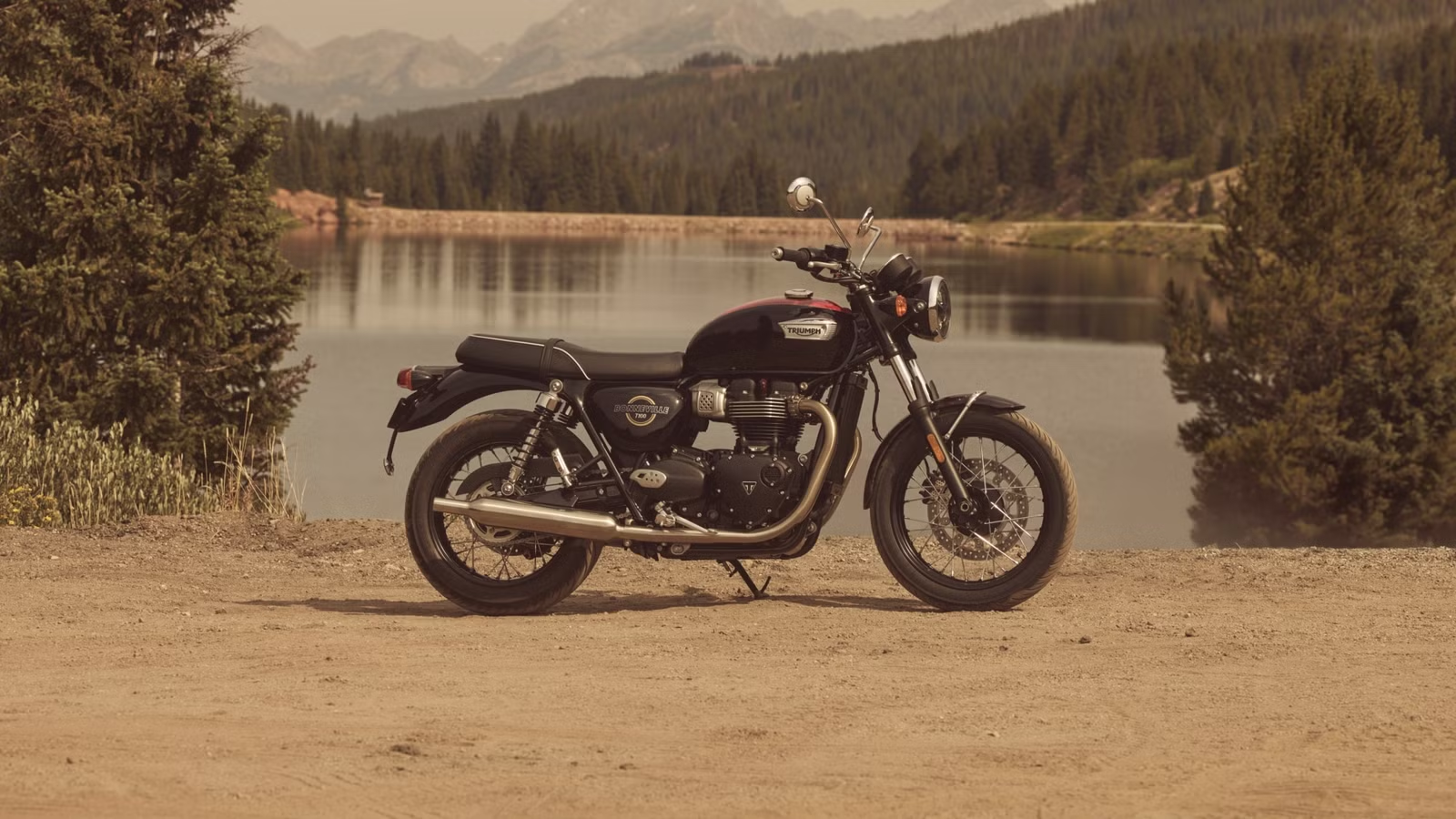
It is no surprise that Triumph’s parallel-twin heritage lives on in the Bonneville range. This is part of the brand’s modern classics lineup. Triumph has retained the best bits of its retro design, and under the skin, it has given it modern engineering. The result is a motorcycle that looks timeless yet has none of the idiosyncrasies that one takes for granted with a retro motorcycle.
Design elements like the fake-carburetor throttle bodies, the cylinders with cooling fins, and the age-old tank shape are deliberate design decisions that hide fuel injection, liquid cooling, and a six-axis IMU. There is something for everyone. Besides the standard motorcycle, there are scramblers, bobbers, and even a cruiser, but nothing embodies the spirit of the Bonneville like the meat-and-potatoes base model.

The Bonneville T100 Is Everything You Want In A Neo-Retro Bike

All the variants of the Bonneville range have some specialty or the other. For example, the T120 is the range-topping Bonneville with its much larger engine, the Speed Twin offers roadster agility along with the torque from the parallel-twin engine, the Bobber is a work of art, and the Speedmaster is a surprisingly good highway cruiser.
The T100 cannot claim to be the best at something in the range, but it is the Bonneville in its most approachable and essential form. It doesn’t have high horsepower or overwhelming electronics, but what it does have is clean lines, accessible performance, and something that appeals to everyone, from beginners to seasoned riders. This is not a cut-price variant, but something that can stay in your garage through every stage of life.
The $11,495 Sticker Makes The T100 The Sweet Spot Of Triumph’s Range

The Bonneville range encompasses so many different styles of motorcycle that the large price difference between the lowest- and highest-spec variants is not a surprise. The Bonneville T100 has a base price of $11,495. To upgrade to the T120, you will need $13,995. The Bobber and Speedmaster command a premium over that as well, at $14,795. And if you want the quickest in the range, you’ll need the Speed Twin 1200 RS, which retails for $17,195.
That is on par with liter-class sportbikes. Therefore, the pricing of the Bonneville range goes from value-oriented to super premium depending on which model and engine combination you pick. Whatever the result, you will get the same modern quality with real metal and chrome.
The 270-Degree Parallel Twin Trades Peak Horsepower For Usable Low-RPM Drive

The Bonneville T100 has a 900 cc parallel-twin engine that has helped turn it into a long-term favorite. It has liquid cooling, an SOHC head, and four valves per cylinder. It is a slightly short-stroke engine with a reasonably high 11:1 compression ratio. It generates 64 horsepower at 7,400 RPM; that might seem low because it focuses its energy on the substantial 59 pound-feet of torque at a low 3,750 RPM.
Triumph has chosen a 270-degree firing order and mated it with a five-speed gearbox with an assist-and-slipper clutch and chain drive. However, you will not need to change gears too much with so much torque available so low in the rev range. The lack of a sixth speed here can make it feel a little out of breath while overtaking on the highway, but upgrading to the T120 with the larger displacement and the six-speed gearbox fixes that problem.
A Double-Cradle Steel Frame Is Paired With Traditional Tube-Type Spoked Rims

Just like the engine, the chassis follows a retro formula that makes it a ‘boring’ motorcycle, but it will outlast every flashy rival. This is a tubular steel cradle frame with a two-sided steel swingarm. Triumph has given it KYB suspension. There are 41 mm cartridge front forks with 4.7 inches of travel, and at the rear, there are twin shock absorbers with adjustable preload; they offer identical travel.
The brakes are a slightly different matter. At the front, there is a single 310 mm disc paired with a Nissin two-piston floating caliper, while at the rear, there is a 255 mm disc with a Nissin two-piston floating caliper. It has wire-spoked wheels with an unconventional 18-inch front and 17-inch rear combination. The rear tire is a radial, but tubeless tires are not part of the equation. While the engine might not have a lot of power, there is certainly a lot of heft to the Bonneville T100, and better brakes would definitely be appreciated.
Approachable Proportions Accommodate Beginners Without Feeling Cramped
One of the reasons the Bonneville is the motorcycle that Triumph fans keep coming back to is the fact that it is a reasonable size for anyone. It is 30.4 inches wide with an accessible seat height of 30.8 inches. The wheelbase is 56.6 inches, which makes it manageable in traffic, but it is a little heavy at 502.7 pounds wet. The fuel tank holds 3.8 gallons of fuel. This is a slightly wide motorcycle, so the low seat helps. The mass is centralized, so it doesn’t feel like a 500-pound motorcycle, especially when moving.
Analog Dual Dials Blend Nostalgia With Modern IMU Safety

Triumph has struck a great balance between retro looks and modern electronics, and the feature set of the Bonneville T100 echoes that. The classic dual-pod instrument cluster houses an analog speedometer and tachometer; each has an LCD display that shows the remaining information, including gear position, fuel level, distance to empty, clock, odometer, and dual trip meters.
Under the skin, the recent overhaul has added a six-axis IMU (a by-wire throttle was always present), which means lean-sensitive traction control and ABS are now included. Coupled with the riding modes, this is a thoroughly modern riding experience. The headlamp is an LED projector unit despite the retro circular housing, and there are quite a few accessories to add, but the T100 works best as a stripped-down, back-to-basics machine.

The Bonneville T100 succeeds where others don’t, simply because it doesn’t pretend to be something it isn’t. It sticks to what made it famous in the first place: the pure, accessible roadster spirit that makes it one of the motorcycles that refuses to go out of style, and adds modern cornering-enabled safety to it. It works whether you want to run a quick errand or head out for an all-day ride, and whatever distance you choose to cover, you will experience that honest, soulful connection that has made riders fall in love with it since its inception.
Source: Triumph Motorcycles USA

Related posts


Latest Post


No Comments