
10 Used EVs That Cost Less Than A New Toyota Corolla
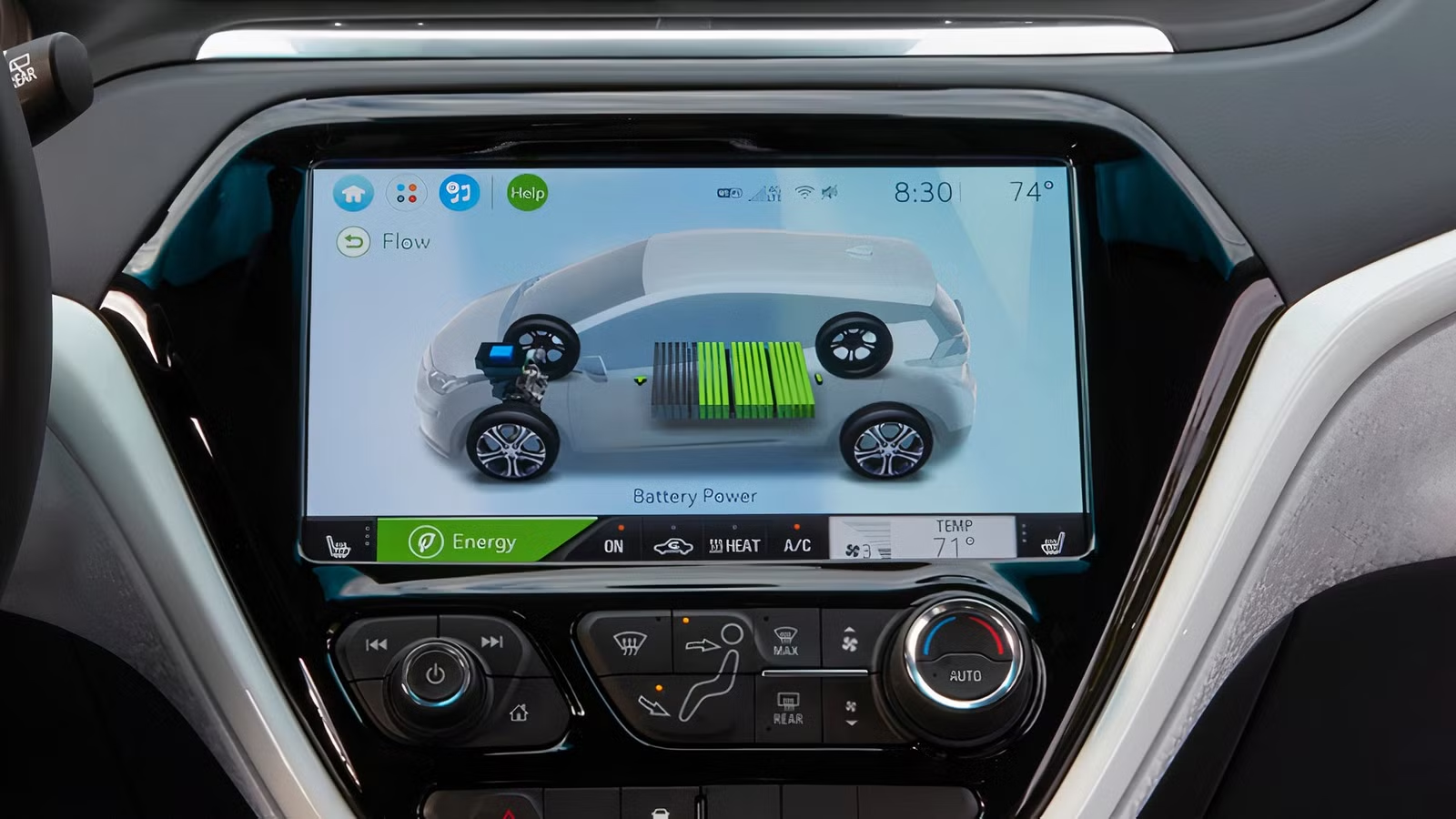
A new Toyota Corolla starts at roughly $23,325 before fees, and for that money you get a competent, frugal compact with a fuel bill that never goes away. Spend the same or less on a used electric car and the equation changes somewhat. You get quicker acceleration, silent cabins, cheap running costs and, in several cases, more standard technology than a base Corolla offers. The trade-off is battery age and the homework that comes with it. These ten models sit below the Corolla’s sticker at representative market prices, not one-off bargain listings, and each makes a genuine case for skipping the default Corolla choice.
Nissan Leaf
2018 to 2020: $11,000

The Nissan Leaf is the cheapest way into electric motoring here, and it is also the one that demands the most caution. The standard 40-kWh car returned an EPA-rated 151 miles when new, while the 2019 and 2020 Leaf Plus stretched that to 226 miles with a 62-kWh pack. Charging uses the aging CHAdeMO standard, which is steadily disappearing from public networks, and the Leaf has no active battery cooling, so heat and repeated fast charging take a visible toll.
The standard 40-kWh car’s front-mounted motor makes 147 horsepower and 236 pound-feet of torque, while the Leaf Plus raises that to 214 horsepower and 250 pound-feet from a 62-kWh pack. Cargo space is a useful 23.6 cubic feet behind the rear seats, and the standard model weighs in at around 3,400 pounds.

Nissan’s 8-year/100,000-mile battery warranty has already lapsed on 2018 cars and runs out in 2028 for 2020 models. Check the dashboard capacity bars before anything else. Why choose it over the Corolla? Price, mostly. At $11,000 you pocket well over $10,000 compared with the Toyota, and a healthy Leaf is a comfortable, quiet commuter. Buy the Plus if range matters, and avoid anything with missing capacity bars.

Chevrolet Bolt EV
2017 to 2021: $15,000

The Chevrolet Bolt EV is the poster child for affordable electric range. Early cars were rated at 238 miles, rising to 259 miles from the 2020 model year, and the 200-horsepower motor gives hatchback-beating punch. Fast charging is modest, topping out at around 50 to 55 kW on the optional CCS port, so a road-trip stop is a long one. Level 2 charging at 7.2 kW overnight is perfectly adequate.
Early cars use a 60-kWh battery, increased to roughly 66 kWh from 2020, feeding a front-mounted motor that produces 200 horsepower and 266 pound-feet of torque. That is enough for a 0 to 60 mph sprint in around 6.5 seconds, with 16.9 cubic feet of cargo space behind the rear seats.

The reliability story is dominated by the battery fire recall. Chevrolet replaced packs across the affected model years, and replaced packs carry a fresh 8-year/100,000-mile warranty, so a recalled-and-fixed Bolt can be a bargain with years of cover left. Confirm the work was completed using the VIN. Against the Corolla, the Bolt offers vastly more range than its price suggests, and for $15,000 it leaves money for a home charger.
Kia Niro EV
2019 to 2022: about $16,500

The Kia Niro EV is the sensible grown-up of this group. A 64-kWh battery delivers an EPA-rated 239 miles, the 201-horsepower motor makes 291 pound-feet of torque, and the cabin is genuinely practical, with the cargo room and seating position of a small crossover. DC fast charging reaches 100 kW and a 7.2-kW onboard charger handles home duty, so a 10-to-80-percent top-up takes roughly an hour on a decent public charger. The front-wheel-drive Niro EV pairs its 64-kWh battery with a motor producing 201 horsepower and 291 pound-feet of torque, good for 0 to 60 mph in roughly 6.5 seconds. It weighs about 3,850 pounds and offers 18.5 cubic feet of cargo space with the rear seats in place.

Kia’s battery cover is 10 years or 100,000 miles, but it generally applies to the original owner, so a second owner may have less protection than the brochure suggests. Reliability has been strong overall, with isolated reports of charge-port and 12-volt battery issues. Versus a Corolla, the Niro gives you a hatchback’s usability, a heat pump on many trims and electric running costs, at a price still comfortably below the Toyota’s.
BMW i3
2018 to 2020: $17,500

The BMW i3 remains the most intriguing car on this list. Its carbon-fiber passenger cell, rear-hinged coach doors and sustainable-material cabin look like a concept car that escaped. Cars from 2019 got a 42.2-kWh battery rated at 153 miles, and the optional range-extender (REx) adds a small gasoline generator for peace of mind. Fast charging is CCS at roughly 50 kW and the 170-horsepower rear motor feels nippy around town. A rear-mounted motor drives the rear wheels with 170 horsepower and 184 pound-feet of torque, delivering a 0 to 60 mph time of around 7 seconds in a car that weighs only about 2,900 pounds. The 42.2-kWh battery pack sits low in the floor, and the rear compartment offers 15.1 cubic feet of cargo space.

Watch the REx cars for software and generator issues, and be mindful that repair costs can be steep if the carbon structure is damaged. The 8-year/100,000-mile battery warranty still covers many 2019 and 2020 examples. Compared with a Corolla, the i3 is a premium, characterful city car with a cult following. It is also production-ended, so clean low-mileage cars are slowly becoming collectible.
Hyundai Kona Electric
2019 to 2022: $18,500

The Hyundai Kona Electric is one of the better range-per-dollar propositions. Its 64-kWh battery was rated at 258 miles, the 201-horsepower motor is quick off the line, and 100 kW DC fast charging means a 10-to-80-percent stop in around 47 minutes. A 7.2-kW onboard charger takes care of the overnight top-up. The front-wheel-drive Kona Electric uses a 64-kWh battery and a 201-horsepower motor with 291 pound-feet of torque, enough for 0 to 60 mph in about 6.4 seconds. It weighs around 3,700 pounds and provides 19.2 cubic feet of cargo space behind the rear seats.

The major caveat is the battery fire recall that hit 2019 to 2020 cars (and some later ones), resulting in pack replacements and, on some vehicles, extended coverage. Verify the VIN for completed recall work, because a replaced pack makes the car more attractive. Hyundai’s 10-year/100,000-mile battery warranty typically favors the first owner. Why not the Corolla? The Kona is a taller, more versatile crossover with real EV range and better standard tech, and a well-documented car can undercut the Toyota by several thousand dollars.
Mini Cooper SE
2020 to 2021: $19,500

If you are shopping with your heart, the Mini Cooper SE is the obvious pick. It has the go-kart steering and tight body control of any Mini, wrapped around a 181-horsepower electric motor and a 32.6-kWh battery. The catch is the EPA range of just 110 miles, which means this is a city and suburban car, not a motorway cruiser. Charging is 50 kW DC and up to 11 kW AC at home. Cargo space is tight at about 8.7 cubic feet with the rear seats up, reflecting its compact two-door body.

Reliability has generally been good, with the main complaints being the firm ride and limited rear space. The 8-year/100,000-mile battery warranty still has plenty of life on 2020 and 2021 models. Against the Corolla, the Mini is the fun choice. It is smaller, more expensive to insure in some areas, and less practical, but if your daily drive is under 60 miles it will put a smile on your face every morning.
Volkswagen ID.4
2021 to 2022: $20,500

The Volkswagen ID.4 is the mainstream family crossover of the group. Its 82-kWh battery (about 77 kWh usable) gave rear-drive models an EPA-rated 260 miles on 2022 cars, with a bit less for all-wheel drive. 2022 All-wheel-drive cars add a front motor for 295 horsepower and 339 pound-feet. It weighs roughly 4,600 pounds and offers 30.3 cubic feet of cargo space behind the second row. Fast charging peaks at 125 kW, the 11-kW onboard charger is generous, and the cabin is spacious and quiet.

The big complaint is software. Early ID.4s were criticized for a laggy touchscreen, fiddly capacitive controls and occasional glitches, though updates have improved matters. There was also a recall on door handles. The 8-year/100,000-mile battery warranty remains valid on most examples. For the money, you get a roomier, more comfortable and far more modern car than a base Corolla. The ID.4 suits families who need space, and at $20,500 it undercuts the Toyota by a useful margin.
Chevrolet Bolt EUV
2022 to 2023: $21,000

The Chevrolet Bolt EUV is the Bolt EV’s more mature sibling. It adds roughly 6 inches of overall length and extra rear legroom, a more upright design and, crucially, available Super Cruise hands-free driving on higher trims. EPA range is 247 miles, power is 200 horsepower and fast charging reaches 55 kW, so road trips need patience. Power comes from a 65-kWh battery and a front-mounted motor making 200 horsepower and 266 pound-feet of torque, enough to reach 60 mph in about 7 seconds. It weighs around 3,700 pounds and has a stretched wheelbase compared with the Bolt EV, with 16.3 cubic feet of cargo space behind the rear seats.

All 2022 and 2023 cars were built with the revised battery after the fire recall, which is a reassurance, and the 8-year/100,000-mile battery warranty has years to run. Early cars had some software quirks, and the DC charging speed is not class-leading. Versus a Corolla, the EUV gives you a spacious, comfortable and reasonably high-tech crossover at a lower price. If you can live with the charging speed, it is a smart used buy.
Tesla Model 3
2019 to 2020: $21,500

The Tesla Model 3 is the benchmark. EPA range ran from around 240 miles for the Standard Range Plus to 310 miles for the Long Range, with dual-motor cars reaching 322 miles. Charging is where it shines: Supercharger access is built in, and with North American networks adopting the Tesla plug, Tesla owners enjoy the simplest charging experience around. The 11.5-kW onboard charger is excellent at home.
The rear-drive Standard Range Plus reaches 60 mph in about 5.3 seconds, the dual-motor Long Range does it in roughly 4.4 seconds, and the Performance version manages 3.2 seconds with a top speed of 162 mph. Cargo is split between a rear trunk and a small front trunk, and the Standard Range Plus weighs around 3,600 pounds.

Early build quality is the watch-out, with panel gaps, paint issues and interior rattles reported on some cars. Battery warranty is 8 years/100,000 miles for the Standard Range, and 120,000 miles on the Long Range. Versus a Corolla, the Model 3 is simply a different class of car: faster, more connected and with the best charging network behind it. At $21,500, it is the performance bargain of the list.
Hyundai Ioniq 5
2022: $22,500

The Hyundai Ioniq 5 is the most advanced car here, and it barely squeaks under the Corolla’s price. Its 800-volt architecture allows charging at up to 350 kW on compatible chargers, with 10 to 80 percent possible in roughly 18 minutes. EPA range was 220 miles for the standard battery, up to 303 miles for the rear-drive long-range model, and the cabin is airy, flat-floored and futuristic. The 2022 lineup spans a 58-kWh standard battery with 168 horsepower and a 77.4-kWh long-range pack, which delivers 225 horsepower in rear-drive form and 320 horsepower and 446 pound-feet of torque with all-wheel drive. The all-wheel-drive model reaches 60 mph in around 5 seconds, and the 118.1-inch wheelbase gives the cabin remarkable space, with 27.2 cubic feet of cargo room behind the rear seats.

The main reliability concern is the integrated charging control unit (ICCU), which has been the subject of recalls and can cause a loss of drive, so check that any needed repair has been done. Hyundai’s 10-year/100,000-mile battery warranty usually protects the original owner more fully than later owners. Compared with a Corolla, the Ioniq 5 feels like it comes from another decade, and its fast-charging capability is class-leading even today.

Related posts



Latest Post


No Comments