
The Motorcycle That Quietly Redefined the Modern Cruiser
There was a time when cruiser bikes were laid-back first, chrome-laden second, and performance came way later in the checklist. Today, though, there’s an entire lineup of performance cruiser bikes that look completely unhinged today. Machines like the Ducati Diavel V4 and Triumph Rocket 3 generate well over 160 horsepower, have neck-straining torque off idle, and sprint from 0-60 MPH in under three seconds. They combine feet-forward ergonomics and wide handlebars with acceleration figures that can humble liter-class superbikes at a drag strip. How did we end up here, you ask? Well, credit goes to one iconic V4 cruiser from none other than Honda. Here’s how it all panned out.
The Pre-1983 Cruiser Formula: Low Revs, Heavy Chrome, And Zero Speed

“Cruiser” and “fast” started off as mutually exclusive concepts that never shared space in product briefs. Such bikes were built strictly around laid-back ergonomics, chrome, low revs, and lazy Sunday afternoons. They were built, to put it succinctly, for cruising around. Going fast was for streetfighters or sport bikes, while the cruiser world remained comfortably insulated from the horsepower wars. Harley-Davidson and Indian led the way with their V-twin bikes, all of which had relaxed tunes for low horsepower and high torque. They were quite popular, too, so other brands inevitably recreated the same core idea in their own cruisers.
Then, The CBR-Maker Rejected the Slow-Cruiser Shtick

While other manufacturers played it safe by copying Milwaukee’s air-cooled V-twin template, Honda looked at the American cruiser scene through the lens of hot rodding and SoCal drag strips. Honda has never been content following when it can be leading, as evidenced by models like the CB750 Four and Gold Wing. So the company decided to find out what happened when you wrapped a custom motorcycle frame around a high-revving sport bike engine, birthing what was technically the first “power” cruiser.
The Accidental Hot Rod Was Born With The V65 Magna


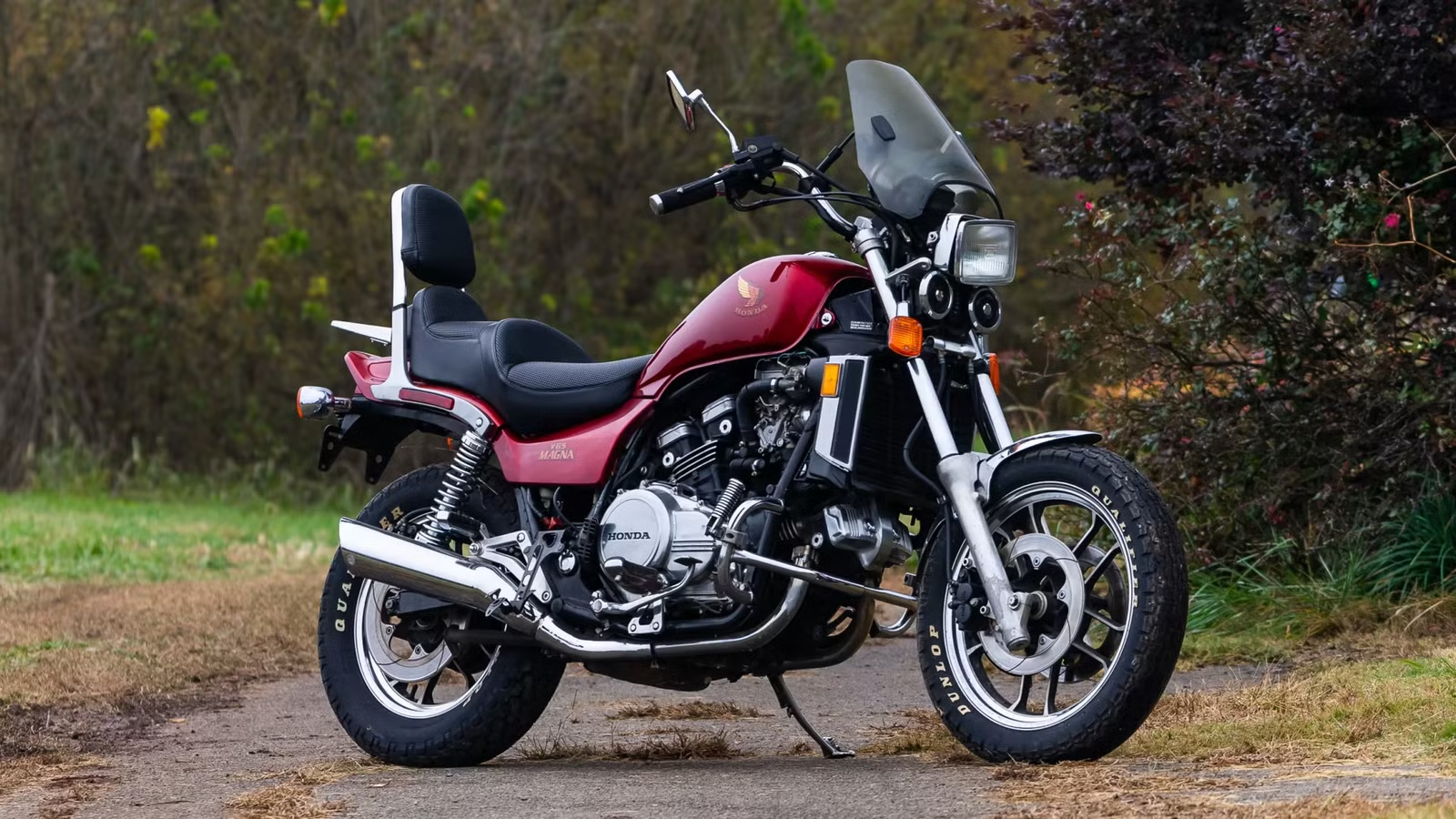
In 1983, Honda detonated the cruiser establishment with the V65 Magna, known inside the factory as the VF1100C. It looked like an innocent factory custom, complete with a stepped seat and pulled-back bars, but underneath sat pure, unadulterated muscle. Not only was it the first cruiser to use a V4 engine, but it was also one of the first mass-produced motorcycles to use one. When legendary drag racer Jay ‘Pee Wee’ Gleason clicked the Magna into first gear and ripped off a 10.92-second quarter-mile pass at nearly 125 MPH at the press launch, the power cruiser category was born on the spot.
The 1,098cc Racing-Derived V4 Revved Past 10,000 RPM

The heart of the beast was a 1,098cc, liquid-cooled, 90-degree V4 powerplant displacing 65 cubic inches — hence the name. It had a DOHC head, four valves per cylinder, and four 36 mm Keihin downdraft carburetors. This short-stroke engine was derived from Honda’s bleeding-edge superbike and endurance racing programs of the time. It revved past 10,000 RPM and churned out an outrageous 116 horsepower and 70 pound-feet of torque at a time when most cruisers struggled to make half that!

Backing that muscle was a slick six-speed transmission paired with a low-maintenance enclosed shaft drive. The gearbox’s bottom five gears were close-ratio ones for relentless straight-line launches, followed by an overdrive sixth for relaxed highway cruising. To keep the rear tire from skipping uncontrollably under aggressive downshifts, Honda integrated a hydraulic slipper clutch, giving street racers the mechanical safety net needed to hammer down through the gears once the quarter mile was breached. Today, depreciation has made it extremely affordable while still being more powerful than a Sportster S.
A 45/55 Rear Weight Bias Meant Rocket-Like Launches Off The Line

Taming that much power required a frame to match. Honda gave the Magna a stout double-cradle steel frame with 41mm air-assisted front forks and dual coil-over rear shocks. The front fork incorporated Honda’s Torque Reactive Anti-dive Control (TRAC) system, which mechanically diverted fork oil under braking to minimize front-end dive during hard stops.

The brakes consisted of dual 270 mm front discs with twin-piston calipers and a large 282 mm disc at the rear. Yet, true to its hot rod nature, the V65 Magna was built to dominate the drag strip rather than carve through tight canyons. With a distinct 45/55 rear-biased weight distribution and noticeable shaft-jacking under hard throttle, the front end felt light and vague when leaned into corners, reminding riders that this was a straight-line missile and not a corner carver. Despite all its shortcomings, it still made Harley-Davidson sweat in the 1980s.
The V65 Magna’s Twin Fuel Tanks And Fuel Pump Were A Novelty
The Magna had an exceptionally long 62.8-inch wheelbase, along with a seat height of 31.6 inches. This was taller than traditional low-slung cruisers, but low enough to suit the majority of riders while at the same time offering enough clearance for a respectable lean angle. A quirk of the V65 Magna was the twin fuel tanks that held a combined 4.5 gallons.
The visible tank was constrained by packaging requirements and was too small to offer a respectable tank range, so a second underseat tank was designed and installed. A fuel pump fed the fuel from the underseat tank to the carbs, which was a necessity when launching at the dragstrip. It weighed 589 pounds wet, but the weight was biased towards the rear, for maximum drive off the line.
Early Digital Instrumentation And Self-Canceling Signals Were Part Of The Package

Honda loaded the V65 Magna with advanced electronic features that were rare on any street bike in 1983. The instrumentation featured an electronic digital gear position indicator, an analog tachometer, a coolant temperature dial, warning sensors for oil pressure and taillight bulb failure, and self-canceling turn signals. It also had five-spoke aluminum wheels with tubeless tires, and an integrated passenger sissy bar. The history and mystery of this Honda was furthered with the FOIL (Fiber Optic Integrated Lock) security system, which routed a live light beam through an armored cable; severing the tether instantly triggered the horn and disabled the starter.
Why This Hot Rod Rebel Quietly Faded Away

The V65 Magna was an accidental hot rod spawned by Honda’s refusal to follow the herd. It shattered the idea that cruisers had to be slow, polite machines. Yamaha rushed to build its answer, and the 145-horsepower V-Max was born in 1985. Kawasaki threw its hat in the ring by dropping the Ninja 900 engine into the ZL900 Eliminator, and two decades after the V65 Magna, Harley-Davidson turned to Porsche to build the high-revving Revolution motor for the V-Rod. Which, incidentally, is a cruiser designed to destroy all at the drag strip.

Yet despite lighting the fuse for the entire power cruiser revolution, the V65 Magna never became a sales success. It was hit immediately by the punitive 45-percent ‘Harley tariff’, suffered from early camshaft oiling concerns, and saw its sales cannibalized by its own cheaper, better-handling sibling, the VF750C Magna. Overshadowed by the louder cultural arrival of the V-Max and quietly discontinued after just four model years, the V65 slipped into the background with modest sales numbers. It never got the loud, mainstream recognition it earned, but its legacy is undeniable: it was the machine that quietly became a legend because it redefined the modern cruiser.
Source: Honda Global

Related posts


Latest Post


No Comments