This Reinvigorated SUV From Hyundai Is An Absolute Gamechanger
8 minutes reading
Tuesday, 6 Oct 2026 17:00 0 44 autotech
South Korea’s Hyundai Motor Company has transformed from an ambitious entry-level manufacturer into a dominant global automotive force over the last 40 years. The brand established its American footprint in 1986, rapidly building consumer trust through competitive pricing, relentless engineering improvements, and an industry-leading ten-year powertrain warranty.
Today, Hyundai Motor Group holds a top-three market share position in the U.S., driven by record-breaking sales across its advanced internal combustion, hybrid, and fully electric vehicle lineups. Through heavy investments in domestic manufacturing, design innovation, and cutting-edge technology, Hyundai continues to solidify its reputation for exceptional value, safety, and modern reliability.
Hyundai’s Crossover-Focused Strategy Is Paying Off
Hyundai
Hyundai Motor Group is underway with executing a diverse powertrain product strategy in the U.S., with a strong focus on electrification. The strategy balances flexible internal combustion, hybrid, plug-in hybrid, and extended-range electric systems alongside dedicated battery-electric vehicles. Hyundai’s approach allows it to address evolving regional market demands while maintaining steady electrification growth. Architecturally, the lineup relies on advanced modular platforms, boasting a design language that integrates structural functionality with futuristic aesthetics.
Hyundai’s current strategy also heavily focuses on light trucks, crossovers, and SUV platforms, accounting for roughly three-quarters of overall domestic volume. The broader utility portfolio spans diverse sub-segments, covering entry-level urban crossovers, versatile midsize platforms, dedicated electric architectures, and spacious three-row family vehicles. Strategic market shifts toward higher-riding profiles reinforce strong brand adoption, as utility offerings consistently anchor annual sales growth. This crossover-centric lineup provides functional versatility through elevated seating configurations, higher ground clearances, multi-terrain all-wheel-drive setups, and adaptable cargo space to fulfill the active lifestyle demands of North American buyers.
Hyundai’s New Tucson Completely Changes The SUV Game
Hyundai
The 2027 Hyundai Tucson has been revealed as the brand’s boldest iteration yet. The exterior design is based on the South Korean brand’s new Art of Steel design language, featuring muscular exterior proportions, pronounced fenders, restrained door surfaces, and sharp lines that emphasize structural strength.
Larger dimensions enhance visual presence, extending length to 185.0 inches, width to 75.0 inches, and height to 66.3 inches, alongside a 109.6-inch wheelbase and expanded 83-degree door opening angles. The frontal architectural H-Edge lighting integrates indirect center and edge illumination, while standard two-in-one LED headlamp modules sit above a pedestrian-friendly front fascia. Micro Pixel Lighting utilizes 25,600 LED pixels to enable dynamic welcome animations and precision beam patterns.
Hyundai
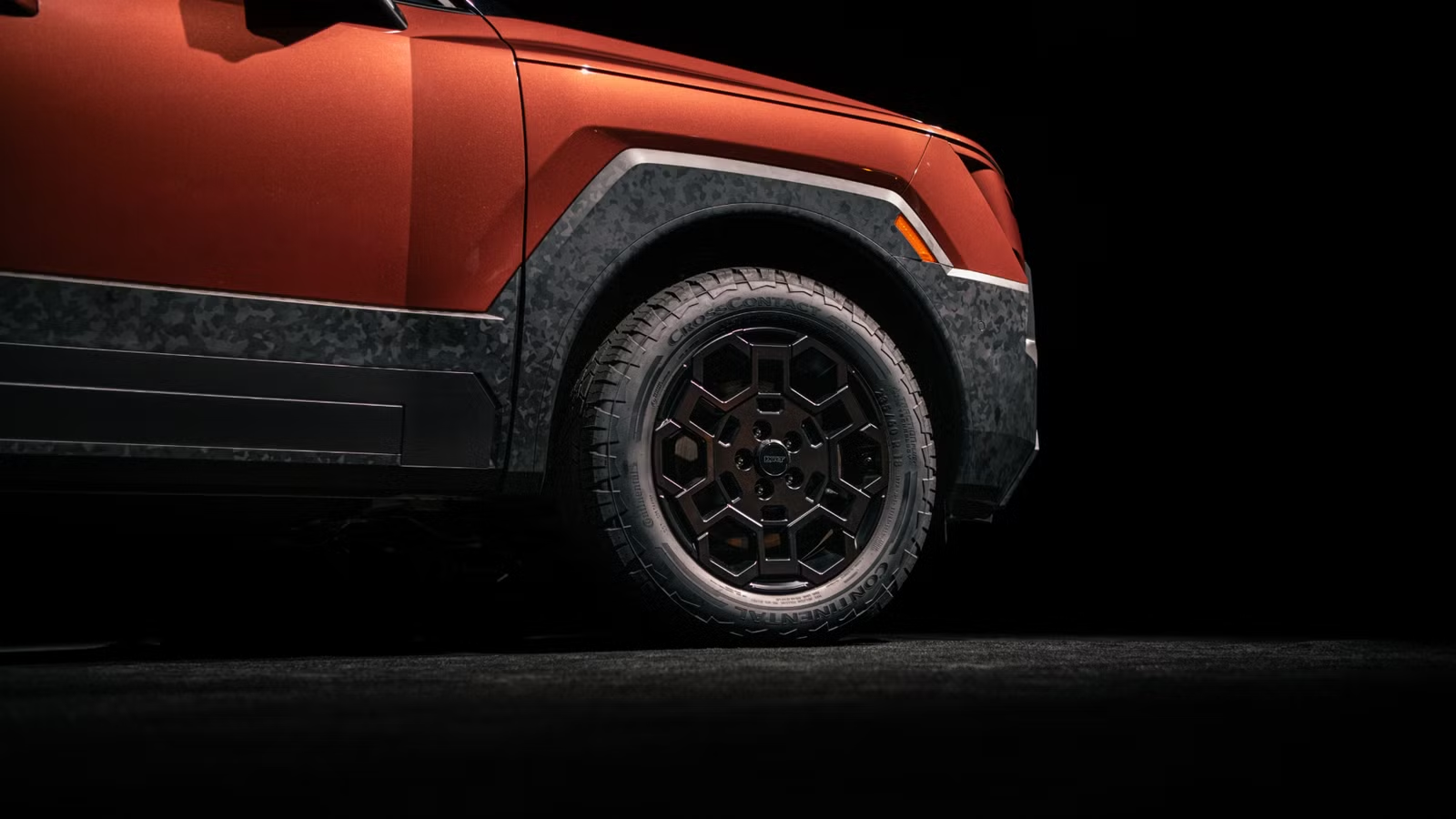
The rear incorporates 3D sculptural Prism Rear Lamps featuring a transparent lens with intricate internal detailing. The adventure-oriented XRT trim adds protective frontal cladding, extended wheel-arch covers, forged-carbon-inspired motifs, and bold skid-plate designs, while the XRT PRO elevates ground clearance to 8.3 inches using all-terrain tires, interlocking wheel designs, aggressive approach and departure angles, and front recovery hooks. Nature-inspired finishes comprise Ranger Green Pearl, Kodiak Blue Pearl, Driftwood Gray Metallic, and Red Rock Orange Pearl.
Futuristic Refinements To The Cabin
Hyundai
The cabin redefines SUV minimalism through a two-layered instrument panel that features soft, voluminous cushioning across top surfaces, doors, and console armrests to deliver furniture-inspired comfort. Ergonomically positioned controls prioritize driver focus, pairing a Double D-Cut steering wheel with a steering column-mounted 9.9-inch slim display, an illuminated Shift-By-Wire stalk, and tactile HVAC and audio controls below the main touchscreen.
Spacious interior dimensions accommodate five occupants with 40.8 inches of front headroom and 41.9 inches of rear legroom. Available seating upgrades include an Ergo Motion Seat with a seven-cell pneumatic massage system and a four-link Relaxation Comfort Seat that reclines to 10 degrees. Climate control utilizes a Multi-Air Mode System with indirect airflow distribution, an available three-zone HVAC configuration, and a 13.5V metal-coated heated windshield featuring 20 integrated functional layers.
Storage solutions include a deep open tray, a hidden personal storage compartment, an extended console armrest, dual 15W wireless charging pads, and 100W USB-C rear ports. Material options span monotone Black, dual-tone Black/Dove Gray, Mud Gray/Dove Gray, Black/Sand Beige, and Black/Brown, alongside XRT-specific dark metal accents and N-Line suede leather with red stitching.
Further Enhancing Interior Practicality
Hyundai
The 2027 Tucson features a long-wheelbase interior layout engineered for five occupants, offering 40.8 inches of front headroom (39.0 inches with the available sunroof) and 40.6 inches of rear headroom (39.5 inches with sunroof). Front-row seating height measures 12.4 inches above the floor, while second-row seating height measures 14.1 inches in gasoline and hybrid models.
Legroom dimensions accommodate occupants with 41.4 inches in the front row and 41.9 inches in the second row, which includes a 60/40 split-folding seat configuration. Passenger access improves through expanded 83-degree door opening angles, representing a 10-degree increase over the previous generation. Cargo capacity totals 41.7 cubic feet behind the second row under domestic SAE measurement standards.
A Broad Range Of Powertrains Suiting Different Needs
Hyundai
The standard internal combustion engine setup features Hyundai’s 1.6T-GDI turbocharged four-cylinder gasoline engine producing 184 horsepower and 195 pound-feet of torque. Hyundai pairs this with an eight-speed automatic transmission. Global markets outside the U.S. have access to the 2.0 MPI engine, along with a six-speed manual and seven-speed dual-clutch transmission. Power routes through either two-wheel drive or HTRAC all-wheel drive systems, delivering 0 to 60 MPH acceleration time between 9.5 and 12.4 seconds and a top speed reaching up to 122 MPH. EPA fuel economy targets 28 MPG for front-wheel drive models and 26 MPG for all-wheel drive configurations.
Hyundai’s Unwavering Commitment To Hybridization
Hyundai
The next-generation hybrid powertrain combines a 1.6T-GDI engine with two electric motors, backed by a 1.49 kWh, 270V battery. The system delivers a total output of 233 hp up to 195 lb-ft of engine torque, mated to a six-speed automatic transmission in front-wheel drive or all-wheel drive systems. Acceleration from 0 to 60 MPH takes 8.5 seconds, with the same top speed limit as the ICE. Fuel efficiency targets up to 42 MPG for front-wheel drive models on 17-inch wheels (40 MPG on larger wheels) and 40 MPG for all-wheel drive models on 17-inch wheels (38 MPG on larger wheels). The HEV model boasts a towing capacity of up to 3,000 pounds, reflecting a 1,000-pound increase from the current-generation model.
The plug-in hybrid integrates a 1.6-liter turbocharged four-cylinder engine with two electric motors that produce more power than the standard hybrid model. Joining this is a 17.1 kWh, 351 volt battery, generating a combined 288 hp and 280 lb-ft of torque. A six-speed automatic transmission with all-wheel drive results in the PHEV model achieving a claimed 0 to 60 MPH acceleration time in 7.9 seconds. Hyundai limits the top speed to 128 MPH. The powertrain offers 50 miles of all-electric range and a 7.2 kW onboard charger.
New Advanced Systems For Improved Safety
Hyundai
The 2027 Tucson XRT Pro incorporates Hyundai Motor’s first Smart Terrain Assist. This analyzes traction and surface conditions in real time to display visual difficulty feedback via a green, orange, or red score. Target Speed Control complements this capability by managing acceleration and braking between 1 MPH and 15 MPH during low-speed off-road maneuvers. Drivers gain improved spatial awareness through the Ground View Monitor, which provides transparent visibility beneath the chassis, while class-first Memory Reversing Assist records driving paths up to 19 mph to automate steering along narrow reverse routes.
Trailer Reverse Assist semi-automatically manages steering alignment. Level 2+ driver assistance systems combine Stop and Go Smart cruise control, lane following assist, and emergency stop. Navigation-linked smart cruise control automatically decelerates for curves, roundabouts, and speed bumps, working alongside intelligent speed limit assist. Safety monitoring relies on the in-cabin monitoring unit, which evaluates the driver’s eye movement to issue fatigue alerts. Child presence detection and rear occupant alert protect unattended passengers, while structural protection integrates hot-stamped steel and reinforced center pillars to absorb impact energy in the event of a collision.
The Hyundai Tucson Is A Global Success Story
Front 3/4 view of a 2005 Hyundai TucsonHyundai
The Hyundai Tucson’s historical cumulative U.S. sales across all generations have surpassed 1.87 million units. This performance establishes the nameplate as Hyundai’s single best-selling vehicle. The first-generation JM model, produced between 2004 and 2009, entered the U.S. market as a budget-friendly option, recording an initial annual delivery rate of roughly 50,000 to 60,000 units. Demand accelerated with the second-generation LM iteration, sold between 2009 and 2015. This generation introduced sleeker styling and higher production volumes, consistently pushing U.S. sales past 40,000 to 50,000 units annually.
The third-generation TL modelwas available between 2015 and 2020. This marked a turning point in market adoption as U.S. demand doubled to an annual sales peak of over 114,000 to 137,000 units, as consumers gravitated from sedans toward compact crossover platforms.
Front 3/4 shot of 2023 Hyundai Tucson Hybrid parkedHyundai
The current NX4 fourth-generation has achieved unprecedented volume since its introduction in 2020. It has generated approximately 3.373 million units globally at an annual pace of 506,000 units, representing a fourfold increase over the original model.
A major catalyst behind this recent demand expansion is the introduction of electrified powertrains. Hybrid variants represent just 12.3 percent of U.S. Tucson sales in 2021, a proportion that rises to 17.8 percent in 2022, 19.2 percent in 2023, 32.5 percent in 2024, and maintains a steady 31 percent share through 2025 and 2026. This trend reflects a permanent shift in consumer demand, as hybrid models now drive roughly one-third of all Tucson retail volume in North America heading into the fifth-generation rollout.










No Comments