
The Motorcycle Owners Almost Never Regret Keeping
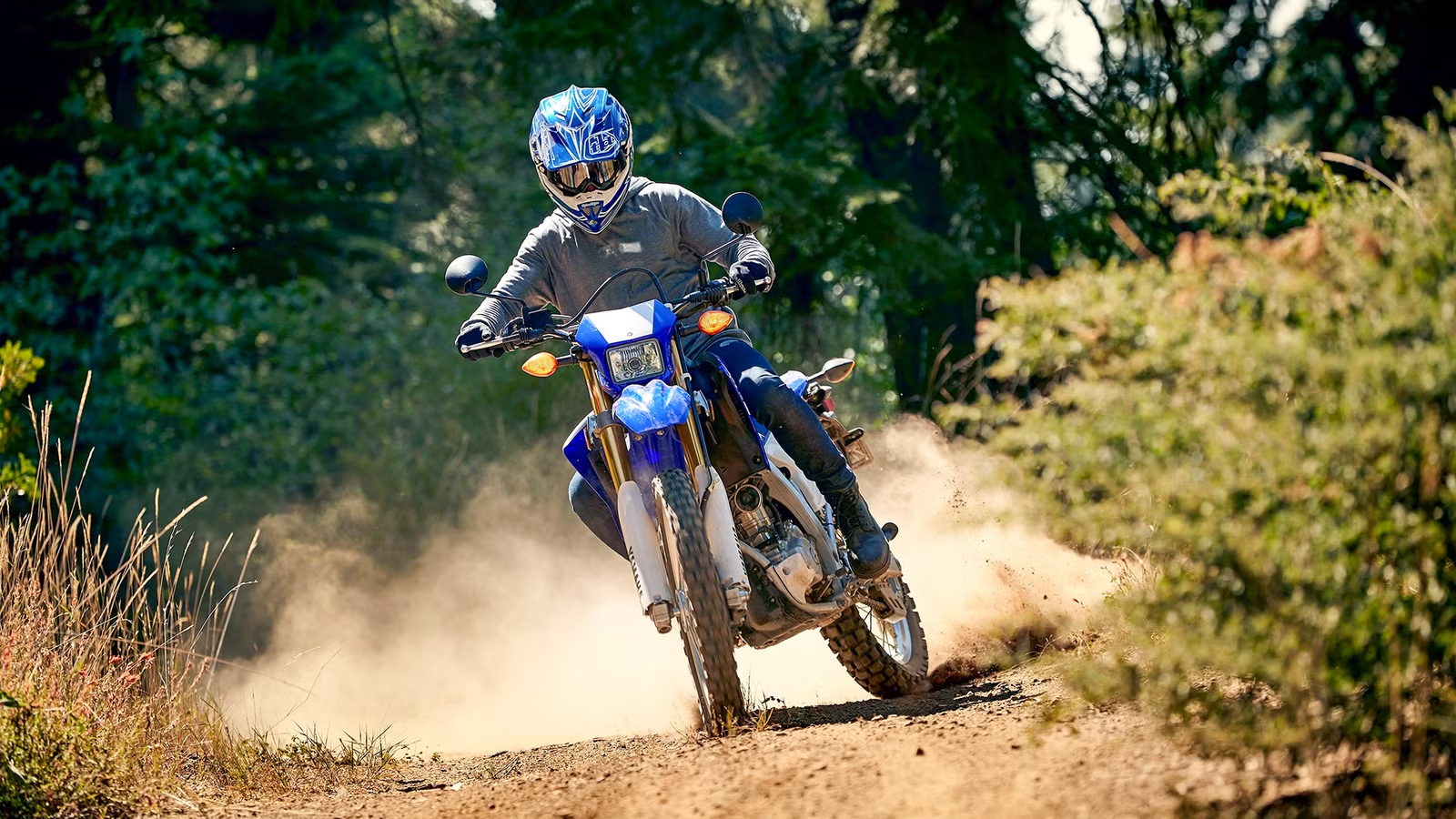
With so many fantastic motorcycles available to us these days, there are actually several that are worth keeping forever. Realistically speaking, a bike that you can keep indefinitely only needs to be mechanically reliable and fun to ride. With everyone having their own unique definition of what a “fun” bike might look like, or what kind of riding is the most rewarding, that second part is deeply subjective. But if you’re someone who wants something that can take any terrain any time of the day, a certain discontinued Yamaha dual-sport deserves your attention.

Buying a used motorcycle always has an element of risk attached, so please do your research and proceed with caution.
The Humble Dual-Sport Segment Has Changed Over The Years
Small displacement dual-sport bikes have never really been the center of attention before. They are traditionally just tools for a certain job. All the glamour was reserved for the high-end hard enduro machines with their race-bred engines. While fun, those bikes are cut from a different, more dedicated high-performance cloth. But, with so much interest in adventure riding, these entry-level dual-sport bikes have suddenly been thrust into the spotlight.


With these bikes offering the ideal starting point for budding explorers, manufacturers have been forced to either update existing platforms or bring in models from other markets. Riders are also discovering firsthand just how versatile these machines are, and have been taking them further than we ever thought possible. One of the very best dual-sport bikes actually got discontinued before this new era even began.
The Yamaha WR250R Has More To Offer Than Initially Meets The Eye
Price Range: $3,000 – $5,000

The WR250R was discontinued back in 2020 along with a couple of other legendary Yamahas in the form of the R6 sport bike and the VMax power cruiser. Those two bikes stole all the headlines, and the fact that an aging dual-sport also got axed wasn’t exactly surprising. What is rather surprising is the fact that the two Yamaha dual-sport bikes still available are both from the dark ages.
At the end of the day, the decision to discontinue the WR mostly boiled down to pricing. It was a little more expensive than the other Japanese bikes, and even though it was always worth the extra outlay, the demand didn’t justify the necessary update for global emissions compliance. It was always something of a unicorn, and for the most part, those that understood what it was would hold on to them forever. That said, some riders are willing to let them go, and now these hardy, capable dual-sport bikes are more affordable than ever on the used market.
A Reliable Single-Cylinder Engine Promises Impressive Power
Power: 30 Horsepower

At this end of the market, you certainly won’t be finding anything other than single-cylinder engines. The one employed here in the WR250R is relatively modern, though. It features liquid cooling, fuel injection and dual overhead camshafts. In this rather mild state of tune, it is pretty robust, but with these bikes it is highly likely that the previous owner has done some form of modification. While a simple slip-on exhaust might be desirable, other modifications to the engine itself could compromise reliability.
Wide Ratio Transmission

The WR you see in the name stands for Wide Ratio. This higher gearing is what makes these bikes so versatile, and increases the top speed to over 80 MPH. It is important to note the fact that while these bikes are indeed capable of doing that speed, it certainly is not advisable to maintain that speed for any duration of time. It will drain the rather small 2-gallon tank in a hurry, and the bike isn’t particularly stable at that kind of speed.
The WR250R Really Can Do It All

One of the main reasons owners hold on to these bikes is because of how effective they are off-road. Unlike the other more affordable Japanese bikes competing in this space, the WR is significantly more capable thanks to the fact that it has fully adjustable long-travel suspension. With 11.6 inches of ground clearance, it will easily clear just about any obstacle on the trail, but there is a price to pay for this level of off-road competence.
A 36.6-inch seat height means it really has the ergonomics of a top-flight dirt bike. So, for shorter folk, it is anything but accessible, even though it weighs less than 300 pounds. If you are on the taller side, this is the kind of bike that you can learn to ride and keep forever. It can handle everything from the weekday commute to out-of-town escapes.
Plus, if you are willing to get a bigger aftermarket tank, then multi-day adventures are also well within its scope. It may not be the most powerful off-road bike, but the Honda CRF300L has proven that power is not everything in the world of adventure riding. This is a little more powerful than the Honda, and significantly more capable.
Yamaha Killed Our Unicorn

Adventure and dual-sport enthusiasts have long since mused over a potential “unicorn” motorcycle that really can do it all on a budget. Most ruled out the WR in the past because it doesn’t exactly win any spec-sheet wars. It has a tall seat height and only 30 horsepower. In the real world, it proved to be far better than what any spec sheet might suggest. New riders get an approachable entry point into the world of adventure travel, yet it isn’t the kind of bike you outgrow. It is the kind of bike you keep, then pass down to the next generation of riders.
For those who discover the joy of riding off-road, this is a great trail bike. Even if you don’t particularly enjoy doing tight single track on the regular, it is still a handy second bike because of how light and fuel efficient it is. Owners never regret keeping one of these bikes around because they really can do a bit of everything. Unfortunately, most of us only realized this after the fact, and by that time Yamaha had already ruthlessly culled our unicorn.
Sources: Yamaha Global and KBB

Related posts



Latest Post


No Comments