
The Suzuki That Quietly Outlasts The Competition
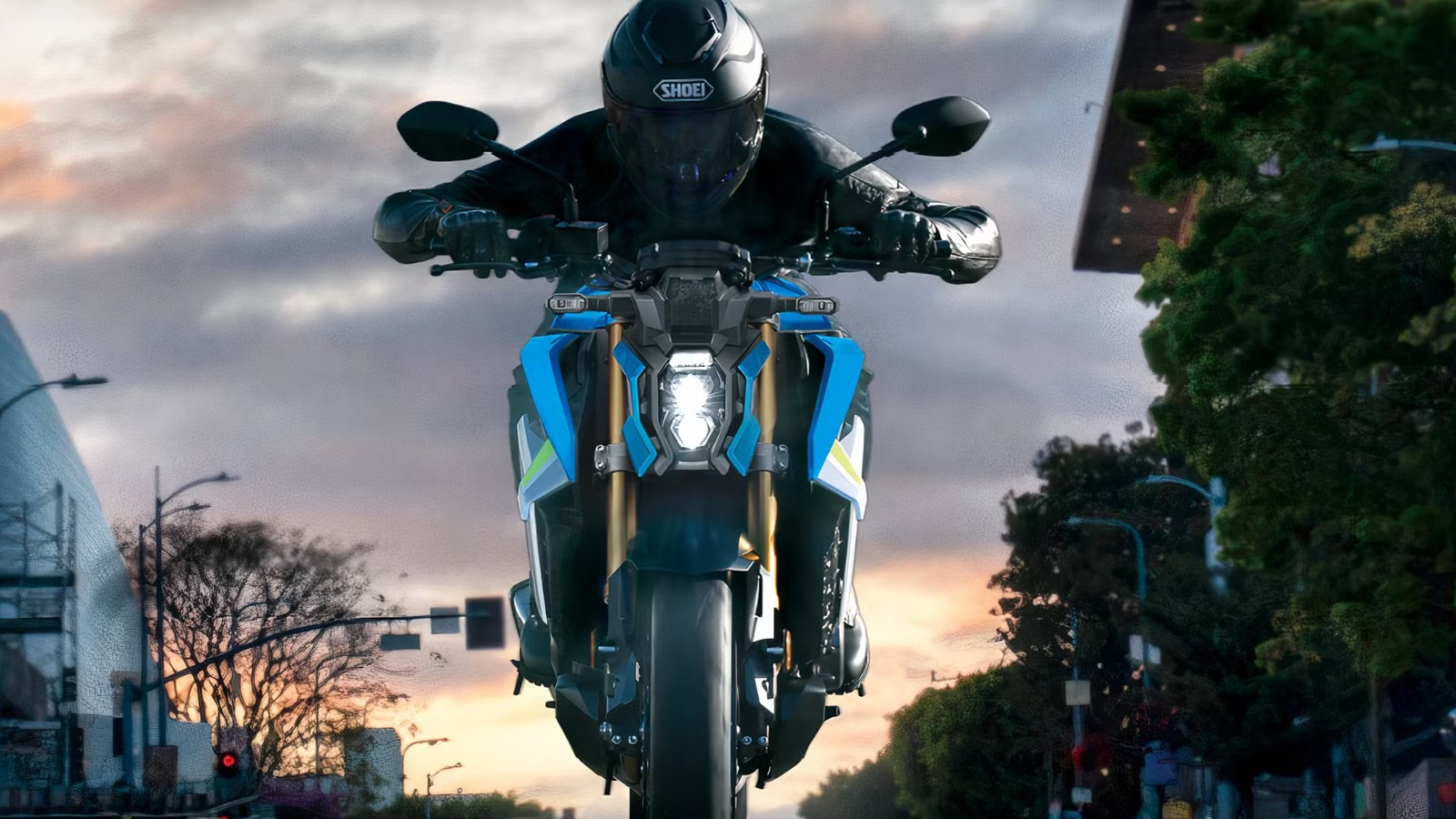
Suzuki has built a reputation for making motorcycles built to last. Constant technological change and rising engine power demands require keeping up with the trend. However, the Japanese brand has decided to rely on its proven engineering, mechanical dependability, and solid motorcycles that do not die even if the world demands it. This particular formula has helped Suzuki become one of the most enduring brands in the industry, with reliability being their badge of identity.
Suzuki Has Its Hands Full With Competition Today

Reliability as a badge can only take you so far. The motorcycling community has changed considerably, with manufacturers adapting to the audience’s needs. Both neighboring and European rivals have implemented improvements with sophisticated electronics that help the bikes deliver optimal performance, more technology that aids the rider, and other changes that improve the overall refinement.
So Outlasting The Competition Is Easier Said Than Done

While brands have introduced models that excel in different areas, being a jack of all trades is easier said than done. Buyers expect motorcycles to deliver peak performance while also offering better electronics and everyday usability. So, relying on a single attribute becomes challenging.
On the flip side, implementing them all can send the price tag soaring. It becomes crucial for Suzuki to hit the sweet spot while maintaining practicality and refinement to keep up with adapting rivals. That is where the ‘sleeper’ GSX enters. Instead of implementing everything that’s trending, Suzuki has taken a measured approach. The liter-class naked bike comes with a proven inline-four and is coupled with the fundamental packages that don’t rob your purse and outlast its rivals.

The GSX-S1000 Brings Proven Inline-Four Reliability To Outlast Rivals

The inline-four powering the GSX-S1000 is one of Suzuki’s most celebrated engines. Suzuki revived the legendary K5, which was last seen in the 2005 GSX-R1000. The K5’s reputation precedes it, with the engine widely considered by motor enthusiasts as one of the greatest superbike engines ever made. So, instead of sticking with modern short-stroke engines, Suzuki revisited the proven platform and retuned it to meet emission norms while delivering the performance of a modern streetfighter.
A Recent Price Cut Elevates Its Appeal

What makes the motorcycle even more appealing is the astonishing price tag. The 2026 model was priced at 11,990 USD, which was competitive. However, Suzuki made things even more interesting by revealing the 2027 model at a 10% lower price. You can now grab the GSX-S1000 at $10,898! This strategic move not only undercuts its fierce rival, the Honda CB1000 Hornet SP, but also cements it as the best value-for-money liter-class streetfighter on the market.
A Four-Cylinder Heart That Still Knows How To Perform

At its heart sits the legendary K5, a 999cc four-stroke inline-four engine that produces 150 horsepower at 11,000 rpm, with a 2.8-inch bore and 2.3-inch stroke. The relatively longer-stroke design produces substantial mid-range torque, delivering 78.2 pound-feet at 9,250 rpm. Moreover, this is what sets the engine apart from short-stroke rivals, which are designed to deliver peak performance higher up the rev range. Instead of becoming another ‘rev-monster’, the GSX-S1000’s engine layout makes it well-suited for real-world street riding.
This Is One Of The Most Reliable Engines In The Segment

Suzuki and reliability go hand in hand. And given its journey, the GSX-S1000’s engine is the most reliable in its segment. Although the Honda CB1000 Hornet SP shares Japanese reliability, its engine, which was heavily modernized in 2017, hasn’t been tested as thoroughly as the GSX-S1000. On the European front, the BMW S1000 R features one of the most technologically advanced creations ever. Unfortunately, that’s also its kryptonite. A minor oversight can prove extremely expensive for the German motorcycle. This means strictly following the maintenance schedule is non-negotiable.
Failure to do so causes a domino effect; lack of timely maintenance could cause component failure, which demands changing parts, which happens to be even more expensive as they are imported from Germany. The S1000 R is a technological marvel; however, it comes with a heavy price tag, both before and after purchase. Suzuki GSX-S1000 uses the 20-year-old proven engine. Meaning it has been heavily engineered over the years to withstand the harshest conditions. The latest iteration sees the K5 engine become more durable, with the implementation of hardware that helps it stand among its peers.
Everyday Usability Comes Naturally To The GSX-S1000

The GSX-S1000 is made to be a mean streetfighter. Yet, it comfortably ticks all the essentials of an everyday practical motorcycle. The tapered handlebar, coupled with a 31.9-inch seat height, provides a relatively upright riding position. It doesn’t force the rider into an aggressive position, keeping the strain off the wrist and the upper body.
But what actually makes the Suzuki stand out in usability is the 19-liter fuel tank. Not only does it defy the industry norm, but it also challenges a different class altogether. With the capacity to travel around 174 miles without refueling, it confidently categorizes itself as a tourer in streetfighter’s clothing. Furthermore, this only strengthens the statement that it is an everyday usable motorcycle.

The GSX-S1000 comes with fully adjustable 43mm KYB front forks and a fully adjustable link-type, single-shock absorber rear suspension. This helps the motorcycle stay nimble and sporty while providing a comfortable on-road experience. Stopping power comes from fully floating 310 mm dual discs and Brembo Monobloc calipers up front, plus a 240 mm rear disc with a Nissin caliper.
It Also Saves On Premium By Avoiding Premium

The Japanese approach to motorcycle features cannot get any simpler — bringing only the necessary technology. Apparently, this is what sets them apart from their European counterparts. The BMW S1000 R is literally a computer on two wheels. It features semi-active suspension, adjustable wheelie control, MSR, DBC (Dynamic Brake Control), HSC Pro (Hill Start Control), and ECALL, among many others. However, this comes at a premium of around $5,000 over the Suzuki, and the price keeps climbing with packages.

The GSX-S1000 is not technologically backward. But the bike omits the complex 6-axis Inertial Measurement Unit (IMU) complications and sticks to the basics. It has ride-by-wire throttles, improved by the updated 40mm electronic throttle bodies. The five-inch TFT display is nothing special. It also features three power modes and a five-step Suzuki Traction Control System (STCS) that helps tune the bike to your needs. The bi-directional Quick Shift System (QS), the Suzuki Easy Start System, and the Low RPM Assist System provide more control and predictability, making urban cruising fun and comfortable.
The GSX-S1000 Keeps Making Sense In The Segment

The GSX-S1000 may not have the most modern engine or the most sophisticated technology. However, that simplicity somehow makes sense. The inline-four engine comes with 20 years of experience, something none of its competitors have. This translates to reliability, and for someone planning to spend around $10,000 on a motorcycle, that matters.
When it comes to technology, the GSX is far from the best student in class. The BMW completely outclasses it in this segment, with an expensive price tag, of course. Many will complain about Suzuki being lifeless in this section; however, that simplicity is what has helped the brand enjoy longevity. A reliable engine, coupled with only the essential features that don’t overcomplicate anything, is the perfect Suzuki recipe for a streetfighter that can quietly outlast its competition.
Source: Suzuki Cycles

Related posts



Latest Post


No Comments