
Ford Fusion Sport: The AWD Sleeper Sedan You Forgot
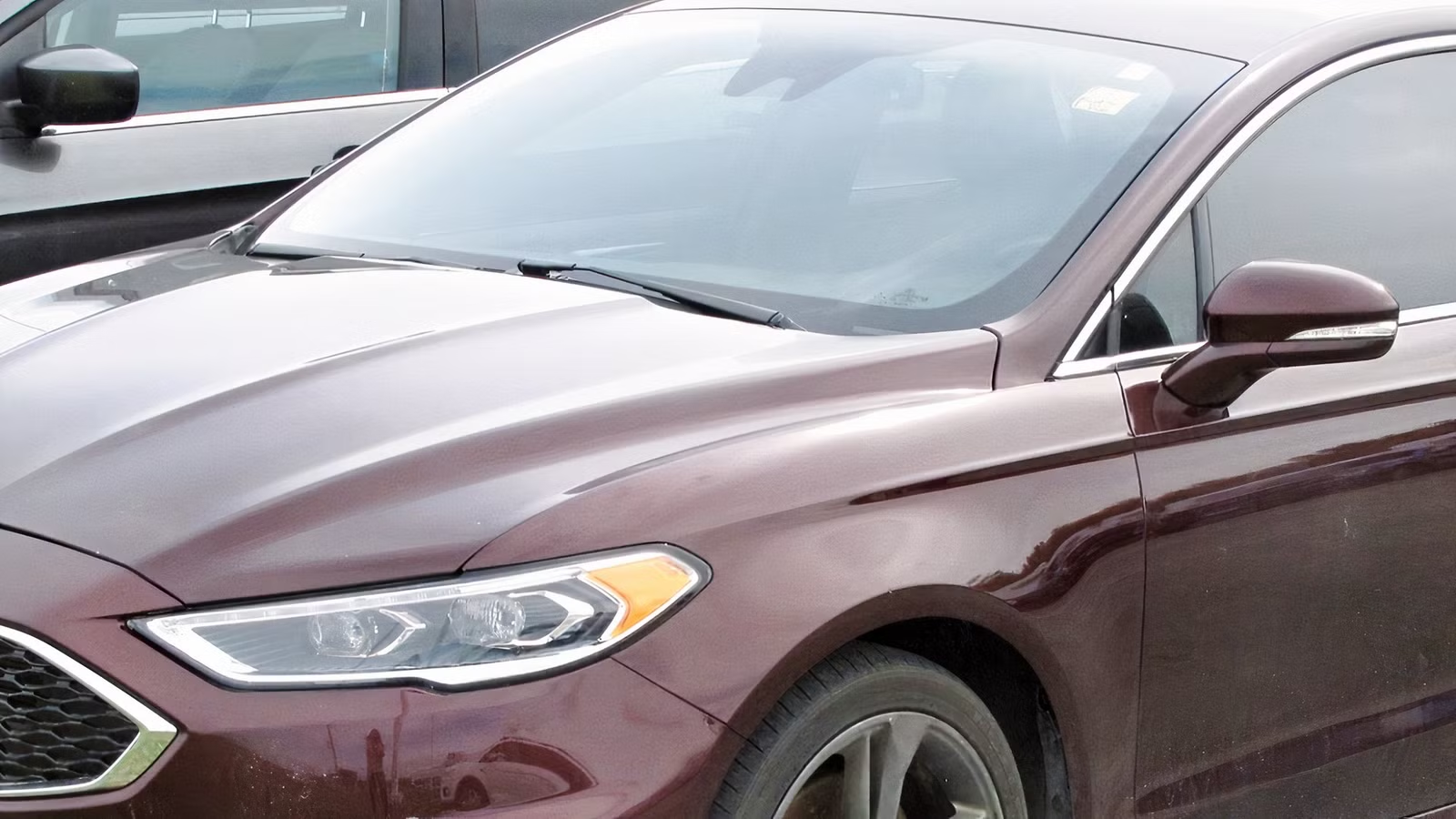
There was a brief period when Ford put serious performance hardware into cars that looked ready for the airport rental lot. One of them shared its 2.7-liter EcoBoost V6 architecture with F-150 applications, made 380 lb-ft of torque — 12 lb-ft more than a 2017 Porsche 911 Carrera S — and today averages barely half the starting price of a 2026 Honda Civic Sedan.

That makes this one of those overlooked family-car sleepers that looks stranger with age. And the engine is only the beginning.
This Plain Sedan Had 380 LB-FT And Serious Hardware
Start with the numbers, because they sound like they belong to something wearing a much more dramatic badge. The twin-turbocharged 2.7-liter V6 made 325 horsepower and 380 lb-ft of torque on 93-octane fuel, with all-wheel drive standard. A heavier-duty six-speed automatic and paddle shifters were part of the package, too.

Period instrumented testing put the sedan at 5.1 seconds from 0–60 mph despite a 4,128-pound curb weight. That’s quick enough to make the bodywork seem almost dishonest. There wasn’t a giant wing, swollen body kit, or hood scoop announcing what was underneath, just a high-gloss black mesh grille, 19-inch wheels, a small rear spoiler, and four exhaust tips. If you weren’t looking for those details, it was remarkably easy to walk right past it.
Then there was the suspension. Continuously Controlled Damping wasn’t unusual on expensive performance cars, but finding it on a mainstream Ford sedan was another matter. Its dampers could adjust every 2 milliseconds, with pothole detection designed to reduce the severity of a wheel dropping into a sharp road crater. Horsepower is easy to advertise; adaptive dampers on a car that looks like something your insurance company might loan you are exactly the kind of detail that makes forgotten performance bargains interesting.
The result wasn’t a lightweight back-road weapon. At more than two tons, it was never going to feel delicate, and the six-speed gearbox could blunt some of the engine’s urgency. But that mismatch is what made this sleeper interesting. This was an ordinary family sedan with enough torque to embarrass much more exotic machinery when the light turned green.
Its Extinct Rivals Make The Value Look Even Wilder

The used market is where this gets harder to ignore. As of September 2026, current nationwide asking-price data puts a 2017 example of our mystery sedan at about $12,688 on average, with some advertised for less. Divide that price by its 325 hp and you get roughly $39 per horsepower. Horsepower alone doesn’t tell you whether a used performance car is worth buying, but that’s a useful starting point.
Now put it against the other forgotten sleepers in this group. A 2018 Buick Regal GS averages about $16,299 with 310 hp, or roughly $53 per horsepower, while the 2017 Ford Taurus SHO sits around $22,146 with 365 hp, or about $61 per horsepower. The 2017 Volvo V60 Polestar averages about $22,399 for 362 hp, landing near $62 per horsepower. On this admittedly simple measure, the anonymous sedan is the clear value pick.

Those are asking-price averages rather than transaction prices, so mileage, condition and local inventory can move the numbers considerably. The price gap is still large enough that the comparison doesn’t hinge on a few hundred dollars either way. The Taurus SHO brings more power in a larger package, the Regal GS pairs its 310-hp V6 with AWD and a nine-speed automatic, and the Polestar is the far more exotic choice. Each gives buyers a reason to pay more.
The anonymous Ford never had that kind of status, and that’s working in its favor now. Anyone already shopping for underrated American performance under $20,000 can get serious output and AWD without paying an enthusiast-car premium. It’s not the rarest car here, the most prestigious, or the one most likely to draw a crowd at Cars and Coffee.
The Ford Fusion Sport Was Hiding In Plain Sight

The car is the 2017–2019 Ford Fusion Sport, and suddenly the rental-car disguise makes sense. The regular Fusion was everywhere, but Ford slipped a twin-turbo V6, AWD and adaptive suspension underneath the same basic shape with very little visual warning. The famous “F-150 engine” description needs some restraint: the Fusion Sport used Ford’s 2.7-liter EcoBoost V6 architecture, an engine family also found in the F-150, rather than receiving a literal pickup-engine transplant. A 2017 F-150 product sheet rates its 2.7-liter EcoBoost at 325 hp and 375 lb-ft; the Fusion Sport made the same horsepower but 380 lb-ft.
Fuel matters, too. Ford’s Fusion V6 Sport specifications state that its 325-hp and 380-lb-ft ratings were achieved on 93 octane. Ford never published a separate official output figure for 91 octane, so the familiar 325-hp number shouldn’t automatically be applied regardless of fuel.

The bigger concern for used-car shoppers is early production. Ford’s Technical Service Bulletin 19-2243 covers certain 2017 Fusion models with the 2.7- or 3.0-liter EcoBoost built from April 1, 2016, through January 1, 2017. Affected cars can suffer excessive oil consumption, rough idle, misfires, and white or blue exhaust smoke due to valve-guide problems, with cylinder-head replacement specified when the bulletin’s conditions are met.
If you’re shopping an early Fusion Sport, check the build date and service history before getting distracted by the horsepower-per-dollar bargain. That warning matters more than shaving another tenth from a 0–60 run. Like the Taurus SHO, this was Ford’s old sleeper formula at its best: ordinary body, serious hardware, very little noise about it.
Ford Quietly Buried A Dying American Sleeper Breed

Ford barely marketed the Fusion Sport, and it didn’t stay around for long. Ford still listed the V6 Sport for 2019, but its official 2020 Fusion order guide dropped the trim while the regular Fusion continued. The sleeper disappeared before the nameplate did.
It had flaws. The six-speed automatic never felt as urgent as the twin-turbo V6 deserved, and period reviews repeatedly singled out the transmission as the car’s main dynamic weakness. More than 4,000 pounds didn’t help at the pump, either: the Sport carried EPA ratings of 17 mpg city, 26 highway, and 20 combined. Fast family sedan, yes. Magic trick, no.

via autodeals.pk
Its timing mattered even more. In 2018, Ford told investors that almost 90 percent of its North American portfolio would soon consist of trucks, utilities and commercial vehicles, while investment in new generations of traditional Ford sedans would end. The Fusion Sport was caught right in that shift; the Taurus SHO was also disappearing, and Buick’s Regal GS would soon vanish with the American Regal line.
Fast family-car buyers watched the choices shrink around them. Anyone who still wanted serious pace with four doors increasingly had to pay for a premium badge, accept a performance crossover, or look somewhere else; the cheap mainstream American sleeper sedan remains a rare thing even as General Motors talks about new rear-drive passenger cars. That makes the Fusion Sport feel stranger now than it did when it was new: 325 hp, 380 lb-ft, AWD, adaptive dampers and almost no visual ego, often for roughly half the price of a new base Civic. Ford built it just as this breed was disappearing, then the Fusion Sport disappeared with it.

Related posts




Latest Post


No Comments