
The 50-Unit 1966 Dodge Dart That Beat Hemis
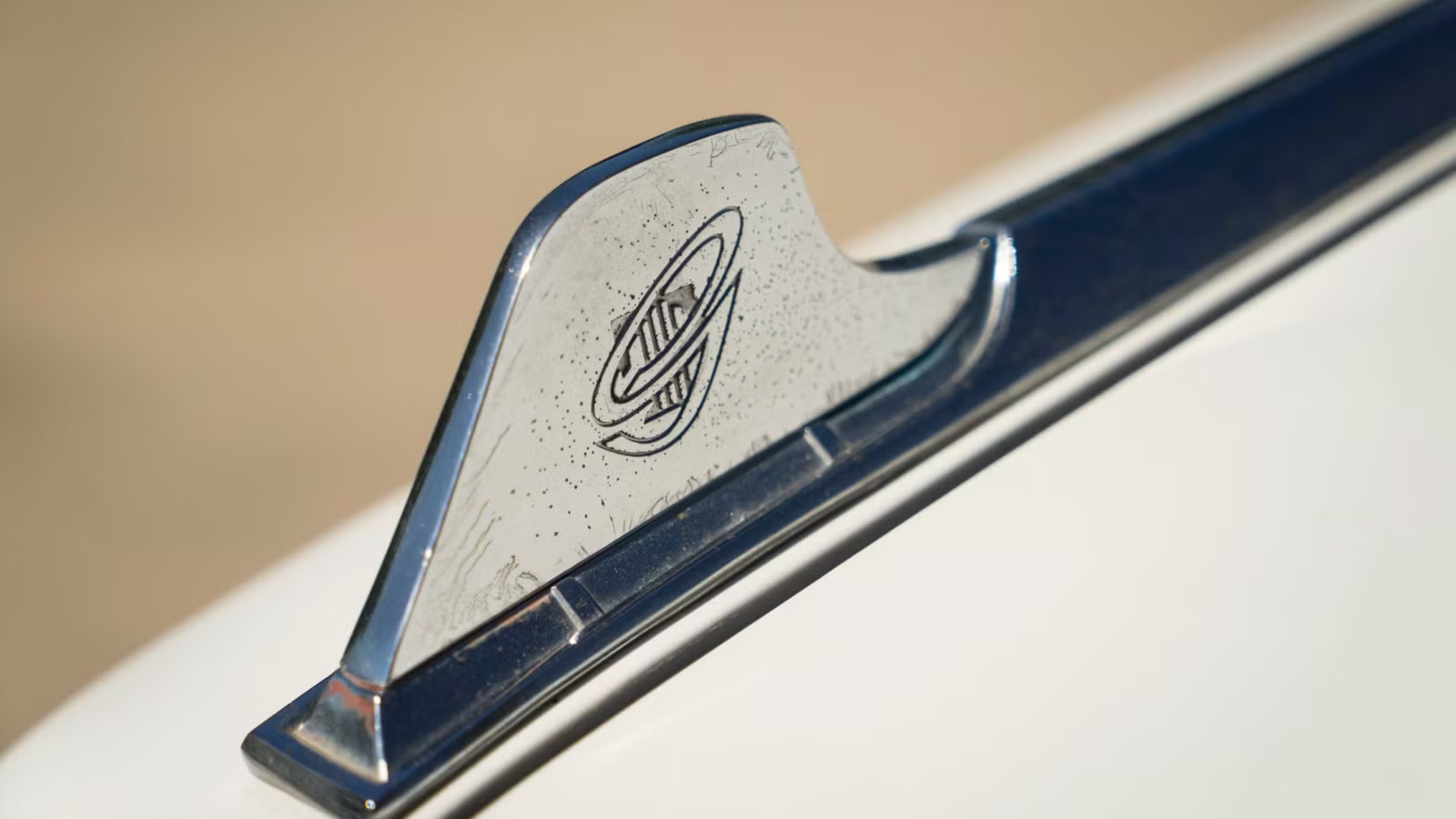
The Mopar drag racing story of 1966 usually starts and ends with displacement. But the most effective factory drag program Dodge ran that year used the smallest V8 the division sold, in the cheapest body it built, and it was never meant to out-power anything at all.

The whole car was aimed at a rulebook instead of a dyno sheet. Fifty of them left the line with no badges, no warranty, and a formula that made a 426-cubic-inch (7.0-liter) Hemi beside the point on a Sunday afternoon.
In NHRA Stock Racing, Big Engines Were A Penalty
Stock and Super Stock cars don’t get sorted by how quickly they cover a quarter-mile. NHRA slots each one into a class using a ratio of shipping weight to a horsepower factor, published in its official Stock Car Classification Guide. A heavy car with a big engine and a light car with a small one can land in the same bracket.

Each class carries an index — the time a well-built example should run — and the racing is handicapped against it. Cars in different classes never leave together; the slower one gets a head start worth the gap between indexes.
Beating a Hemi car in that system has nothing to do with running a lower elapsed time. It means beating your own index by a wider margin than the Hemi driver beats his, and a much slower car can do that.
D/Stock was the bracket that covered roughly 10.60 to 11.29 lbs per advertised horsepower in 1966, according to period racer documentation.
Tube steel headers, aftermarket flat-tappet camshafts, and carburetor swaps were all legal by 1966, along with plenty of other deviations from showroom-stock condition. A manufacturer could ship a car with speed shop parts already bolted on to classify it as stock.
Because of the regulations, horsepower became a liability in this format. Adding power without adding weight didn’t make you faster in your class; it moved you up into a harder one against bigger engines. Winning meant landing precisely inside a bracket rather than on top of a dyno chart.
Chrysler Had No Hemi To Send Racing In 1966

Chrysler built a Hemi package car every year in the mid-1960s — the A-864 cars in 1964, the A990 Coronets and Belvederes in 1965. Those A990s largely morphed into A/FX machines, and Dodge’s heritage account notes that factory involvement there ended quickly on safety grounds and because the cars no longer resembled showroom models. That pushed Chrysler toward a more production-themed Hemi package car for 1967.
That leaves 1966 as the hole in the sequence, and the car that filled it was the only Super Stock vehicle any Chrysler division produced that year. It was never going to be measured against a Hemi head-to-head, because it was built to win a bracket no Hemi could enter.

NHRA approved the 273-cubic-inch (4.5-liter), 275 hp engine and certified the 1966 Dodge Dart GT for D/Stock on March 4, 1966, four-speed only. Dick Maxwell and Dodge’s Special Performance Group designated it Super Stock Package sales code 699 the next day, and a Special Order Information Bulletin went out to dealers on March 15. Fifty cars came out of the Hamtramck plant as confirmed by Mecum Auctions.
The order sheet stacked code 699 special order, 409 special order axle, 364 Super Stock, 624 heavy-duty suspension, 554 deleted rear seat belts, 393 four-speed and 408 Sure-Grip, all in WW1 white paint over P4H red trim. Nothing on the outside marked it as anything but a Dart GT, and buyers got neither air conditioning nor a warranty.
Shipping weight came in at 2,946 lbs, and one of the fifty crossed the block at Mecum’s Harrisburg auction in July 2026.

Dodge’s high-performance 273-cubic-inch V8 made 235 hp in a regular Dart GT, and the drag package took it to 275 hp using nothing more exotic than bolt-on hot rod parts. The gap was 40 hp, and every piece that produced it could be bought over a counter. It was the rarest Dodge muscle car.
The factory release lists a Camcraft camshaft at 284 degrees with .495-inch intake and .505-inch exhaust lift, Racer Brown valve springs, a modified full-breathing intake manifold, a low-restriction air cleaner and a Weber clutch. A Holley 4160 four-barrel and a dual-point distributor came with sales code 699, feeding an A833 four-speed with a Hurst shifter.
Out back sat a heavy-duty 4.86:1 Sure-Grip 8¾-inch rear axle on 6.94 x 14 BSW tires, with free-flow exhaust headers Dodge listed as headers by Doug of California. That’s the racer’s own decal wording, not a part number.

Doug Thorley had founded Doug’s Headers in Southern California in 1958, and the Headers by Doug logo turned up on cars across multiple drag classes. Chrysler wasn’t specifying a component here so much as ordering a brand off the same shelf a privateer racer would.
Weight came off the same way the A990 Hemi cars had shed it, with no undercoating and no seam sealer on the body. Dodge kept 10-inch drums and the standard V8 Dart GT heavy-duty suspension rather than raiding the Slant Six parts bin.
Under the hood, the 275 hp engine looks stock down to its single Max Wedge air cleaner.
Dodge Needed 275 Horsepower To Land Inside D/Stock

At 2,946 lbs and 275 hp, the math comes out at 10.71 lbs per horsepower — inside the D/Stock window and sitting near its fast end.
The 275 hp figure was the number that put the car exactly where Dodge wanted it, and roughly the only rating in the range that does. Those bracket figures come from period racer documentation rather than a surviving rulebook page, but the arithmetic lines up too neatly to be accidental.

The cars waiting in D/Stock weren’t Hemis. The class record belonged to the Musser brothers of Reading, Pennsylvania and their 1961 Corvette with the dual-quad 283-cubic-inch V8, and the bracket also drew the 289-cubic-inch K-code Mustang and the 327-cubic-inch L-30 Nova. Mopar built the fifty cars to compete against Ford Mustangs and Chevy IIs, not anything out of its own showroom.
A 426 Hemi cost $907.60 as an option on a Coronet 500, roughly a third of that car’s base price. The whole drag package Dart carried a special order suggested price of $2,875 according to the dealer bulletin, which makes the Hemi’s option box alone worth about a third of an entire car.
Dodge never built this thing to out-power a Hemi. It built one that would never have to meet a Hemi on equal terms.
The Famous 14.33-Second Pass Was This Car’s Worst Run

Car Craft’s August 1966 issue ran the number that has followed this car ever since: 14.33 seconds at 94.2 mph. That pass was the car’s first, made at Lions Drag Strip in May 1966 with Charlie Allen driving and essentially no tuning done to it.
Period racer accounts put well-prepared cars in the 12.91 to 12.95 range at 105 to 106 mph during 1966, and the D/Stock record dropped to 12.78 that July. The magazine number captures a car nobody had touched yet.

A 1966 Hemi Coronet, for comparison, went 0-60 mph in 6.1 seconds and covered the quarter-mile in 14.5 seconds, with roughly 730 built. An out-of-the-box drag package Dart on its very first run was already quicker than that, which means the headline claim holds on raw elapsed time as well as on class math.
The VIN starts with LO23, where the O in second position marked a Super Stock drag car — the same prefix Dodge reused for the 1968 Hemi Dart program.
$36,300 bought one at Mecum Harrisburg on July 25, 2026. That’s less than a driver-grade Hemi Coronet, and Hagerty’s read on the sale was that the model needs history research and a story about its competition purpose to build a legend and support a stronger value.
Sources: Mecum, Hagerty, NHRA

Related posts



Latest Post


No Comments