
1962 Pontiac Catalina Super Duty Sedan: 465-HP Sleeper
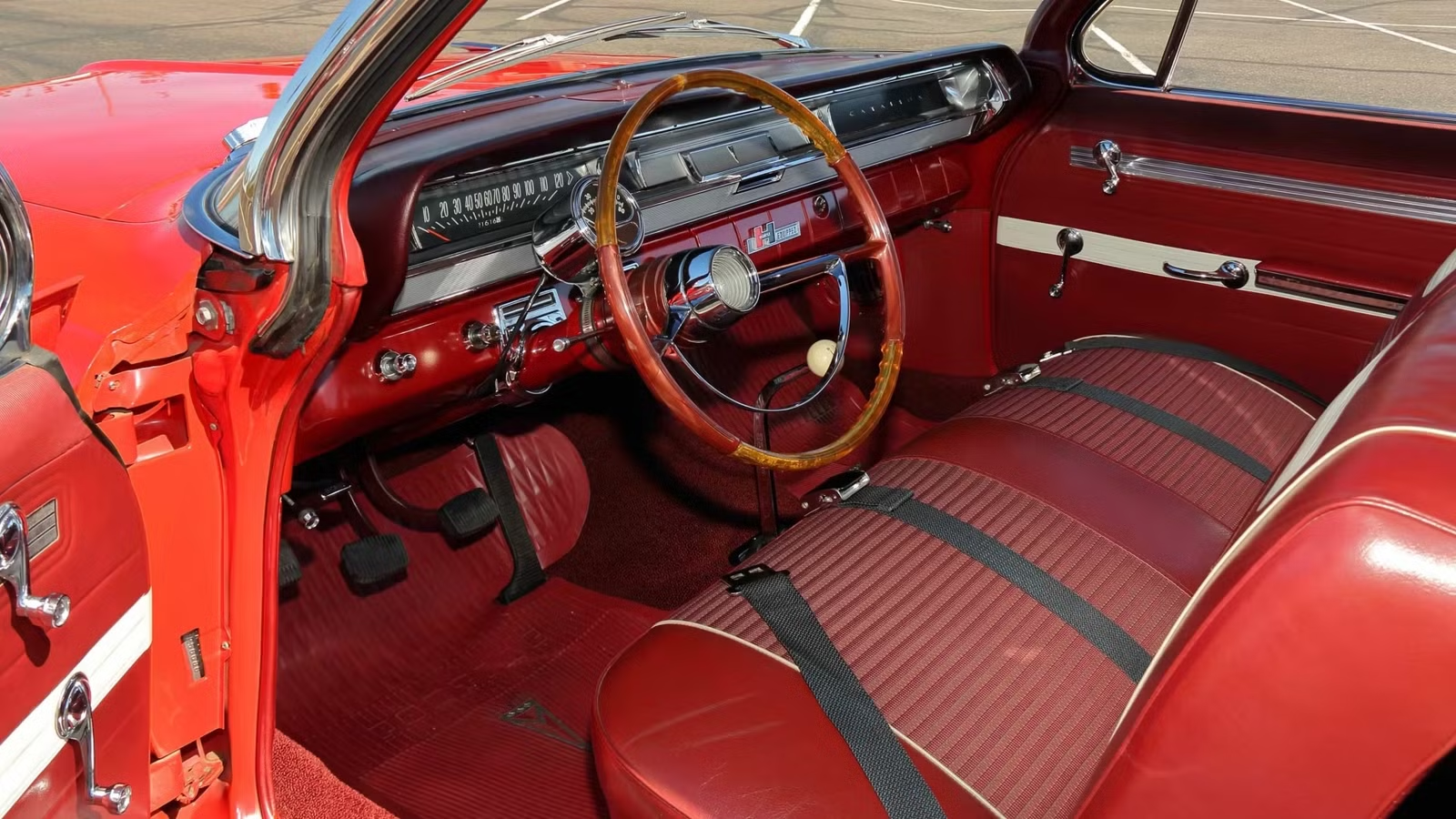
When you take a look at the golden age of the American automotive industry, there are so many cars that show up that look normal but have crazy amounts of power. Alternatively, regular cars that sold in big numbers had crazy engine options on the order forms that only a small number of people ever knew (or, more likely, dared) to tick. The car we’re going to talk about definitely fits into that category. It’s a hugely powerful sedan that only exists because of unique rules that automakers had to abide by if they wanted to enter their cars into some of America’s top motorsports championships.
American Automakers Have Ended Up Building Lots Of Homologation Specials

If you look through the history of American Sports Cars and Muscle Cars, you’ll notice that a lot of their variants were originally designed as homologation specials. That’s no accident. Several of the top racing series in America at the time had homologation regulations that required them to use cars that were similar to models you could buy in any dealership in the country. NASCAR, SCCA, and NHRA all ran series that required the use of fairly ‘stock’ cars. This included the top tier of NASCAR stock car racing that sent super powerful muscle cars around fast ovals, SCCA’s TransAm series that focused on road course racing and several ‘stock’ classes of drag racing that the NHRA sanctioned.
As a result of these rules, a lot of those homologation specials were crazy. They would be versions of regular cars with massive, high-performance engines installed. They were often produced in limited numbers, for a limited number of model years, or were secretive specs tucked away on the order forms. Sometimes, they were even dealer-produced specials that the manufacturer wasn’t even involved with at all!
Some Of The Most Legendary Homologation Specials Were Built For Drag Racing


Out of all those crazy homologation specials that got built, perhaps the craziest and most iconic are the ones that were built for drag racing. Specifically, they were built to fit under the NHRA Super Stock regulations. These rules required cars to be true to production vehicles, and have a minimum number of cars (50) produced for sale to the general public. During the Super Stock class’s peak around 1962, it was even mandated that all Super Stock components had to be factory installed. This meant that automakers had to release some crazy engine options into the wild for anyone with the money (and bravery) to choose to have fitted into their cars.
The car we’re about to discuss came about entirely as a result of this requirement in the NHRA Super Stock homologation regulations. While it’s very similar to a homologation special you already know, it’s in a body style you wouldn’t have seen coming.
The 1962 Pontiac Catalina Super Duty Sedan Is A Fire-Breathing Muscle Car That Only Exists Because Of NHRA Rules
When most people think of the 1962 Pontiac Catalina Super Duty, they’ll think of the 2-door variants. That’s understandable, as pretty much every single example you’ll ever see will have two doors. But, that wasn’t the only body style you could have the 421 cubic inch Super Duty engine in. It was actually an option on the 4-door sedan as well! While it’s difficult to find any examples of 4-door sedans that were optioned with the Super Duty engine, it definitely existed on the order form back then.
This massive engine is a real performance monster. Thanks to its race-derived internals (including a forged steel crankshaft, forged aluminum pistons, and dual Carter four-barrel carburetors), it officially produced 405 hp and 425 lb-ft of torque. That’s since been proven to be grossly under-rated. It’s been claimed that this engine produces anywhere from 450-465 horsepower and up to 505 lb-ft of torque stock. One dyno test done by an independent tuner put a more conservative figure of 413.6 hp and 500.3 lb-ft of torque. That kind of power is still impressive for a traditional sedan, let alone one made back in the early ’60s. Add that huge power to a very rear-biased weight transfer, and Catalinas equipped with the Super Duty engine were known to pop wheelies under full acceleration!
It Was A True 1960s Sleeper Car
As well as having crazy amounts of power, these 1962 Pontiac Catalina Super Duty models were true sleepers. At a single glance, they’re completely like a regular Catalina from that era. There’s no obvious badging, and no distinct visual cues. The only way you’d know that a 4-door Catalina you’d pulled up alongside had that monstrous engine was if you heard it rev. Or, if you found one that was parked, if you looked under the hood.
It Was One Of The Fastest-Accelerating Production Cars In Its Day

As you’d expect, a by-product of the monstrous power these Super Duty engines have is that Catalinas equipped with these engines were ridiculously fast for their day. When Car Life Magazine tested a 1962 Catalina Super Duty in its March 1962 issue, it named the car one of the fastest-accelerating stock production-line cars it had ever tested. It based that on a 0-60 mph time of 6 seconds and a 1/4 mile time of 14.3 seconds at 103 mph. There wasn’t enough room to run it up to its full top speed, so Car Life gave it an estimate of 135 mph.
The Super Duty Option Was Incredibly Costly

So, you really want all that performance from that gloriously massive Super Duty engine? Well, if you ticked that box on the order form back when these cars were new, it would have cost you a serious amount of money. The base price of a Pontiac Catalina sedan was $2,860 in 1962. Adding the Super Duty option cost an extra $2,250, almost doubling the price. To put into perspective how expensive this was: a Cadillac Series 62 Sedan didn’t cost that much more at $5,213. If you weren’t that fussed about performance and wanted to spend big on a new car, you could have gone for something much more plush and refined. You would have still had the charm and character of a good ’60s American V8, too.
With the Super Duty engine option being so expensive, it does go some way to explaining why so few Catalinas were ever ordered with it. It’s estimated that only 130-180 ever left the factory with this engine installed. That ensured it more than cleared the homologation regulations for the NHRA Super Stock class at the time. But, it’s made Catalinas equipped with this engine some of the rarest muscle cars in the world.
It Wasn’t The Only Pontiac Family Car That Got The Super Duty Engine During This Time

You might think that a 4-door sedan with a 421 cubic inch racing engine might be crazy enough as it is. But, it didn’t even come close to stopping there. Pontiac made the Super Duty engine available in all its B-Body cars. That included the Catalina Safari wagon. Yes, that’s right—you could order a 9-seater wagon with a big-block engine that was built for the drag strip! Obviously, it wouldn’t be as fast as a 2-door or 4-door Catalina Super Duty due to all that extra size and weight. But, it likely wouldn’t have been that far off the pace.
It’s Influenced A Whole Range Of Super-Powerful Muscle Sedans Ever Since

The 4-door version of the 1962 Pontiac Catalina Super Duty may be long forgotten, and somewhat of a footnote in America’s performance car history. But, its legacy has lived on in the more modern muscle sedans we’ve seen in recent years. Perhaps the closest car to the spirit of that is the Dodge Charger SRT Hellcat. This was the first American sedan to hit 200 mph, thanks to its 707 hp 6.2-liter supercharged Hellcat V8. While you can very clearly see that a Charger Hellcat is a Charger Hellcat, it’s still built on the same practical sedan foundations as the more regular variants.
Sources: Car Life Magazine, Curbside Classic, Hemmings, Macs Motor City Garage, Muscle Car Fan, Owego Pennysaver Press, Pontiac, SlashGear, YouTube (@JbaSpeed)

Related posts


Latest Post


No Comments