
The Cheapest New RWD V8 Car With A Manual Transmission
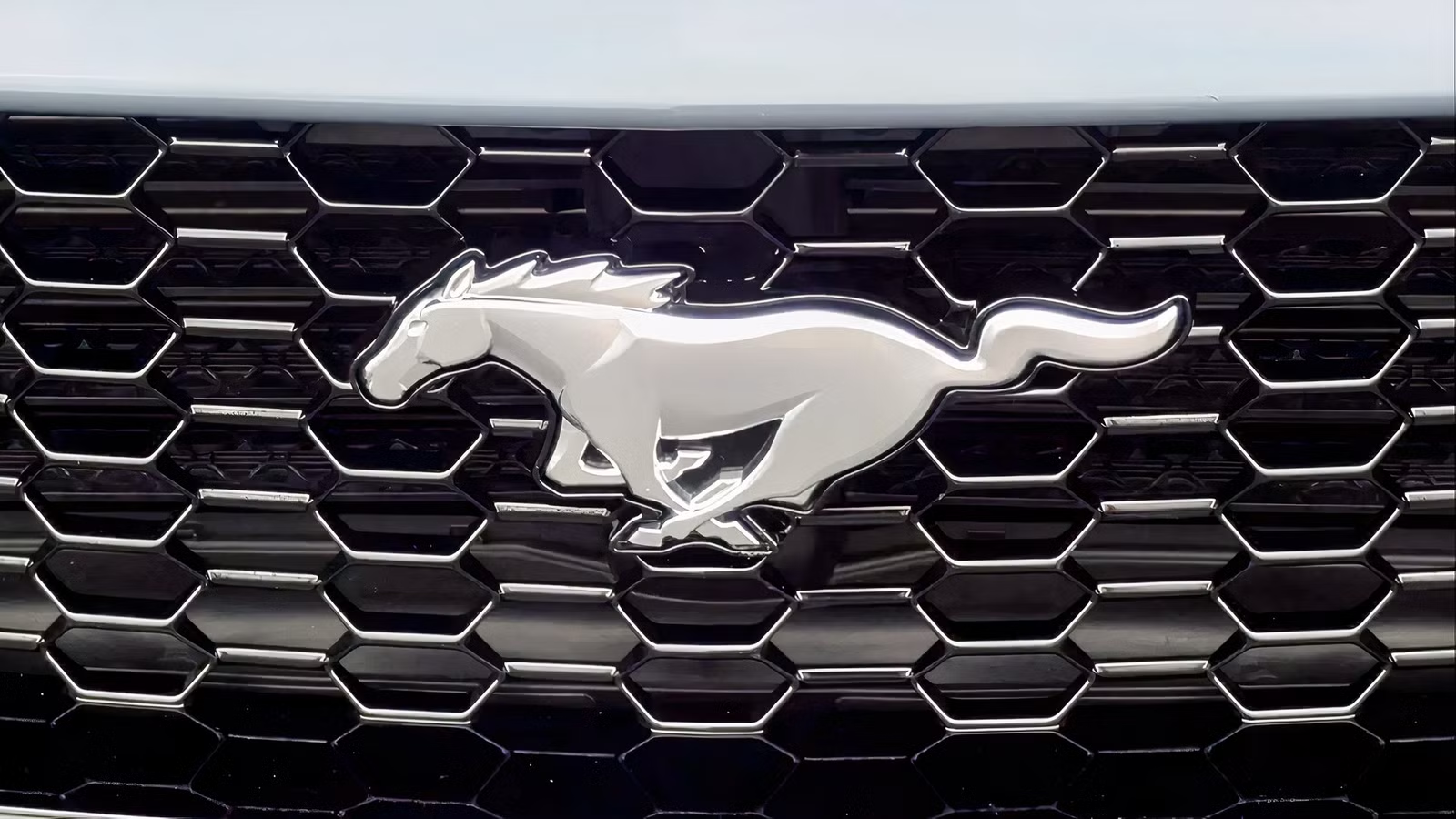
The sound of American performance has always been the roar of a V8, and historically, it has been paired with the feel of a solid manual shifter that clunks into its slot. Enthusiasts play with the clutch and gas pedal like a precision instrument. The combination of these things has been a staple of the American performance car for decades. That unlocks the hair-raising acceleration and the guttural sensation of driving something raw, almost animalistic.

But if you step into a dealership today, the picture will be quite different. The soul that defined American performance has been replaced by modern, clinical, and efficient ways of achieving maximum horsepower. The analog experience of rowing your own gears in a howling V8 is almost a thing of the past. Large screens, modern convenience tech, and track-time numbers have replaced the pure joy of enjoying a car on the streets, making it feel more sanitized.
With rising emissions and safety regulations, cars have not only become quieter but also more expensive. The rear-wheel-drive, manual V8, which was the bread and butter of the American blue-collar buyer, has turned into a luxury, with pricing even crossing the six-figure mark. But there is still one car for sale today carrying the torch from yesteryear.
Why Modern Muscle Cars Lost Their Identity

For the better part of the last decade, car manufacturers have become hyperfocused on a single metric: the numbers on a spreadsheet. In an endless battle to one-up each other, manufacturers focused more on the 0 to 60 mph times and Nürburgring lap records above everything else. Achieving these metrics meant removing human error from the equation.
Mechanical throttle cables were replaced with drive-by-wire software. Traditional hydraulic racks, which vibrated and provided tactile feedback from the road, were swapped with numb electric power steering systems. And the biggest letdown of them all, the manual transmission, which is so vital to the driving pleasure of a car, was replaced by a rapid dual-clutch automatic transmission. While the modern dual clutch shifts more quickly than any human hand could, it fundamentally changed the relationship between a driver and the car.
The driver was no longer actively driving the car, but instead instructing it on what to do with the tap of a pedal behind the wheel and asking a computer to handle the gear shift. Muscle cars, which were built on a foundation of raw, unrefined personality, became highly complex tech platforms, leaving enthusiasts longing for an era when driving actually required effort.
The Ford Mustang That Beat V8s With A Four-Cylinder And A Spoiler
This misunderstood ‘80s Mustang ditched the V8 and still punched above its weight, thanks to a turbo and some serious engineering.
The Near-Total Extinction of the Budget V8

The connection to the era of pure driving pleasure became deeply disconnected as the automotive industry entered a deep crisis in 2020. One by one, the affordable V8 platforms that enthusiasts love were discontinued. General Motors axed the iconic Camaro and, with it, its small-block V8. Dodge canceled the beloved Supercharged V8 Hemi from the Charger and Challenger lineup in favor of twin-turbo inline and electric options.
Suddenly, an entire subculture of car culture vanished. The few American V8s that remained were priced like premium European sedans or massive six-figure SUVs. Suddenly, the mechanical purity of the front-engine, rear-wheel-drive car with a manual gearbox became a luxury rather than an everyday option. And a sudden realization hit the market: if you want to buy this type of car today on a budget, there are not many options.
If you want a brand-new car off the lot today with the classic American V8 paired with a manual, only one car manufacturer is keeping the torch, with a nameplate so classic and iconic that it is ingrained in the cultural zeitgeist. The Blue Oval has an answer to the enthusiast’s question.
The S650 Mustang GT: A 480 Horsepower Pony With Three Pedals

Ford has kept the American tradition alive with the S650 Mustang and preserved the formula that started the pony car revolution 60 years ago. As it stands, the S650-generation Ford Mustang GT Fastback is the only new front-engine, rear-wheel-drive V8 with a manual transmission on the market. With a base MSRP of just under $50,000, it remains the most accessible price point for the classic American performance experience.
Under the hood of the S650 Mustang, you are greeted by the pinnacle of modern American engineering: the 4th-generation 5.0-liter Coyote engine. With a close look at the engine of this new generation, Ford has upgraded some major components. A unique dual-air intake box feeds into a dual-throttle-body design. This setup allows the massive naturally aspirated engine to breathe more freely. It belts out a ferocious 480 hp and 415 lb-ft of torque.
S650 Mustang GT Fastback Specs
|
Engine |
Transmission |
Power |
Torque |
Drivetrain |
|---|---|---|---|---|
|
5.0 L Coyote V8 |
6-Speed Manual |
480 @7,150 rpm |
415 LB-FT @4,900 rpm |
Rear-Wheel Drive (RWD) |
The best the Mustang has to offer is the Getrag MT82 6-speed manual transmission, which elevates the driving experience to another level, turning the S650 into a genuine driver’s car. And the good news for enthusiasts is that Ford made the 10-speed automatic an optional extra. That means for the S650 GT, the mechanical shifter and three pedals aren’t a premium package you have to upgrade to. It comes standard on the car.
1969 Ford Mustang Buying Guide: Mach 1, Boss 302, Boss 429, And GT500
The 1969 Ford Mustang represents the moment the Mustang reached its full potential—where design, performance, and identity aligned perfectly.
What Makes The Mustang Really Special To Drive

What makes the S650 Mustang truly magnificent to drive cannot be quantified by a dyno sheet or a spec sheet. It is the unfiltered, raw, and visceral experience you get as soon as you drop the clutch, as the naturally aspirated V8 Coyote engine screams to its redline. Unlike a modern turbo engine, the naturally aspirated Coyote engine builds power linearly and demands to be taken to its 7,250 rpm redline to extract its full potential.
The manual transmission turns even a mundane commute into an event. The S650 Mustang features an electronic auto-rev matching system to smooth out downshifts. You can turn it off and perform the perfect ballet of heel-and-toe downshifting, matching the engine’s RPMs to the gearbox by yourself.
As you drive the Mustang, you instantly notice that raw power is not the only thing the car offers, and that it is more than a one-trick pony. To handle the 480 horsepower only through the rear wheels, the S650 comes equipped with a limited-slip differential that helps route power to the rear wheels without tire slippage. For a front-engine car, the Mustang has an impressive, near-50/50 weight distribution, with 55% on the front and 45% on the rear, achieving high-speed stability and rear tire grip under acceleration.
Top 10 Fastest Mustangs Ranked
We’ve ranked the top 10 fastest Mustangs ever built, from track-focused beasts to supercharged street demons hitting over 200 mph.
The Final Victory For Pure Analog Driving Pleasure

The S650 Mustang is far more than a well-priced performance coupe; it represents a moment in automotive culture when a manufacturer prioritized the joy of analog feel over clinical efficiency. By keeping the manual V8 accessible under the $50,000 mark and giving manual enthusiasts a lasting tribute to the analog era.
Considering what it would cost to find the same type of car elsewhere, something like a European car with the same manual layout and a V8 would easily cross the six-figure mark. Decades from now, when every car will be a completely digitized, numb transport box, enthusiasts will look back at the Mustang GT and remember it wasn’t just the most affordable manual car available at the time, but also a rebellion against the sanitization of the automotive market, with its six-speed manual transmission and the roar of its mighty V8.
Source: Bring a Trailer, Ford

Related posts




Latest Post



No Comments