
This ’90s Toyota Truck Can Outlast A Land Cruiser
Few trucks earn the kind of loyalty that only comes from never letting anyone down. Decades after rolling off the line, the fifth-generation Toyota Hilux — sold in North America simply as the Toyota Pickup — is still hauling loads, crossing deserts, and racking up mileage that would retire most modern vehicles. It lacks the cult mystique of the Land Cruiser and the flashy tech of today’s off-road pickups, but this unassuming Toyota pickup truck may be one of the toughest vehicles the brand ever built. Enthusiasts and remote communities around the world swear by it — and once you understand why, the truck’s refusal to die makes perfect sense.
The Toyota Hilux Can Outlast A Land Cruiser

The Toyota Hilux has a legendary reputation that spans decades, earning its place as one of the most reliable and rugged trucks ever built. First introduced in 1968, the Hilux evolved from a simple compact utility vehicle into a global icon trusted by farmers, overlanders, and even military forces in active conflict zones. By the time the fifth generation arrived in 1988, Toyota had refined the Hilux into an exceptionally durable and practical platform. This generation, which ran through 1997, is widely regarded as the pinnacle of the Hilux nameplate. In the United States, it was sold simply as the Toyota Pickup and built in Fremont, California beginning in 1991 to sidestep the 25-percent chicken tax. Though it was replaced by the Tacoma in the U.S. in 1995, the fifth-gen Hilux remains a benchmark for toughness and longevity around the world.
Toyota Hilux Key Specs
|
Toyota Hilux |
|
|---|---|
|
Engines |
 57 autotech 1.8-liter, 2.0-liter, 2.2-liter, or 2.4-liter 4-cylinder, turbocharged 2.4-liter 4-cylinder, 3.0-liter V6, 2.2-liter or 2.4-liter 4-cylinder diesel, and 2.4-liter 4-cylinder turbodiesel |
|
Transmissions |
4-speed or 5-speed manual, 4-speed automatic |
|
Max towing |
3,500 pounds |
|
Overall length |
174.4 inches |
|
Overall width |
66.5 inches |
|
Height |
60.8 inches |
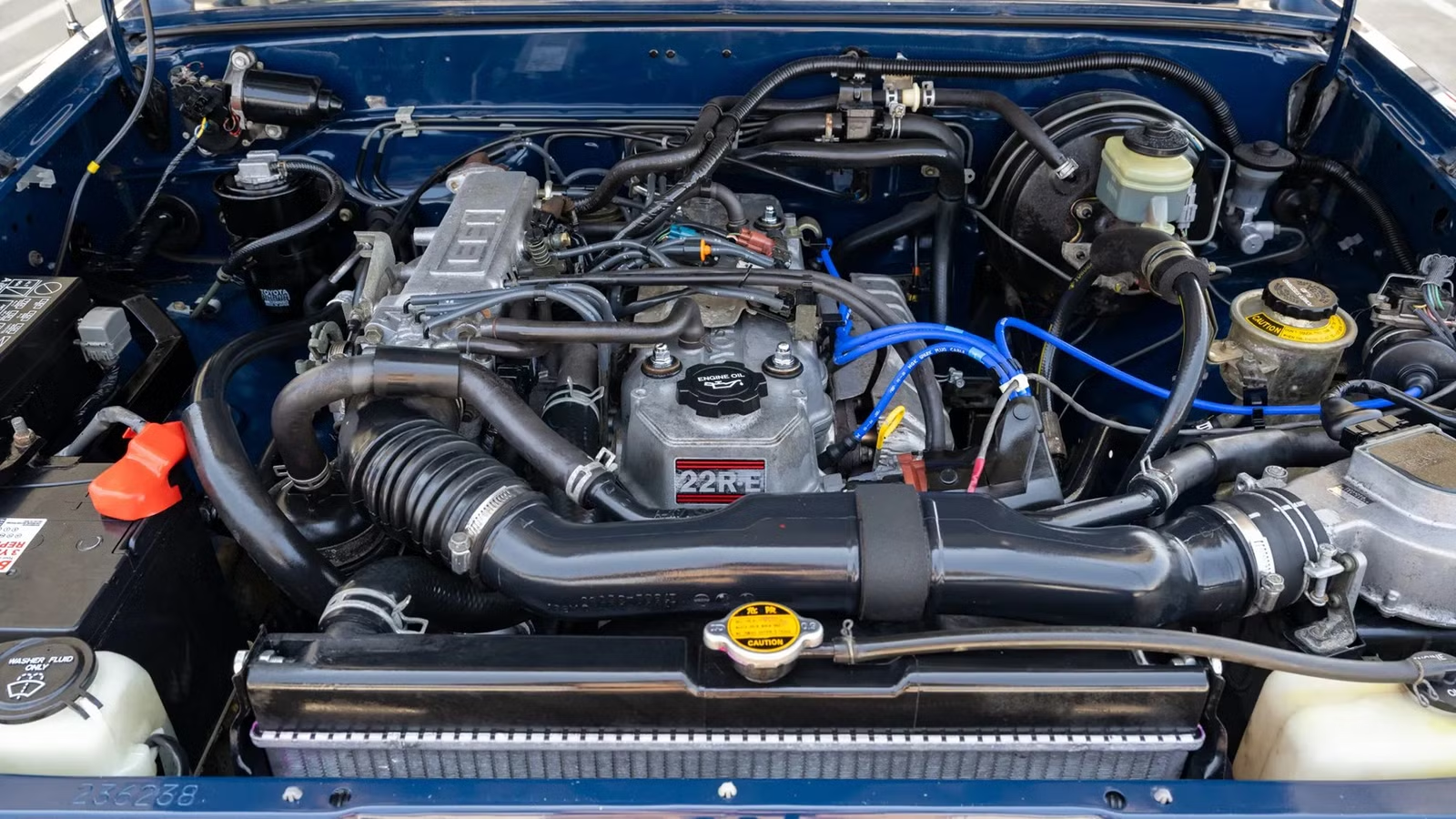
The fifth-generation Toyota Hilux was available with a range of engines across different global markets, including the 2.0-liter 3Y, the 2.4-liter 22R, and the legendary fuel-injected 2.4-liter 22RE — the most common engine found in the North American Toyota Pickup. A 3.0-liter 3VZ-E V6 producing 150 horsepower was also on the options sheet. Diesel variants were more popular globally and included the 2.4-liter 2L and 2L-T turbodiesel. In North America, the 22RE is widely considered the most reliable choice. It was the fuel-injected evolution of the carbureted 22R, bringing improved efficiency and drivability to an already proven architecture.
The Toyota Hilux’s 22RE Engine Can Last Over 300,000 Miles
The 22RE engine is one of the most iconic four-cylinder engines Toyota has ever produced, celebrated for its exceptional reliability, straightforward maintenance, and extraordinary longevity. Introduced in 1982 as the fuel-injected successor to the carbureted 22R, the 22RE became a staple in Toyota trucks and 4Runners throughout the 1980s and into the early 1990s, including the fifth-generation Hilux sold in North America as the Toyota Pickup.
Toyota 22RE Engine Specs
|
22RE inline-four cylinder |
|
|---|---|
|
Displacement |
2,366 cc (144.4 cu in) |
|
Fuel system |
Electronic Fuel Injection (EFI) |
|
Valvetrain |
SOHC, 8 valves (2 valves per cylinder) |
|
Cooling system |
Water cooled |
|
Horsepower |
105–113 hp @ 4,800 rpm |
|
Torque |
136–140 lb-ft |
The 22RE is a 2.4-liter inline-4 featuring a cast-iron block and an aluminum cylinder head — a combination well suited to durability and longevity. Early versions produced 105 horsepower and 137 lb-ft of torque, with output climbing to 113 horsepower and 140 lb-ft from the 1985 model year onward. A chain-driven timing system and robust internals make it highly resistant to catastrophic failure. Many 22RE engines are known to exceed 300,000 miles with nothing more than routine maintenance. Parts remain widely available and affordable, from complete rebuild kits to aftermarket performance upgrades. Even now, the 22RE stands as a benchmark for small-truck engine reliability.
The Toyota Pickup Was Cheaper And As—Or More—Reliable Than The 80-Series Land Cruiser
No nameplate in the automotive world carries as much weight as the Toyota Land Cruiser when the conversation turns to durability and reliability. The 80-Series model, produced from 1990 to 1997, is widely considered one of the most capable and well-rounded off-road SUVs ever built. Under the hood, the 80 Series offered a variety of bulletproof engines depending on the market, including the 4.5-liter 1FZ-FE inline-6 and several turbodiesel options such as the 1HD-T and 1HD-FT. Today, the 80 Series is beloved by overlanders and collectors for its old-school toughness, solid front and rear axles, and available locking differentials.
Toyota Land Cruiser vs. Toyota Pickup Specs Compared
|
Toyota Land Cruiser |
Toyota Pickup |
|
|---|---|---|
|
Engines |
4.0-liter inline-6 or 4.5-liter inline-6 |
2.4-liter 4-cylinder or 3.0-liter V6 |
|
Transmissions |
4-speed automatic or 5-speed manual |
4-speed automatic or 5-speed manual |
|
Overall length |
196 inches |
174.6-193.1 inches |
|
Ground clearance |
8.3 inches |
7.5 inches |
The Toyota Land Cruiser 80 Series and the Toyota Pickup are both renowned for their durability and off-road capability, but they serve different purposes and appeal to different types of enthusiasts. The Land Cruiser is a full-size SUV designed for long-distance family travel and serious off-road expeditions, offering a level of comfort and refinement the simpler Toyota Pickup simply doesn’t match. Its full-time four-wheel-drive system, coil-spring suspension, optional front and rear lockers, and available luxury touches make the 80 Series capable of traversing challenging terrain while keeping occupants comfortable. The Toyota Pickup, by contrast, is a much smaller and more utilitarian vehicle. Its 4-cylinder or diesel engine makes it exceptionally reliable and easy to maintain, though it trades interior space and creature comforts for greater efficiency and a significantly lower purchase price.
The Average Used Price For A Toyota Pickup Is Under $20,000

The fifth-generation Toyota Hilux, produced from 1989 to 1997, has become a sought-after classic thanks to its reputation for durability, reliability, and off-road capability. According to Classic.com, the average sale price for this generation sits around $20,869, with individual sales ranging from $9,700 to $41,000 depending on condition, mileage, and configuration. In the North American market, where it was sold as the Toyota Pickup, the average sale price is somewhat lower, around $16,272. Hagerty’s valuation tool places used Toyota Pickups at an average of roughly $12,000 in good condition. As with any appreciating classic, values can shift — check current listings for the most up-to-date figures.
Used Toyota Pickup/Hilux Sales
|
Model Year |
Mileage |
Price |
|---|---|---|
|
1991 Toyota Pickup |
227,000 miles |
$8,600 |
|
1992 Toyota Pickup Xtracab Deluxe |
184,000 miles |
$14,500 |
|
1989 Toyota Pickup |
78,000 miles |
$13,000 |
|
1994 Toyota Pickup DX |
124,000 miles |
$17,750 |
|
1991 Toyota Hilux SSR Double Cab |
115,000 miles |
$15,015 |
|
1991 Toyota Hilux SR Crew Cab Diesel |
73,000 miles |
$26,250 |
|
1995 Toyota Hilux SSR-X Crew Cab Turbodiesel |
129,000 miles |
$20,500 |
Source: Toyota.

Related posts

Latest Post


No Comments