
Hi-Tech Automotive: South Africa’s Licensed Shelby & GT40 Builder
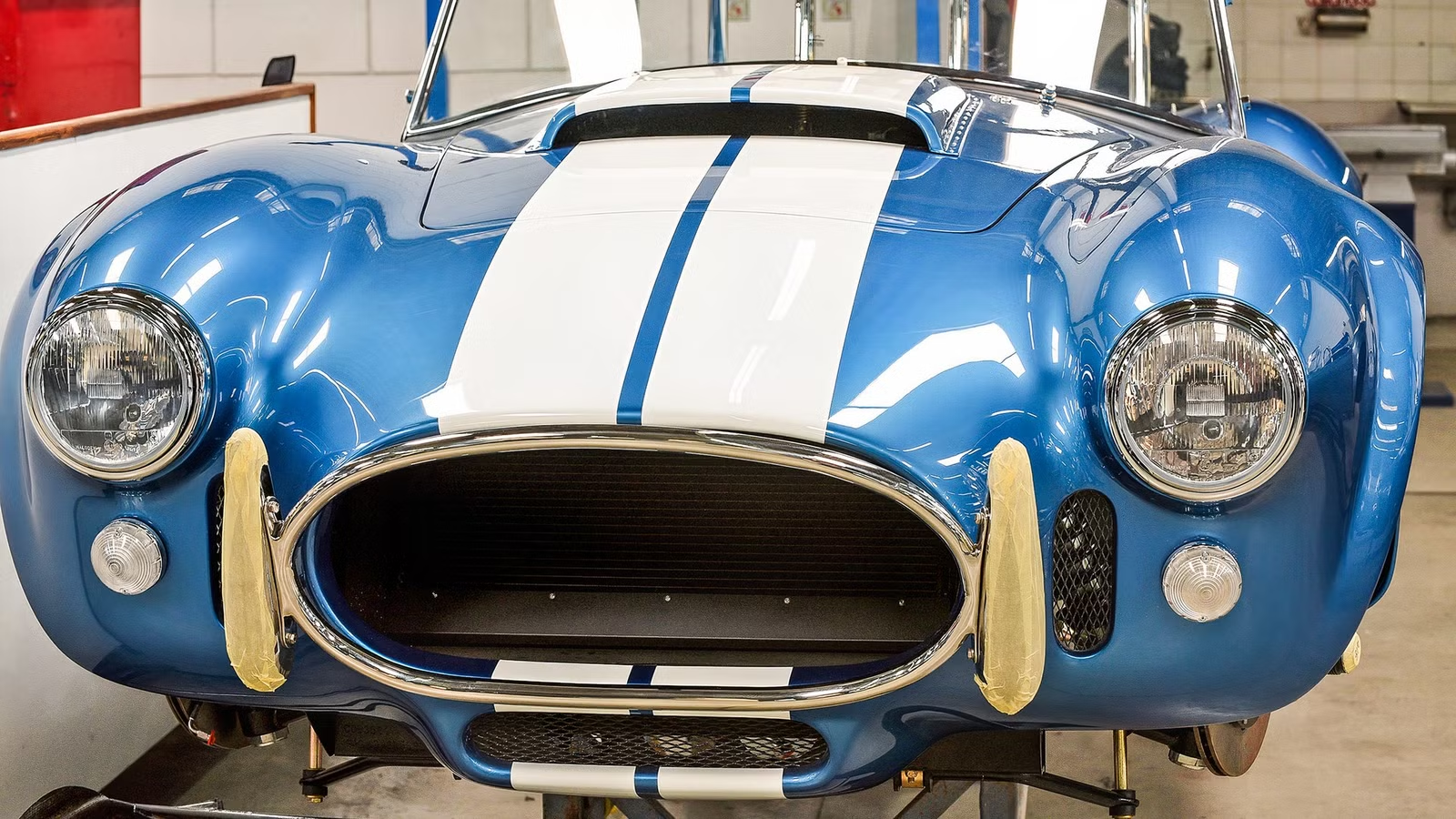
As modern cars shift to increasing levels of hybridization and electrification, there is growing demand for enthusiast cars from the past that enthrall and excite. Accordingly, it is no surprise that restomods, continuation cars, and recreations of some of the most iconic performance cars are all the rage.

A South African niche business has built a revered reputation around the world for producing fully licensed and historically accurate Shelby Cobras, Daytona Coupes, Ford GT40s, and Chevrolet Corvette Grand Sports. It recently expanded its lineup with a reproduction version of the legendary 1967 Shelby GT500.
Humble Beginnings
Hi-Tech Automotive was founded by Jim Price in 1990 as a specialist manufacturer of replica and continuation cars, although its origins date back a couple of years earlier when he helped a small business that was producing MG TD replicas get on its feet. Price had experience in construction and racing power boats, but saw the potential of the replica car business – primarily in the US.

The company was set up in Gqeberha (formerly Port Elizabeth), South Africa, which was long considered the Detroit of the country, as it’s where Ford Motor Company and General Motors first established local operations in the 1920s.
Explorer Imports Fund Cobra Project

Production of replicas or continuation cars needed funding, and Price found an unconventional solution to make money by shipping US-built cars to South Africa, the opposite of his later export-driven business model.
Ford launched the first-generation Explorer in the US in 1991, and Price saw an opportunity to bring semi-knocked down units into South Africa. He would strip the SUVs down in the US, ship them across and reassemble the cars before sending them off to selected Ford dealers for sale.
This innovative workaround attracted a 25% import duty instead of the 120% that applied on fully built-up vehicles at the time. The business didn’t make huge amounts of money, but was sufficient to fund the development of Hi-Tech Automotive’s first Cobra.
The Rolex Of Replica Cars

Hi-Tech Automotive wasn’t aiming to just be another of the rapidly growing number of replica and kit car manufacturers. “We focused on a niche. We wanted to be the Rolex as opposed to the Citizen (watch) of the replica car building business. We focus on quality and originality,” Price said.
The company started producing its first Cobras in 1994, turning out 35 hand-built units in the first year. Unlike basic kit cars, which typically had a fiberglass body mounted on a variety of second-hand chassis, suspension, and drivetrain parts sourced from used cars (often Jaguar and BMW), the Hi-Tech cars were built as completely new Cobras from the ground up, just as Shelby had done in the 1960s.
The cars were shipped from South Africa as fully assembled cars, minus the engine and gearbox, which were installed in the US by Superformance, which Price helped establish as its sales and distribution company – once again avoiding some of the legislative hurdles and added costs that would apply to a complete car. Since 2005, Superformance has been owned by Lance Stander and his Hillbank Automotive Group.
Legal Battle With Carroll Shelby And Ford

The cars that Hi-Tech Automotive produces and supplies through Superformance are all legendary machines from the 1960s, comprising the Shelby Cobra, Shelby Daytona Coupe, Ford GT40 and Chevrolet Corvette Grand Sports. And they’re all manufactured under license – but this wasn’t always the case.
In 2000, Superformance was sued by Carroll Shelby, Carroll Shelby Licensing and Shelby American for trademark, trade-dress and counterfeiting violations, with Ford subsequently joining the litigation. By 2004, the parties reached a global settlement, and Price used this opportunity to turn the whole legal battle into a contract to build licensed replica cars as an official partner of Shelby American. This was only possible due to Shelby accepting that the Hi-Tech-built cars were manufactured to the high standards, quality, and authenticity of the original cars. Accordingly, every Cobra and Daytona Coupe it produces is listed in the official Shelby registry with CSX serial numbers alongside the 1960s originals.

The same applies to the lesser-known Chevrolet Corvette Grand Sport, which is built under license from General Motors. It is based on the five original C2 lightweight cars that were covertly produced by a small team of GM engineers in 1963 to take on the Shelby Cobra and Ferrari 250 GTO. GM canceled the program after only five cars were built, as it had officially withdrawn from factory-supported motorsport.
Ford’s GT40 Trademark Oversight

In the case of the GT40, the trademark and licensing rights for this iconic car are owned by Safir GT40 Spares, rather than Ford, as the auto giant bizarrely hadn’t secured the GT40 name, despite its dominant wins at the 24 Hours of Le Mans from 1966 and 1969, and the resulting global fame. In 1985, British specialist Safir Engineering began producing a limited run of continuation cars, called the GT40 Mk V, and claimed the rights to “GT40”.
The trademark, tooling, drawings and related assets were sold to Safir GT40 Spares in the US in 1999. This unusual scenario also impacted the naming of Ford’s revived supercar in 2005, which it intended to call the GT40 – but a legal and financial stalemate with Safir GT40 Spares led to the car simply being named the Ford GT.
The cars built by Hi-Tech and sold by Superformance are the only factory-built GT40s recognized as true continuations since Ford’s production ended in 1969. Each car is issued with a genuine continuation P-series chassis number and Certificate of Authenticity, and listed on the GT40 registry.
The Hollywood Link – Ford v Ferrari

When Hollywood needed convincing 1960s Fords and Shelbys for the 2019 film, Ford v Ferrari, it turned to Superformance – and ultimately to the company’s South African manufacturing partner, Hi-Tech Automotive. The South African factory produced the film’s key GT40s, Shelby Cobras and Daytona Coupes, including the GT40 used as Ken Miles’ hero car.
Multiple examples of the cars were required because the production needed vehicles for close-ups, static scenes, driving and high-speed racing. In all, between 10 and 15 Hi-Tech-built cars were used in the film.

Hi-Tech Automotive has manufactured numerous other cars over the years, including the outstanding Noble M12 and M400 British sports cars which were sold from 2000-2008. It also developed and built the striking Zagato-designed Perana Z-One – a project that was scuppered by the 2008 financial crisis. Rebadged as the AC 378 GT Zagato in 2012, it unfortunately never got off the ground.
Jim Price and his sons Justin and Nick are keeping Hi-Tech’s proud legacy alive. One of the Price family’s latest projects has been the Shelby GT500, which is based on the revered 1967 Mustang muscle car legend, and sanctioned by Carroll Shelby Licensing. It is produced in South Africa and sold in the US through a joint venture with Tom Kirkham, called Hi-Tech Legends LLC.
Hi-Tech Legends classifies its Shelby GT500 as a ‘repromod’, not a restomod, as it’s a brand-new, ground-up interpretation of the 1967 car. The all-steel body is newly manufactured, the chassis is reinforced, and the suspension, brakes, steering, and electrical systems are completely modernized.

As with the other cars it builds, the GT500 is shipped to the US without the engine or gearbox. Customers have the option of fitting Ford’s Gen 3 Coyote 5.0-liter naturally aspirated V8 with a Tremec six-speed manual or 10-speed automatic, or the wild supercharged 5.2-liter V8 combined with the Tremec manual.
Hand-Built To Perfection

Superformance (and, by implication, Hi-Tech Automotive) launched in the US in the early 1990s with a bold advertising campaign: “Don’t buy a kit. Buy a Cobra”. The advert ran in most of the major US magazines, distinguishing its hand-built genuine recreation cars from cheap kit cars.
To date, Hi-Tech Automotive has produced in the region of 7,000 cars at its 200,000-square-foot facility, which employs around 300 skilled artisans that produce most of the components in-house for each of the car builds. A Shelby Cobra, Daytona Coupe, GT40 or Corvette Grand Sport can take up to 2,000 hours to complete, with each car built to the customer’s specification. This is not simply a matter of buying a fiberglass body that looks vaguely like one of these era-defining cars and bolting it onto whatever chassis happens to be available.
The goal is considerably more ambitious: to faithfully reproduce the experience, appearance and engineering character of the originals using modern manufacturing techniques and brand-new components. It’s the ultimate blend of historic motorsport heritage with contemporary engineering and craftsmanship.
Sources: Hi-Tech Automotive, Superformance, Safir GT40 Spares, High-Tech Legends, HeraldLIVE, Motor Mouth

Related posts


Latest Post


No Comments