
How The Sonata N Line Embarrasses A Loaded Accord Sport
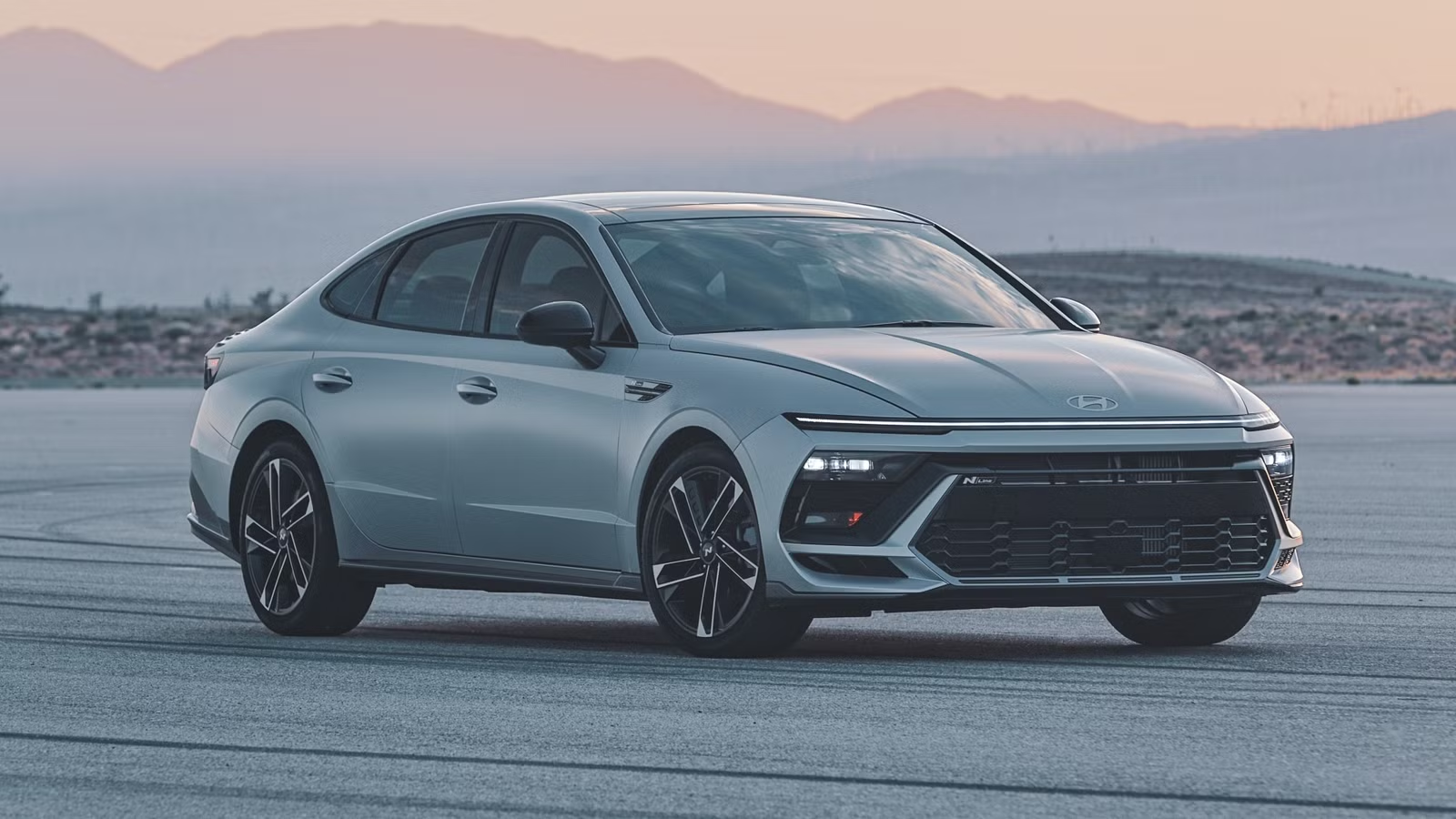
Sedan shoppers walk into showrooms with a script already written. Honda Accord for reliability, Toyota Camry for resale, and whatever’s left over for people who care about how a car actually drives. Hyundai just handed that script back. Under the N Line’s hood sits a 290-horsepower turbocharged engine mated to an eight-speed wet dual-clutch transmission, hardware that has no equivalent anywhere in Honda’s lineup. The Accord Sport counters with a refined hybrid system built for efficiency, not urgency. One of these cars was engineered to be quick. The other was engineered to be smart about gas. Only one wins at the stoplight.
The Mainstream Sedan Market Has Become Too Comfortable With Safe, Sensible Choices

Midsize sedans used to have a pulse. Somewhere between the Camry becoming a hybrid-first appliance and every automaker chasing fuel economy numbers over feel, mainstream started meaning inoffensive. The Accord has ridden that wave about as well as anyone, refining its hybrid powertrain into something genuinely excellent at what it does: sipping fuel, moving quietly, disappearing into a commute. What it hasn’t done lately is give anyone a reason to grip the wheel a little tighter. That’s the gap the Sonata N Line is walking straight into, and it’s brought a 290-horsepower engine and a dual-clutch transmission to make its case.
Hyundai’s 290-HP Sonata N Line Brings Turbo Power And A Wet DCT To The Fight

The 2026 Hyundai Sonata N Line’s 2.5-liter turbocharged four makes 290 horsepower at 5,800 rpm and 311 pound-feet of torque from just 1,650 rpm, sent through an eight-speed wet dual-clutch transmission with paddle shifters. That’s a meaningfully different animal than the naturally aspirated engines powering the rest of the Sonata lineup, and it’s a genuinely quick car for the segment, with independent testing putting the 0-60 mph run around 5.3 seconds.

The Honda Accord Sport, for comparison, isn’t running a turbo four and a conventional automatic anymore. Honda’s current Accord Sport is built around a 2.0-liter engine paired with an electric motor, producing a combined 204 horsepower through a two-motor e-CVT. It’s the same hybrid system that makes the rest of the Accord lineup so efficient, just wearing sportier wheels and firmer suspension tuning.

That’s an important distinction, because it means this isn’t a turbo-versus-turbo fight. It’s a dual-clutch gearbox built for quick, decisive shifts against a continuously variable hybrid transmission built for smoothness and efficiency. Two very different philosophies, and only one of them is chasing a driving-enthusiast audience.
The Sonata’s Acceleration And Cornering Expose The Accord Sport’s Hybrid Trade-Offs

An 86-horsepower gap doesn’t sound enormous on paper, but it’s the difference between a car that merely moves briskly and one that actually shoves you into the seat. The N Line’s turbo four builds boost early and holds it, and the wet DCT snaps off shifts with none of the rubber-band elasticity that CVTs are known for. Get on the throttle hard, and the transmission simply hunts for the next gear, rather than letting engine speed flare while the car figures out how to translate that into forward motion.
The Accord Sport’s e-CVT handles that translation differently by design. Under hard acceleration, Honda’s hybrid system lets engine rpm rise and hold while the electric motor does most of the initial work, which produces smooth, linear thrust but not the layered, building sensation of a turbo car reaching for redline. It’s an entirely appropriate setup for a hybrid focused on efficiency and refinement, but it’s not built to feel exciting, and it doesn’t.

Cornering tells a similar story. The N Line’s sport-tuned suspension and 19-inch wheels give it noticeably firmer body control, less lean transitioning into a corner, and steering that loads up with more feedback the harder you push. The Accord Sport is tuned firmer than a standard Accord Hybrid, and it’s still a genuinely composed car by mainstream-sedan standards, but “sport” here means slightly sharper reflexes on top of a chassis still built primarily around comfort and low rolling resistance. The Sonata N Line was clearly engineered with a specific driving-enjoyment target in mind. The Accord Sport’s sportiness reads more like an option box than a mission statement.
A More Exciting Drive Meets A Surprisingly Upscale Cabin, Better Tech, And A Real Price Advantage

The N Line’s cabin doesn’t feel like an afterthought bolted onto a performance package, either. Microfiber-wrapped sport seats with real side bolstering, a 12.3-inch digital gauge cluster paired with a 12.3-inch touchscreen, and trim details that lean more upscale than the badge might suggest all work together to make the interior feel like it belongs with the powertrain. It’s not a Genesis cabin, but no excuses need to be made for it, either.
Tech is where both cars are genuinely strong, and it’s closer to a wash than a win for either side. Both come standard with wireless Apple CarPlay and Android Auto, and both pair large digital displays with responsive touchscreens. Honda’s infotainment layout leans slightly more intuitive in day-to-day menu navigation, while Hyundai’s setup edges it on sheer screen real estate and configurability. Neither buyer is walking away feeling shortchanged on tech.

Where the case gets genuinely lopsided is price. The Sonata N Line starts right around $35,900, and that figure already includes the turbo engine, the DCT, the sport suspension, and the upgraded cabin. A comparably equipped Accord Hybrid Sport-L—the trim that actually matches the N Line’s equipment level with leather-appointed seating and the fuller tech suite—lands in the $35,000 to $36,000 range before any dealer markup, and that’s for a car making 86 fewer horsepower with none of the performance hardware. Dollar for dollar, the N Line simply delivers more car at a comparable, and often lower, out-the-door price.
Honda Still Has The Long-Term Reliability Argument, But Driver-Focused Buyers Have A Tougher Choice

For a buyer who actually cares about acceleration, transmission feel, and how a car behaves when the road gets interesting, the Sonata N Line is the better sedan. It’s quicker, it corners with more confidence, its cabin doesn’t feel like a compromise, and it costs less than a comparably equipped Accord Sport-L while offering substantially more performance. If the driving experience is the deciding factor, this isn’t a particularly close call.
Where Honda still has a legitimate argument is durability, and it’s worth being honest about what that argument is and isn’t. Consumer Reports’ owner surveys have rated several recent Sonata model years, including ones built around the 2.5-liter turbo engine, as less reliable than other vehicles from the same model year, and Hyundai issued a recall covering 2021–2022 Santa Fe and Sonata models with 2.5-liter turbo engines over a fuel line connection that could leak.

That’s not proof the current N Line will have problems, and dual-clutch transmissions in particular have improved significantly across the industry in recent years. But it’s a documented pattern worth weighing, not just enthusiast forum noise, and it stands in contrast to Honda’s hybrid system, which has built a long track record for durability across the Accord and Civic lineups.
So the decision comes down to what a buyer is actually optimizing for. Someone who wants the most engaging, quickest, best-equipped sedan for the money and is comfortable with a powertrain that hasn’t built the same multi-decade reputation as Honda’s hybrid system should be shopping the Sonata N Line. Someone who wants the most predictable long-term ownership experience and values Honda’s proven durability over outright performance should stick with the Accord. What’s no longer true is the assumption that the Accord automatically wins on merit alone. The Sonata N Line has made this a real fight.
Sources: Hyundai U.S., Motortrend, Kelley Blue Book, Consumer Reports

Related posts

Latest Post


No Comments