
The Peraves EcoMobile Is Part Bike, Part Plane, Part Car, All Insanity
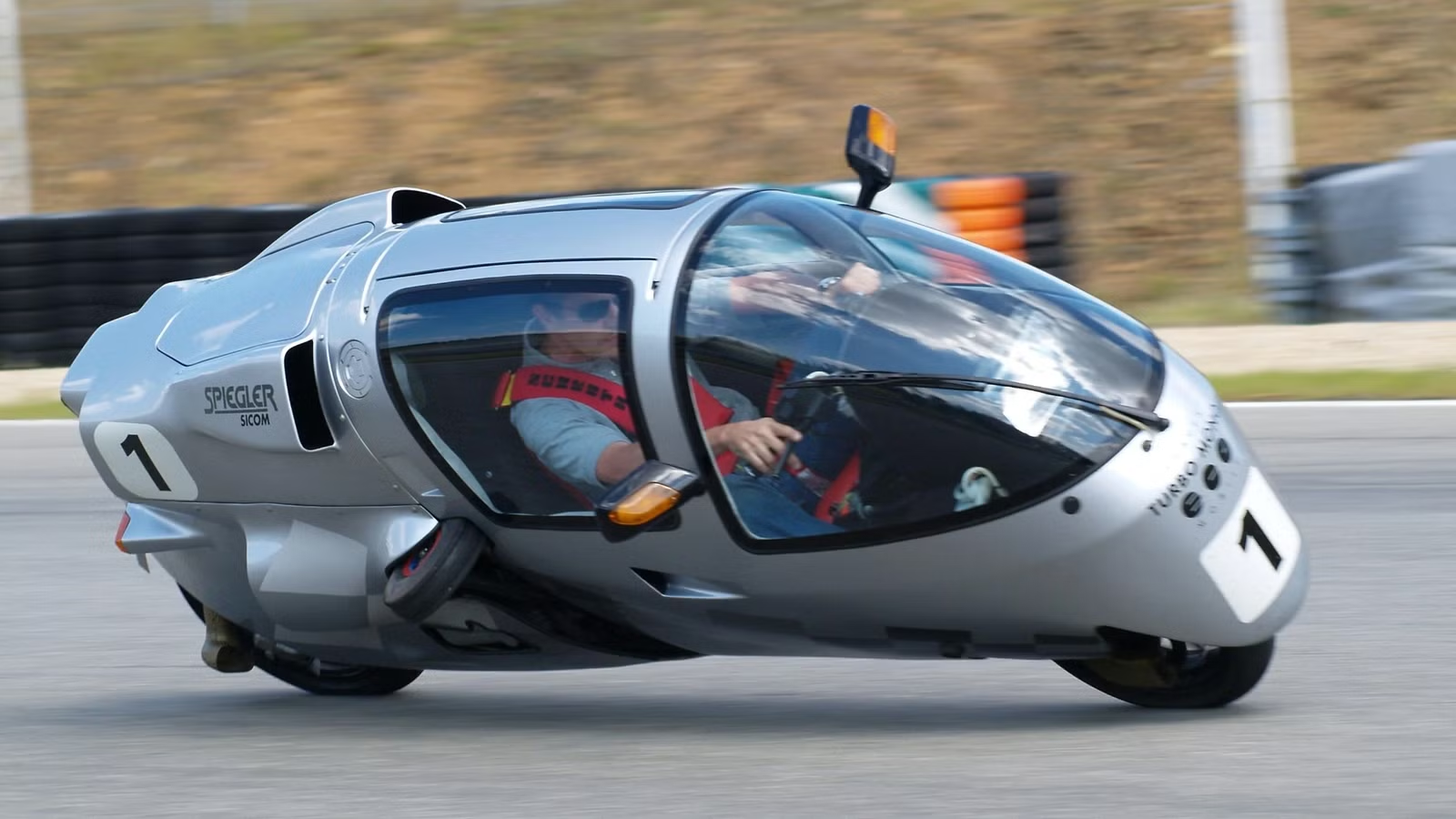
Some vehicles are designed to look futuristic. Some look that way by accident. Some get that way because they took a completely different route to solve a problem. And in the 1980s, designers were increasingly going for a mixture of the three. A new focus on aerodynamics, efficiency, and new technology meant that designs were starting to look increasingly alien, and there was one Swiss bike that mixed the best of multiple worlds to create something truly otherworldly.
When The Future Of Transportation Looked Like Science Fiction

The future of personal transportation seemed wide open in the 1980s. Marty McFly was driving a DeLorean DMC-12 in Back to the Future, while the car market saw an influx of wedge-shaped vehicles focused on aerodynamics, and bikes like the Suzuki Katana tried to usher in a new age of futuristic design. It was an exciting time, as manufacturers and designers seemingly threw out the old rulebook and tried to find new ways of making capable vehicles that also carried the optimism of the future.
This was also helped by the rise of new, lightweight materials, smaller engines, turbocharging, and computer-aided design. These are all things that we know and appreciate today, but that’s not to say everything started off well. Things like the 1986 Buick Riviera’s touchscreen, which used an infrared grid over a CRT display and was roundly hated, or the 1981 Datsun 810 Maxima’s voice warning system, which spoke to drivers via a phonograph that could get stuck on and irritate the hell out of them, were hints of what would later become the norm. But while these technologies were still facing their teething problems, aerodynamics had already proven itself effective.
The Quest For Smarter, More Efficient Transportation


At the same time as designs were evolving, so was the attitude towards power. Engineers were beginning to realize that a bigger engine wasn’t necessarily the best way to improve a vehicle’s performance, and that every part of a car or bike’s design could be just as important as the number of cylinders it had. The typical box-on-box car designs started to give way to wedges, smaller frontal areas and smoother surfaces, while motorcycle designers began taking aim at the air itself. The BMW K1 was one such example.
Designed in a wind tunnel and looking every bit the futuristic bike from the future that it was, the K1 featured an all-over fairing and enclosed wheels that made it exceptionally low-drag and able to slice through the air with remarkable ease. But while the K1 was one of the most aerodynamic bikes of its time, there was one that took the idea even further.
Meet The Peraves EcoMobile: The Motorcycle That Looks Like A Tiny Jet

At first glance, the 1984 Peraves EcoMobile looks more like something that escaped a plane manufacturing plant than something on a motorcycle showroom. The long, enclosed body, pointed nose, cockpit-like canopy, and smooth sides all give it a distinctly aeronautical appearance rather than automotive. It even appears to have what could be the start of wings down its flanks. But beneath this strange exterior is a two-wheeled machine (well, technically four, but we’ll get to that), a BMW engine, and some fascinating ideas.
The EcoMobile was developed in Switzerland, and is based around a tandem seating arrangement. Like a traditional motorcycle, the passenger sat behind the rider/driver, who was at the front of the vehicle and piloted the thing with motorcycle-style handlebars. It was also powered by a BMW motorcycle engine — a BMW R 100 boxer engine, to be precise. The 987 cc powerplant provided 90 HP and was capable of 150 MPH. All fairly standard. But unlike a motorcycle, this all took place inside an entirely sealed cabin.
This cabin gave it two benefits; the first being protection. Riders were shielded from the wind, rain, mud, and other detritus that a normal biker would be pelted with while on the road, as well as any other cars that might not have seen the bike riding by. The other, and arguably more important, benefit is the aerodynamic improvement. Because as weird as the design may have looked, it did have engineering merit.

Almost every surface on the EcoMobile was designed with airflow in mind. The silhouette was free of any sharp edges, severe angles, or unnecessary protrusions, hiding its mechanicals entirely underneath the exterior in one of the clearest cases of function over form. But with the riders entirely encased and no way to balance the bike when it came to a stop — not even two foot holes to Flintstone it – riders needed a way to stop falling over. Enter the two external wheels.
While the EcoMobile acted like a normal motorcycle while it was moving, including leaning into corners and being safe for a reported 52 degrees, there was a button for the rider to deploy the external wheels. This could only be done at lower speeds (reports vary, but it’s around 10-15 MPH) but, when pressed, the two wheels towards the back of the bike would deploy and steady the bike at a stop. It was still very much a bike, for all intents and purposes, but offered car drivers wary of having fewer wheels a noncommittal way into it.
Inside The EcoMobile’s Wild Mix Of Speed, Efficiency, And Engineering

The real fascination of the EcoMobile wasn’t just in its odd aesthetic, but in the engineering behind it and in how it changed the very experience of riding a motorcycle.
The bike’s low center of gravity meant that it remained surprisingly agile, while the narrow, streamlined body gave it stability. The passenger being behind, rather than next to, the rider also had an impact. This narrower shape creates far less drag, with the Peraves MonoTracer — a similar, later version — boasting a drag coefficient of 0.19. For context, a normal, unfaired motorcycle’s drag is 0.7, while a Porsche Cayman sits around 0.29. Even the 2015 Volkswagen XL1, itself an incredibly efficient car with rear wheel covers, was around 0.199.
It all culminated in a bike that was an unusual compromise, but not necessarily in the way you’d think. Riders may have lost the wind-in-their-face feeling you get from a bike (no word on how strong the fans were to compensate), but they retained a lot of the ways a normal bike would handle, along with gaining the extra protection. It wasn’t for everyone, but there was no other way to get the feeling of riding a bike and piloting a plane at the same time.
The EcoMobile’s Legacy: A Strange Idea That Was Decades Ahead Of Its Time

The future is a funny thing. Anything can happen there, and the Peraves EcoMobile undoubtedly looks like it came straight from it. But for all its forward-thinking and potential, the EcoMobile came from a future that never happened.
The original Swiss company declared bankruptcy in 2019, but Peraves CZ — the company’s spiritual and operational successor — continues to this day, and uses much the same design. An electric Monoracer (the newest iteration) weighs 231 lbs, has 173 HP, and costs over $91,000 without taxes, shipping, or extras. I think we can see why they haven’t taken over the roads yet …
But that misses the point. The EcoMobile was a glimpse at what could have come, not something that was supposed to take over the world. Its real-world legacy might not be as large as it could have been, but many of the things it stood for – things like lower drag, better fuel economy, and still being fun – are applicable today. It reminded people that the future doesn’t have to be dull, dreary, and measured in ones and zeros, and that there should be room for progress that doesn’t follow the norm. And somehow, over 40 years since its first introduction, it still looks every bit as futuristic as it did back then.
Sources: Bikez, Moto Collection, Peraves CZ

Related posts


Latest Post


No Comments