
The Motorcycle That Makes You Forget About Fairings
Fully faired sport bikes have been the conventional choice for riders who wanted racetrack-focused performance in a road-legal package. The entire concept revolves around precision, with clip-ons helping put weight over the front tire to feel more connected with the road. Naked bikes, on the other hand, offer much of the same performance with fewer ergonomic consequences to retain a level of daily usability that most sport bikes can’t.

But there was usually a point where the missing commitment became obvious. Modern performance naked bikes now have superbike-grade components, but the interesting question is no longer whether a naked bike can be fast. Rather, it is whether one can deliver the front-end connection and cornering feedback that used to justify buying a supersport in the first place. Triumph has dipped its toes in both departments, and finally caters to those looking for a more committed naked bike.
Middleweight Supersports No Longer Have Performance All To Themselves
A traditional 600-class supersport still makes enormous sense on a racetrack. The bodywork reduces drag and wind load, the riding position helps the rider move around the motorcycle at speed, and the chassis is designed around hard braking and high cornering loads. But road riding is less cooperative. Holding a committed crouch through traffic isn’t especially rewarding, while highly strung four-cylinder engines generally reward rpm more generously than holding back and trundling along at low revs.


With an apparent market demand, performance nakeds have advanced just as much. Electronics became sophisticated, premium radial brakes stopped being unusual, and fully adjustable suspension migrated well beyond homologation specials. Losing a fairing no longer necessarily means losing the hardware required for serious track work, albeit with obvious limitations.

The remaining difference is largely how directly the rider interacts with the front of the motorcycle. Wide flat bars favor leverage and easy steering, something that’s much needed for a streetfighter fighting for every nook and cranny on the road. While supersport clip-ons encourage a more forward, loaded stance, which also means that maneuverability needs to be more precise and fixed to a line on a track than snaking through traffic.

Move a very good naked bike toward the latter without turning it into an ergonomic punishment device and the categories start overlapping rather quickly. But then, this was a modification reserved for the aftermarket and only riders who were looking to extend the road-biased fun onto track-focused accuracy. Now they have a factory tool from Triumph that no longer needs additional bodywork and dials up a naked’s track and canyon capabilities to eleven.
The Triumph Street Triple 765 RX Pushes The Naked Formula Further

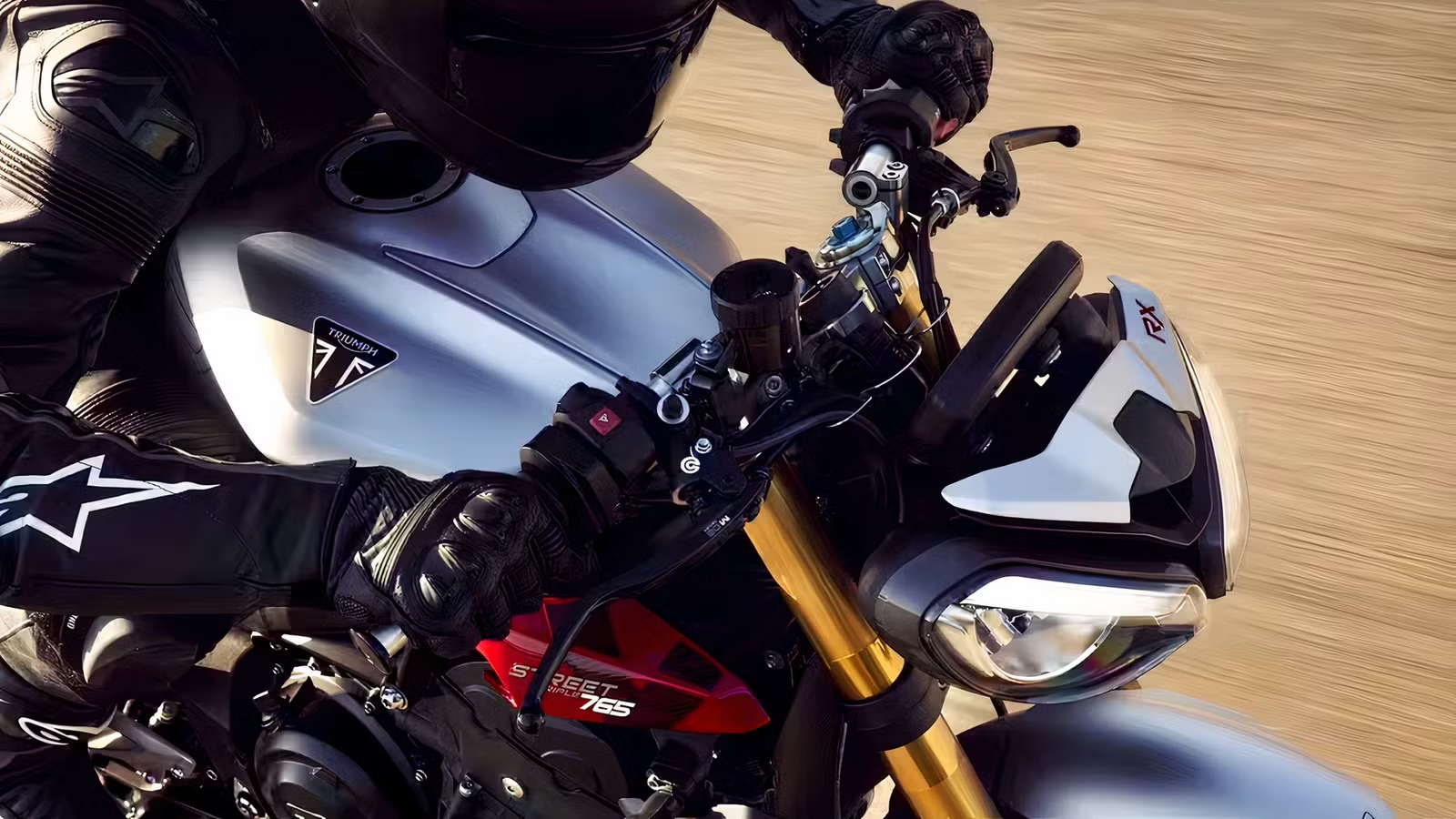
The 2026 Triumph Street Triple 765 RX is exactly that experiment. It evolves the Street Triple 765 RS by reviving the RX badge Triumph previously used on the 675-generation Street Triple. The original RX borrowed visual cues from the Daytona 675, but this one goes considerably further by altering how the rider connects with the chassis. At $14,495, it sits $950 above the current RS and below the more exclusive Street Triple Moto2 Edition, making it the performance-focused middle ground rather than merely another limited-edition.
Its Triple Already Has The Right Kind Of Performance

Triumph didn’t need to reinvent the engine. The 765cc inline-three is the most powerful spec that the nameplate has used. It produces 128.2 horsepower at 12,000 rpm and 59 pound-feet at 9,500 rpm, connected to a six-speed gearbox and standard Triumph Shift Assist up-and-down quickshifter. Its 13.25:1 compression ratio and engine development fueled by Triumph’s Moto2 program give the RX plenty of top-end appetite.

The engine is more than willing to rev while retaining enough midrange to make it less tiring to use than an equivalent four-cylinder, which neatly suits a motorcycle expected to work beyond a racetrack. There is still some compromise, though, as it’s a tad lazy to respond at low RPMs. Once the road opens up, though, the combination of useful midrange and a 12,000-rpm power peak gives the RX the flexibility a dedicated supersport can struggle to match.
Clip-Ons And Öhlins Suspension Alter The RX’s Dynamics

The RX’s defining hardware is ahead of the headstock. Triumph replaces the Street Triple RS’s flatbar and Showa fork with slightly raised clip-ons and a fully adjustable Öhlins NIX30 fork, while retaining the fully adjustable Öhlins STX40 rear shock. The clip-ons place the rider farther forward, and the geometry is suitably sharp at 23 degrees of rake and 3.75 inches of trail. Wet weight comes in at a low 414.5 pounds.

This is where the fairing argument gets more interesting. Lower bars increase the rider’s connection with the front tire under braking and corner entry, but Triumph hasn’t gone all the way to a conventional supersport riding triangle. The position sits between a race bike and a sporty street stance, providing stronger front-end connection without the wrist and back fatigue of a full supersport.

The rest of the specification supports this newfound sporty intent. Brembo Stylema radial monobloc calipers bite twin 310 mm front discs through a Brembo MCS adjustable master cylinder, while Pirelli Diablo Supercorsa SP V3 tires come standard. The Öhlins offer controlled yet compliant damping over imperfect surfaces rather than simply being sporty-stiff, reinforcing the point that against the Street Triple R, the RX’s sharper setup hasn’t sacrificed its usefulness on regular roads to achieve more precision.
Its Electronics Complement The Aggressiveness Of The Chassis

There is plenty of electronic assistance, but the RX doesn’t bury the rider under setup menus. Optimized cornering ABS and cornering traction control work with IMU-fed data, while Track mode reduces intervention for circuit riding. A five-inch TFT handles the interface, and Bluetooth connectivity is offered through Triumph’s My Triumph system.

This relatively restrained approach fits the RX well as it hands more control over fine-tuning the bike mechanically, something that encourages one to keep the bike longer. The suspension is manually adjustable, and it also keeps the relationship between setup and chassis behavior refreshingly direct. The stock suspension calibration already offers a great degree of predictable grip, but for riders interested in learning what compression, rebound, preload, and tire choice actually do, the simplicity is more than welcome.
The ZX-6R And Panigale V2 Still Serve As True Track-Ready Midweights

The 2027 Kawasaki Ninja ZX-6R starts at $11,599, or $12,599 with ABS, and its 636cc four-cylinder produces a claimed 127 horsepower at 13,000 rpm. It remains the more traditional choice for riders prioritizing repeated high-speed track work, where its fairing, dedicated supersport ergonomics, and 600-class architecture serve a clear purpose. It is also meaningfully cheaper than the RX. Ducati’s Panigale V2, at $16,995, combines full sport bike bodywork with an 890cc V-twin and a considerably more overt superbike identity.

The Triumph sits between these machines financially and philosophically, being pricier than the Kawasaki, less expensive than the Ducati, yet deliberately unwilling to commit fully to either one’s format. That is ultimately why the Street Triple 765 RX makes fairings surprisingly easy to forget. It doesn’t pretend wind protection is useless or that supersports have lost their purpose. Instead, it takes the parts riders usually want from them but stops shortly before the compromises start becoming apparent for daily riding.
Source: Triumph

Related posts


Latest Post


No Comments