
The Harley-Davidson That Quietly Became A Modern Icon
Motorcycle manufacturers have to tell you, of course, that every new bike is a revolution, but the showroom floor is where this gets put to the test. Long before product managers finish pitch decks, buyers vote with their wallets, often ignoring massive marketing budgets to buy the exact opposite of what executives pushed.

We saw this exact dynamic at General Motors when buyer backlash forced a quick rethink on dashboard buttons, proving that corporate decision-makers don’t always know what their customers actually want. Harley-Davidson learned that lesson the hard way, pulling a low-slung cruiser from its lineup only to watch secondary market prices explode.
Buyer Demand Forces U-Turns In Automotive History
When a vehicle gets cut from a lineup, it usually just fades away in the back of dealer lots. Yet every so often, consumers refuse to accept a factory cancellation, creating a supply-and-demand anomaly that drives used prices beyond what they were selling for originally. Manufacturers naturally try to hold the line, claiming their new replacement platforms are superior in every measurable metric, but customers paying more for a used vehicle is usually enough for the manufacturer to admit a mistake.

In the automotive world, we have been seeing this more regularly as different beloved vehicles are making a comeback. Usually it takes quite a long time for companies to bring a vehicle back; the Supra was gone for 17 years before we got the MkV. By that time, most are put back into production, styling has moved forward, and the returning vehicle shares very little with the new model that hits the showroom floor.
Harley-Davidson Has Gone Down That Road At Times

The Motor Company is no stranger to reading the room after making a bad call on rider demand. They learned this lesson decades ago with custom Big Twins, and they are repeating history right now with their entry-level strategy. Executives spent years pushing buyers toward high-tech, liquid-cooled engines, assuming the traditional air-cooled layout was a relic of the past that younger riders would willingly abandon.
That assumption aged poorly. Dealer feedback and plummeting showroom traffic eventually forced management to announce the return of the air-cooled Evolution 883 Sportster for2027, complete with a target price tag near $10,000 to win back entry-level riders. While Harley has made a considerable number of bad guesses about what people want or how to modernize the company, when push comes to shove, Milwaukee listens to its buyers.
The Breakout Breaks Out Of Hibernation

*Previous model shown
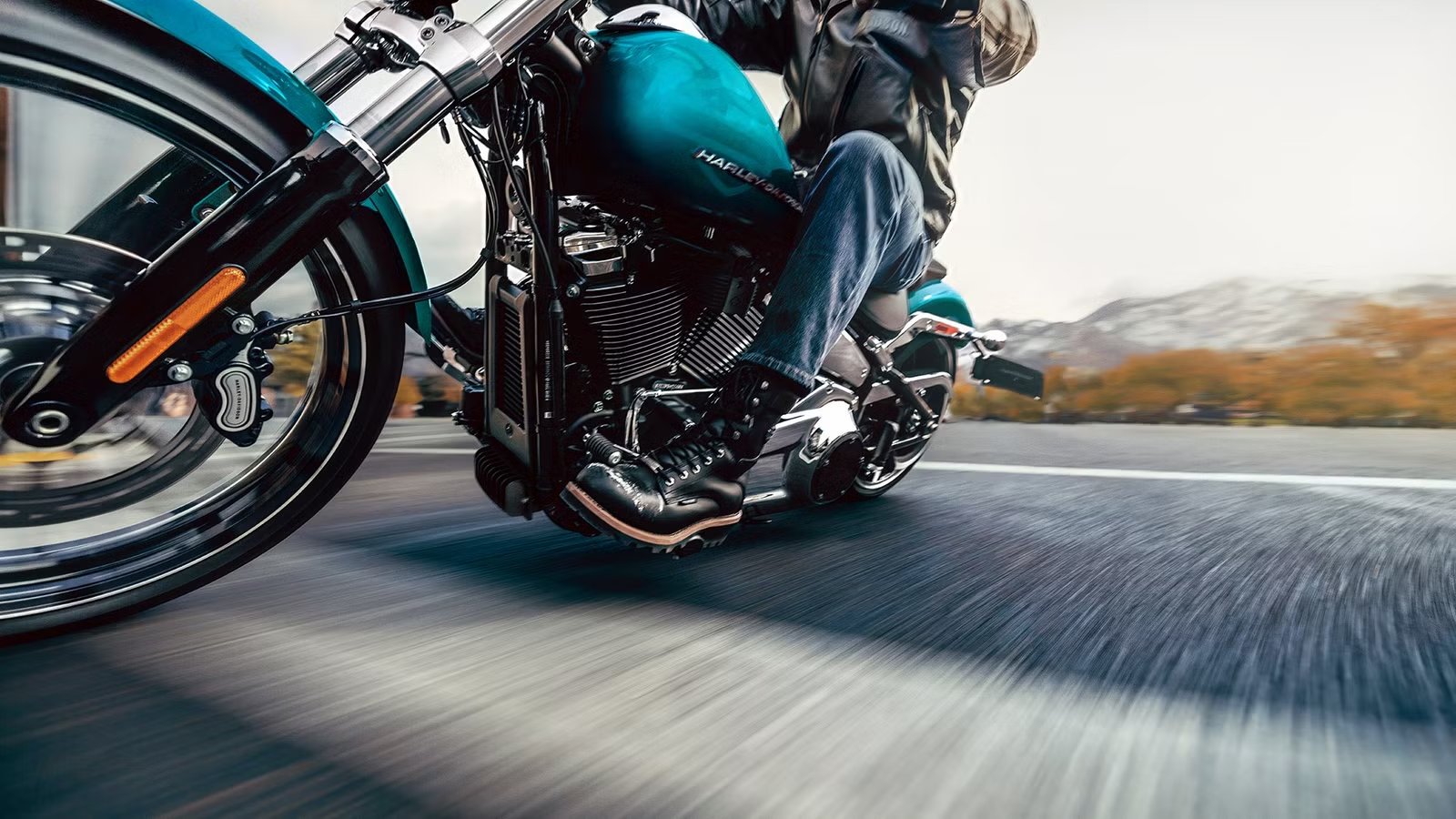
No bike proves this corporate turnaround pattern better than the Breakout. When it debuted back in 2013, it was a factory-built chopper designed to give riders custom drag-bike style without the headaches of custom-shop reliability. It sold exceptionally well for years, but as Harley pivoted toward adventure bikes and modern touring platforms, corporate axed the Breakout from the North American market after the 2020 model year.
The plan was to let the model fade away in favor of standard cruisers, but international markets like Europe and Australia kept buying every single Breakout 114 they could get. Stateside, used Breakouts began selling for more than they cost brand new, with some buyers hunting down clean frames to make their own custom larger displacement versions. Realizing they had abandoned a high-margin cash cow, Harley brought the Breakout back to the US lineup in 2023, but returning to market after a three-year absence meant Harley had to answer a hard question: was the bike actually better, or just back?
Harley Fixed The Breakout’s Biggest Flaw — And Added 1.5 Gallons Of Range

Not only did Harley bring the bike back, but they used this opportunity to overhaul the ergonomics and structural package, fixing the biggest complaints riders had about the older generation. One of the biggest complaints about the older version was the tiny 3.5-gallon tank, which was upgraded to a full five-gallon unit. Now you can actually take this dragster on a highway trip without searching every exit sign for a fuel station logo.
They also made it more comfortable by pulling back the handlebars on taller risers, so you no longer have to hunch over the tank like an open jackknife just to reach the controls. The frame geometry was tweaked to make the massive rear tire handle predictable road turns without fighting the rider through every single curve. It remains long, low, and heavy, but the current iteration feels like a fully developed motorcycle rather than an uncomfortable prototype.
The Mechanics Of Pairing A 240mm Rear Tire With A 21-Inch Front Wheel

Putting a massive 240mm rear tire on the same frame as a skinny, tall 21-inch front wheel sounds like a disaster on paper. In normal custom builds, that combination creates a bike that is really hard to lean, making the rider fight the bike through corners. Harley solved this by giving it proper chopper geometry, setting the front rake to a stretched 34 degrees, and balancing the trail measurement so the front wheel tracks straight without floppy steering at low speeds.
The massive rear contact patch gives you plenty of grip when you crack the throttle wide open from a stoplight. Meanwhile, the thin 21-inch front wheel slices through turn-in with surprisingly low effort, keeping the bike stable on rough highway patches. It’s obviously never going to corner like a sportbike, but the mechanical setup lets you push hard through sweeping backroads without scraping floorboards on every corner.
Engineering The Stance That Defined The Dragster Look

The visual drama of this bike comes down to pure proportion and heavy metal. Harley intentionally dropped the seat height down to 25.6 inches, tucking the rider deep inside the frame rather than sitting them on top of it. This low center of gravity makes the 681-pound running weight feel lighter than you would assume when you lift it off the kickstand at a gas station.
Chrome is everywhere on this machine, covering the fender supports, side covers, turn signals, and muffler shields. This isn’t everyone’s cup of tea, but with a lot of manufacturers hiding cheap metal under matte black paint, the Breakout rocks thick, mirror-finish chrome that looks classic. The long Softail chassis is a perfect match for this modern chopper style, keeping the clean lines of an old-school hardtail without destroying your lower back over bumps.
Powered By A Modern Milwaukee-Eight With A Heavy Breather Intake

At the center of that long frame sits the air/oil-cooled Milwaukee-Eight 117 V-twin engine, pounding out 126 pound-feet of torque at just 3,500 RPM. That low-end muscle means you do not need to drop two gears to make a quick pass on a two-lane highway; you probably don’t even need to drop one.
You can just twist the grip and let the 117-cubic-inch motor pull hard. Feeding that massive engine is a forward-facing Heavy Breather intake equipped with an exposed filter element. It adds to the bike’s muscular visual appeal while functionally ramming cool air straight into the intake manifold. In 2025 the intake was remodeled to make a little more room for the riders legs, but It still produces a deep induction sound under heavy acceleration.
The Financial Strategy Driving Harley’s High-Margin Icon

The Breakout is a calculated business move that prints money for Milwaukee. Building a factory dragster allows Harley to capture the lucrative custom-cruiser market without having to design an entirely unique chassis platform from scratch. By sharing basic Softail frame architecture across multiple models, they keep factory tooling costs down while selling a top-tier product.
Customizers used to buy base cruisers and drop $10,000 in aftermarket parts just to get a wide rear tire, a massive motor, and custom chrome wheels. Harley cut out the middleman by building that exact setup on the factory line. Buyers get a fully styled custom motorcycle backed by a factory warranty, while Harley keeps the fat profit margins that used to go to aftermarket catalog companies.
How A $23,000 Price Tag Converts Factory Customization Into Pure Revenue

Carrying a starting MSRP of $22,999 before destination fees, the Breakout sits firmly in the premium tier of Harley’s non-touring lineup. That price point is steep for a boulevard cruiser, but it is a bargain compared to the cost of trying to build a 117-cubic-inch custom dragster of the same quality in your own garage.
Dealers love this motorcycle because it rarely sits on the showroom floor long enough to start collecting dust. The high entry price attracts well-qualified buyers who know exactly what they are looking for and are likely to spend even more on color upgrades like Midnight Firestorm paint, slip-on exhausts, and custom foot controls before the bike even leaves the building. It turns a single motorcycle sale into a strong revenue generator for both the factory and the dealership service bay.
There’s Nothing Like The Breakout On Sale Today

In the current motorcycle market, which is heavily dominated by plastic adventure fairings, soulless digital dashes, and quiet exhaust notes, the Breakout 117 is a bold throwback to pure American iron. The best bikes don’t try to be everything for everyone, and the Breakout makes zero compromises toward being a sensible commuter or a practical grocery getter. It was built for one specific purpose: to look imposing, sound loud, and pull like a freight train.
That focused identity is precisely why its used values remain strong and why factory demand hasn’t slowed down since its return. Other manufacturers have abandoned the big-tire power-cruiser market entirely, leaving Harley to completely own this space. If you want a brand-new factory chopper with 126 pound-feet of torque, a 240mm rear tire, and a warranty, this is the only game in town.
Sources: Harley-Davidson

Related posts



Latest Post


No Comments