
The Performance Sedan With Toyota Reliability And BMW M-Like Handling
Performance sedans are having a quiet moment of reckoning. Automakers spent the last decade steering buyers toward crossovers, subscription features, and turbocharged four-cylinders dressed up with synthetic exhaust notes — and the genuine, no-excuses sport sedan got squeezed out of most lineups. If you want one new today, the options are thinner than they used to be, and the prices reflect it.

That shift makes the used market more interesting than ever. The past two decades produced some genuinely great performance sedans, and the best of them still hold up as weekend weapons or spirited daily drivers. Reliability matters because nobody wants their sports sedan experience to include a tow truck subscription. And if you want sharp handling that feels German, but dependability that feels Toyota-adjacent, one V8-powered sleeper keeps showing up as the smart play.
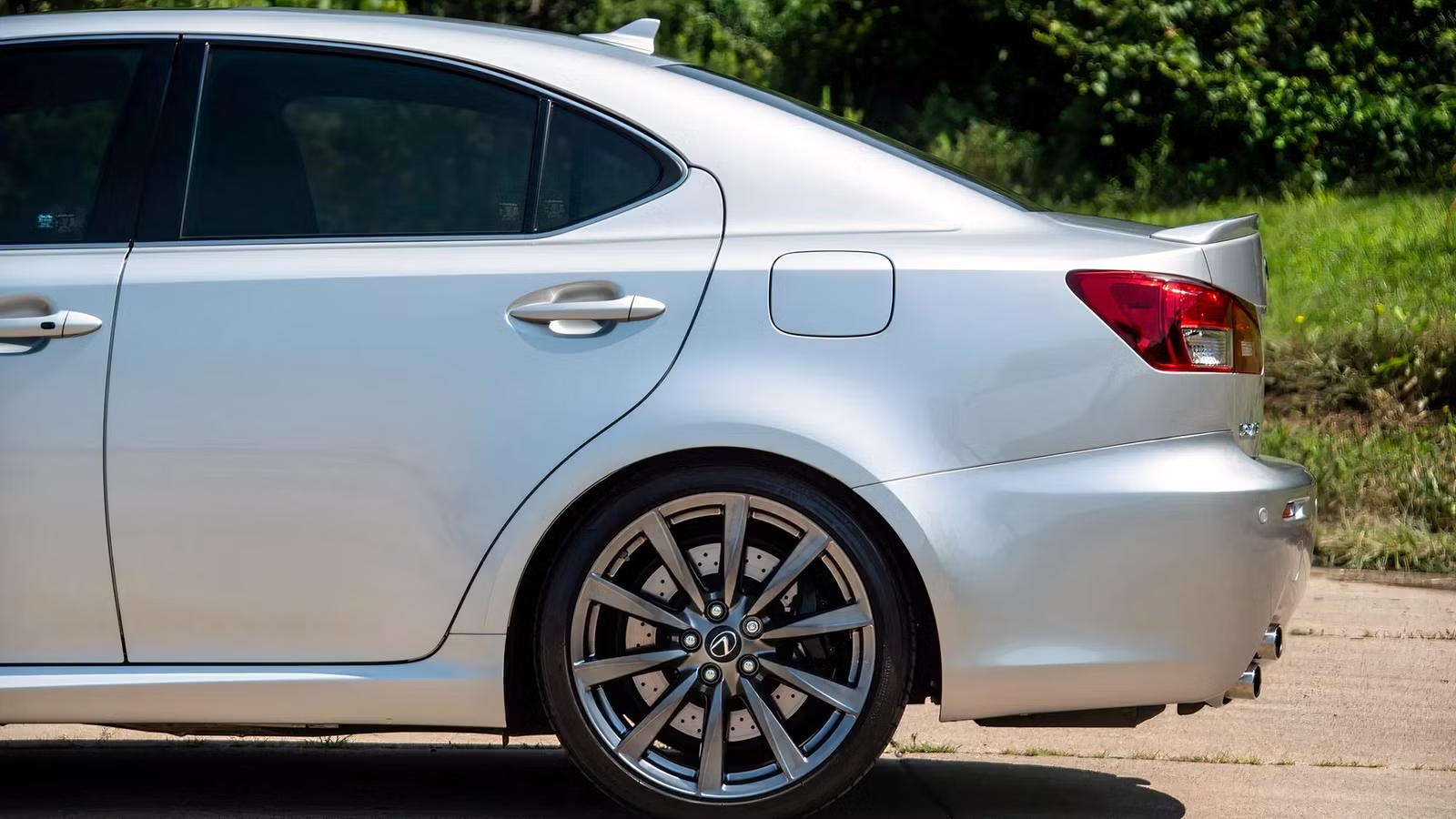
The Second-Gen Lexus IS F Is A Proven BMW M3 Rival
Lexus launched the IS F as the factory hot-rod version of the second-generation IS sedan, and it didn’t tiptoe into the segment. The brand showed up with a 5.0-liter V8, rear-wheel drive, big brakes, and a price that landed in the same neighborhood as the heavy hitters. Both the IS F and the BMW M3 from the same era cost around $56,000 in base form.

The timing put the IS F right in the middle of the modern muscle-sedan boom. Think E90-generation BMW M3, plus rivals like the Mercedes C63 AMG and Audi’s RS offerings that all tried to prove a point with horsepower and grip. Lexus had something extra to prove — it wanted credibility in a space where buyers loved lap times and also loved complaining about their repair bills.
And here’s the part enthusiasts still respect. Lexus didn’t build a loud appearance package and call it performance — it built a genuine performance model. The company even ran development at serious tracks, including the Nürburgring Nordschleife, and it treated the IS platform as a starting point, not a limit.
Naturally-Aspirated V8 Power For Solid Performance

|
Engine |
Power |
Torque |
Transmission |
0-60 MPH |
Top Speed |
|
5.0-liter NA V8 |
416 hp |
371 lb/ft |
8-speed automatic |
4.4 seconds |
172 mph |
The headline feature lives under the hood — a naturally aspirated 5.0-liter 2UR-GSE V8. In U.S. spec, it made 416 horsepower and 371 lb-ft of torque, sending power to the rear wheels through an eight-speed automatic.
That engine carried more engineering pedigree than most people realize. Toyota and Yamaha — yes, that Yamaha, the one that can sell a piano and a superbike under the same roof — collaborated on the 2UR-GSE program, using the LS 600h’s 5.0-liter V8 as a baseline. Lexus also gave the IS F D-4S injection, a system that combines port and direct injection. In practical terms, it targeted strong throttle response and cleaner intake valves than many direct-injection-only setups from the same era.
Lexus paired it with an eight-speed Sport Direct Shift automatic and leaned hard into shift speed. The brand claimed 0.1-second upshifts in manual mode, and it programmed the transmission to hold gears to a 6,800-rpm redline. Lexus also built in throttle blips on downshifts, so the car could fake heel-toe technique even when the driver wore hiking boots.
Numbers backed up the attitude. Car and Driver clocked 0–60 mph in 4.4 seconds, a 12.8-second quarter-mile at 114 mph, and a governed top speed of 172 mph. Lexus didn’t cheap out on the surrounding hardware either — Brembo brakes with 14.2-inch front rotors, serious cooling ducts, and 19-inch wheels wearing performance tires developed specifically for the car’s high-speed capability.
Toyota-Grade Dependability In A V8 Sports Sedan

The IS F’s appeal today comes down to one simple promise — it lets buyers chase performance without signing up for constant drama. That doesn’t mean it never needs anything; after all, it’s still a 400+ hp sedan with big tires, expensive brakes, and the potential for hard driving. But it comes from a brand that built its reputation on long-term durability, and multiple major studies keep backing that up.
Start with the big picture. Lexus keeps landing at or near the top of reliability and dependability rankings, and Consumer Reports has repeatedly placed Lexus (and Toyota) among the strongest brands for long-term reliability. That brand-level track record matters with a car like the IS F, because it shares a lot of Toyota-style thinking — conservative engineering, strong parts quality, and systems that don’t feel like beta software.

Ownership-cost data points in the same direction. RepairPal lists Lexus with an average annual repair cost of around $551 and a relatively low frequency of shop visits compared with many brands. That’s good news, because enthusiasts love receipts almost as much as horsepower. Just almost.
Most importantly, owners back the reliability claims in the real world. On the Club Lexus forums and Reddit, IS F drivers keep telling the same story — the car racks up miles without turning into a weekend repair hobby. Plenty of them report daily driving 100k-, 150k-, even 200k-mile examples with little more than routine service and normal wear items.
When owners do complain, they don’t usually point at blown engines or dead transmissions. They keep circling a short list instead — a coolant leak from the valley plate on some early cars, exhaust manifold cracks that can sound like a tick, and the occasional water pump or belt/tensioner noise. Annoying, yes, but owners consistently describe these as “do it once and move on” chores rather than “sell the car and take up cycling” disasters.
Lexus Ranks Highest Overall According To J.D. Power

J.D. Power’s Vehicle Dependability Study has ranked Lexus at the top overall, including a first-place finish in the 2024 study with Lexus posting the fewest problems per 100 vehicles among all brands measured.
That doesn’t guarantee every single IS F will behave like a perfect angel. But it supports the general point — Lexus tends to build cars that rack up miles without turning every warning light into a personality.
BMW M-Like Handling In A Family Vehicle

Handling makes or breaks this car’s whole argument. Plenty of sedans go fast in a straight line, and the IS F needed to feel confident in corners, because its target wore an M badge.
Car and Driver delivered the most important compliment in plain words. In its M3 comparison, it said the IS F’s handling was “hard to fault,” and it measured 0.92 g of lateral grip. That number still plays well for a street-driven sport sedan on normal tires. It also hints at the car’s personality — stable, planted, and willing to carry speed into a corner without acting spooky.
The same test also shows where the Lexus fit against the era’s M3. The IS F matched the BMW on horsepower (416 hp vs. 414 hp), and it beat it on torque (371 lb-ft vs. 295 lb-ft). It also carried extra weight, though — Car and Driver listed it at 3,780 pounds, about 100 pounds heavier than the M3 in that test. That helps explain why the BMW still won the sprint, hitting 60 mph in 4.1 seconds to the Lexus’s 4.4.
But the IS F didn’t show up as a blunt instrument. Lexus tuned the chassis around a stiff structure and a lowered setup, then backed it up with big brakes and serious cooling. The electric power steering was remapped for better response and feel, and the stability systems were calibrated to stay transparent most of the time.
Early cars had one well-known complaint from track testers — they wanted a more traditional mechanical limited-slip differential, because inside-wheel spin could show up when exiting corners hard. Lexus answered that over time with a Torsen rear differential added to later models, along with suspension and steering tweaks to improve overall confidence.
The end result feels like Lexus took a different route to the same goal. BMW chased sharpness and adjustability, plus a high-revving engine that begged for redline. Lexus chased stability and repeatability, with an automatic that shifted fast enough to quiet the manual-only crowd (at least for a minute). The IS F won’t replace an M3 for drivers who live for that last 5 percent of edge. But it delivers a ton of the fun, and it tends to ask for less sacrifice the other six days of the week.
Want One? Here’s How Much It’s Worth

The used market treats the IS F like a modern cult car. Prices swing considerably, because condition and mileage matter more than model year. Edmunds listings show used IS F prices ranging widely depending on mileage and condition — from well-used commuters into the teens to collector-kept examples commanding significantly more. That spread makes sense once buyers understand the difference between a 150,000-mile daily driver and a garage-kept trophy.
Kelley Blue Book and real-world listings on Cars.com show examples spanning a broad range depending on miles and presentation — check current listings for the most accurate snapshot, as IS F values have been climbing steadily.
Auctions underline the same point. A rough, high-mile car can sell cheap, while low-mile examples can pull serious money. Bring a Trailer has seen no-reserve sales at bargain prices for high-mileage cars, but clean, low-mile examples regularly attract strong bids. The IS F doesn’t “depreciate like a Lexus sedan” anymore — it depreciates like a rare-ish performance model that people finally noticed.
Best Model Years And Must-Have Options

Many enthusiasts focus on the update years. Lexus refined the car meaningfully over its production run — these were real engineering changes, not just new paint and a fresh brochure smile.
For 2010, Lexus made enhancements to cooling and chassis details, and added the Torsen rear limited-slip differential along with connectivity upgrades — a meaningful step forward from the earliest cars. For 2011, Lexus called out an improved suspension and updated steering calibration. If buyers want the most polished setup, those later cars often make the most sense.
Options matter, too, because Lexus sold the IS F with a few big-ticket comfort upgrades that change daily livability. The Mark Levinson audio and navigation package stands out as the most common “must-have,” and Lexus promoted it heavily in press and marketing materials.
And one last practical note — rarity cuts both ways. The IS F never sold in huge numbers, with lifecycle totals quoted by various sources at around 12,000 units worldwide. That helps values, but it also means buyers should shop patiently and pounce on the right car instead of settling for the nearest one. The best IS F usually looks a little boring on the listing page. Then it starts, revs, and reminds everyone what this segment was all about in the first place.
Source: Lexus, KBB, Edmunds, J.D. Power

Related posts


Latest Post


No Comments