
The Toyota That Changed What Americans Expected From Japanese Cars
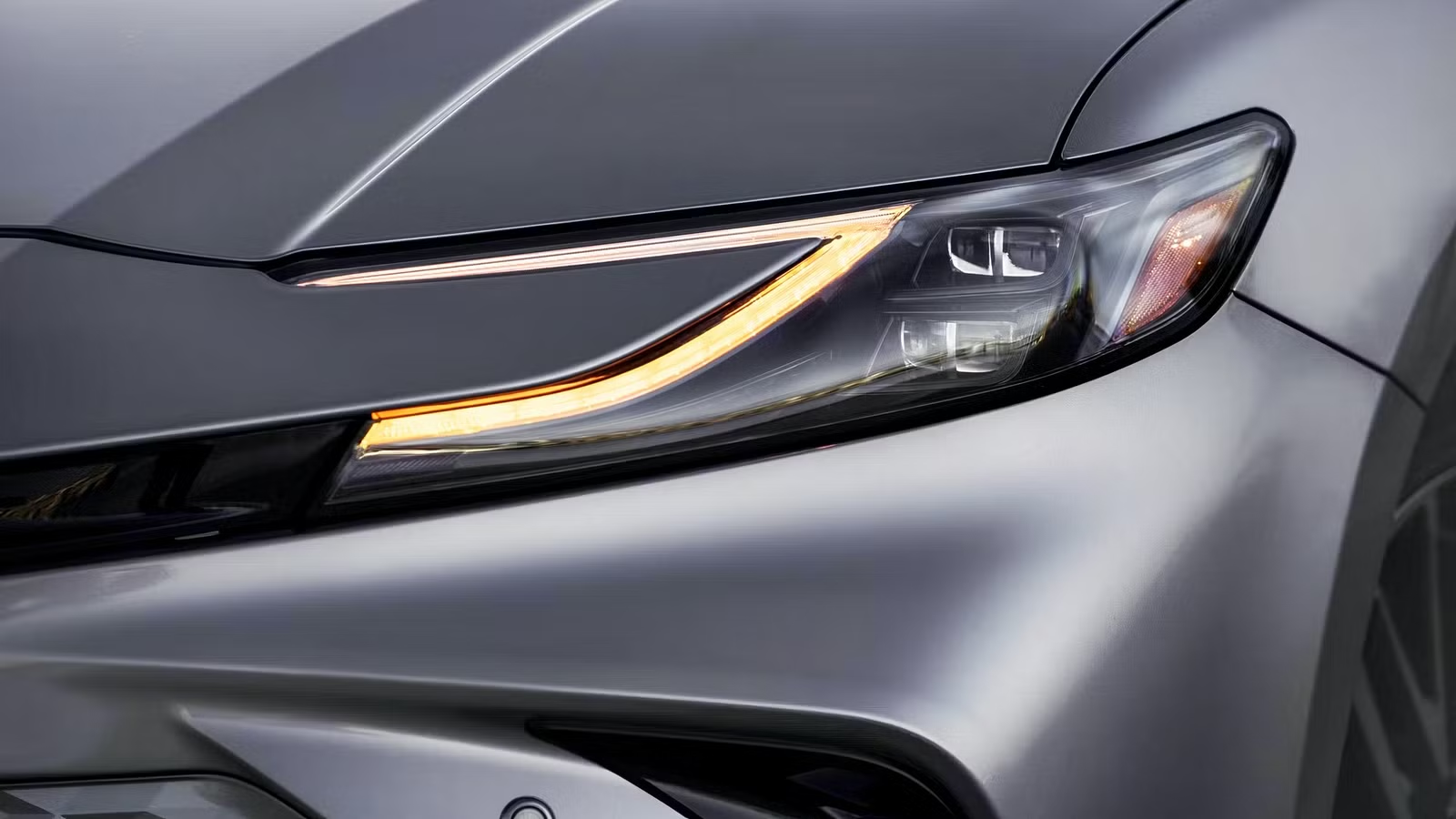
Toyota entered the American market during the late 1950s, fundamentally transforming how consumers perceived Japanese manufacturing. Unfortunately, early Japanese imports suffered from poor build quality and weak highway performance.

Toyota was quick to address these shortfalls directly by studying American driving conditions. These efforts were led by a specific midsize sedan that grew to be an undisputed champion of the segment thanks to decades of dedicated development, resulting in a high level of trust from consumers.
Toyota’s Perfectly Timed Introduction To The U.S. Market
Toyota established its American operations in California in 1957, but only began selling cars the following year. The brand met some challenges during its initial years, because its first cars didn’t offer the performance levels that American drivers needed on the highway networks. Rather than withdrawing, Toyota studied these driver needs and redesigned its engineering principles specifically for North American infrastructure.

The company’s trajectory transformed during the 1970s fuel crisis. During this time, American consumers rapidly shifted buying preferences towards smaller and more fuel-efficient transportation.

It capitalized on this shift by offering affordable, well-assembled vehicles that required minimal maintenance. Over the decades that followed, Toyota continued to solidify its reputation through the execution of the Toyota Production System that still stands today.
This system prioritizes continuous quality control and waste elimination, resulting in vehicles that are now renowned for exceptional long-term mechanical durability, low total cost of ownership, and outstanding resale value. In recent years, Toyota has promoted mass-market hybrid technology and expanded its localized manufacturing facilities across the U.S.
The Death Of The Affordable American Sedan

The affordable family sedan was once a staple product of the American automotive industry, but it experienced a gradual decline in demand that became exponential in the late 1990s. This ultimately led to a rapid market decline in 2024 with the demise of the Chevrolet Malibu. Other victims of this extinction include the Ford Taurus, Chevrolet Impala, and Chrysler 200, as American brands started to favor crossovers, SUVs, and pickup trucks to a much greater extent.
In recent years, consumers have shown a stronger appreciation for utility vehicles thanks to their elevated driving position, higher ground clearance, flexible cargo capacity, and the added sense of security. Simultaneously, regulatory and economic pressures accelerated this transition. Automakers also faced strict Corporate Average Fuel Economy standards, which favored larger truck-based vehicle footprints, while high development costs forced brands to reallocate engineering capital toward expensive electrification efforts and software platforms. Because crossover models yielded significantly higher profit margins than low-margin budget sedans, domestic manufacturers phased their sedan lines to maximize corporate profitability. The segment that once defined suburban mobility ceased to exist among domestic brands, leaving the remaining market almost exclusively to imported brands like Toyota.
How Toyota Reshaped The Family Sedan Market

The first-generation Toyota Camry arrived in the North American market for the 1983 model year. This introduction established a revolutionary template for modern midsize passenger cars. Early models were engineered to replace aging rear-wheel-drive platforms with a space-efficient front-wheel-drive and transverse engine layout. This packaging resolved compromises that plagued American sedans of the era.
Taking this approach meant that the Camry offered better interior volume, a lower curb weight, and impressive assembly quality. Long-term reliability and low running costs were its true claim to fame. Toyota integrated a fully independent suspension, electronic fuel injection, and precise manufacturing tolerances, resulting in superior fuel economy and smooth highway refinement while eliminating the frequent mechanical failures and rust issues common to rival domestic vehicles. Consequently, the first-generation Camry redefined consumer expectations for family transportation and established a new benchmark for long-term operational durability.
The 1983 Toyota Camry Was A Hard-To-Beat Bargain

The original 1983 model launched in North America with a MSRP of $7,988 for standard trims. More premium trims would have cost you $10,238. The sedan features a 2.0-liter single overhead camshaft naturally aspirated four-cylinder engine generating 92 horsepower and 118 pound-feet of torque via a standard five-speed manual transmission or an optional four-speed automatic. In the current pre-owned market, surviving examples sell for anywhere between $2,000 and $4,000, according to J.D. Power. The rare exceptionally preserved, low-mileage collector examples routinely command between $8,000 and $13,000.
Standard features included a functional and driver-centric cabin designed to maximize interior space and everyday usability. This setting includes durable cloth upholstery, full carpeting, a rear-window defogger, and a functional instrument cluster with a tachometer on higher trim levels. The dashboard features intuitive slide-style climate controls, dual side-window demisters, and an AM/FM stereo system.
Drivers benefit from an adjustable steering column, reclining front bucket seats, and soft-touch vinyl at key touchpoints instead of the hard, unrefined plastics common in rival economy cars. Additionally, the cabin incorporates thoughtful storage solutions, including a center console, door pocket compartments, and a spacious glovebox.
The Camry’s Impressive 60-Year Evolution

Toyota evolved the Camry extensively, the peak of which was seen in 1992 with the third-generation model. This was the era when the brand shifted the Camry from the compact classification into the midsize-class, tailored specifically to American tastes. Thanks to the larger platform, Toyota offered increased interior shoulder room, refined noise insulation, and a more capable V-6 engine option.
By 1997, the fourth generation secured the title of America’s best-selling passenger car, a position the nameplate has retained for decades. Over subsequent generations during the 2000s and 2010s, the platform expands its feature set to include active safety suites, advanced multi-link suspension designs, and optional gas-electric hybrid powertrains.

The current 2026 Toyota Camry represents the peak of this evolution, transitioning the platform into an exclusively hybrid lineup. Powered by the fifth-generation Toyota Hybrid System, the standard 2.5-liter four-cylinder setup pairs with electric motors to generate 225 hp in front-wheel-drive configuration or 232 hp with available electronic all-wheel drive. Modern iterations deliver up to an EPA-estimated 51 combined MPG while abandoning former economy-car compromises.
Despite being a mass-market car, the Camry’s cabin prioritizes technical advancements. This consists of dual 12.3-inch digital displays, wireless smartphone integration, and the comprehensive Toyota Safety Sense 3.0 suite.
Why Americans Continue To Support The Camry

American consumers favor the Camry because it consistently delivers long-term reliability, low maintenance costs, and impressive practical value. The Japanese midsize sedan balances interior space, fuel economy, and smooth ride comfort, making it a dependable choice for families and commuters alike. Over its multi-decade production run, certain generations stand out as monumental commercial successes.
The fifth generation, produced from 2002 to 2006, solidified the nameplate’s dominance by pushing annual U.S. sales above 400,000 units consistently, peaking at 431,703 deliveries in 2005. Building on that momentum, the sixth generation, available from 2007 to 2011, achieved the highest single-year sales volume in the badge’s history by selling 473,108 units in 2007 alone. This record-breaking sales performance, paired with consistently high resale values, secures the platform’s status as a fundamental staple of the American automotive landscape.
Toyota Knows How To Build Cars That Last

Toyota optimizes mechanical reliability through a disciplined engineering approach that favors gradual evolution over rapid, unproven redesigns. Rather than rushing fragile technology to market, the automaker thoroughly vets every mechanical component, refining existing engine architectures and automatic transmissions through continuous incremental updates. Quality assurance is integrated directly into the assembly process via strict manufacturing protocols, ensuring that workers correct component defects on the factory line before vehicles leave the plant.
This exact philosophy remains fundamental to the current model generation. By building new iterations around the standardized Toyota New Global Architecture platform and utilizing time-tested naturally aspirated engines paired with mature, planetary-gear hybrid systems, Toyota avoids the fragile turbocharging setups or prone dual-clutch transmissions that often plague competitors. Modern versions maintain the exceptional mechanical durability, low component failure rates, and high 200,000-mile survival odds that have defined the nameplate for decades.

Toyota backs every new model with a comprehensive factory warranty structure designed to ensure complete operational peace of mind. Standard gasoline vehicles feature a basic new vehicle limited warranty covering bumper-to-bumper components for three years or 36,000 miles, along with a powertrain warranty covering the engine, transmission, and drive systems for five years or 60,000 miles.
Electrified options receive significantly extended coverage periods to protect their high-voltage architectures. Hybrid-related components are covered for eight years or 100,000 miles. This includes the battery control module, hybrid control module, and any other relevant components. Furthermore, Toyota extends the coverage on the high-voltage hybrid traction battery itself to 10 years or 150,000 miles. Complementing these coverage tiers, all new models include ToyotaCare, which provides complimentary factory scheduled maintenance for two years or 25,000 miles, alongside 24-hour roadside assistance for two years with unlimited mileage.
Key Rivals That Failed To Conquer The Camry

Throughout its commercial history, the Toyota Camry faces intense competition from established midsize rivals, including the Honda Accord, the Nissan Altima, and domestic contenders such as the Chevrolet Impala and the Ford Taurus. During the early 1990s, the Ford Taurus held the top spot as America’s best-selling car, while the Honda Accord consistently appealed to driving enthusiasts thanks to its sharper handling.
Toyota’s midsize contender steadily held the sales lead by avoiding stylistic gimmicks and focusing on build quality, interior comfort, and high resale value. Competitors often attempt to capture market share through aggressive fleet discounts or drastic redesigns, but the Toyota platform remains the default consumer choice by consistently offering superior long-term dependability, lower ownership costs, and early mass-market integration of hybrid efficiency.
Sources: Toyota, J.D. Power, and the EPA.

Related posts





Latest Post


No Comments