
The Engine That Put One Automaker On The Map
What makes an engine timeless? Some might say the defining factor is an engine’s power-to-weight ratio, while others might point to its indestructibility. However, certain engines become so legendary that they become inseparable from an entire manufacturer’s identity.

Alfa Romeo was already one of the most recognizable names in motorsport and engine development, but in the postwar era, the company had yet to establish itself as a higher-volume production automaker. It was the work of one engineer, Giuseppe Busso, that would ultimately help define the Italian company’s road-car identity. His greatest achievement would become Alfa Romeo’s quarter-century staple, helping reshape the automaker and usher in a new era of performance.
The Engineer Who Transformed Alfa Romeo
Giuseppe Busso did not begin his career by designing the engine that would eventually carry his name. His path through Fiat, Ferrari, and Alfa Romeo instead gave him the engineering background that helped transform Alfa Romeo from a relatively low-volume manufacturer with a strong motorsport heritage into a globally recognized automaker.
Giuseppe Busso Went From Fiat’s Aeronautical Department To Ferrari


Busso was born in 1913 in Turin and graduated in industrial design from the Polytechnic University of Turin. His professional career began at Fiat in 1937, where he worked in the company’s aviation engine department before being recruited to Alfa Romeo in 1939. There, he worked under Orazio Satta Puliga and focused primarily on racing engines and experimental engineering projects rather than conventional production-car development.
After World War II, Busso moved to Ferrari, where he became the company’s first technical director and contributed to the development of its early V-12 engines. He then returned to Alfa Romeo in 1948 and remained with the automaker until 1977, eventually becoming responsible for the mechanical engineering behind its road cars. By then, Busso had developed an unusually broad resume spanning much of Italy’s performance-engineering industry.
His Return Coincided With Alfa Romeo’s Push Toward Higher-Volume Cars

Busso’s second tenure at Alfa Romeo coincided with some of the most important cars in the company’s postwar history. He was involved with projects including the Alfa Romeo 1900, Giulietta, Giulia, 1750, 2000, and Alfetta, helping translate Alfa’s prewar racing heritage into increasingly sophisticated production cars. The 1900 was particularly significant as Alfa Romeo’s first mass-produced model and its first production car built with a unibody structure rather than a separate chassis.
Busso understood that Alfa Romeo needed engines capable of serving multiple roles rather than simply powering niche racing-derived sports cars. His work helped establish the mechanical foundation for a brand that could build everything from practical family cars and executive sedans to sporting coupes. Alfa Romeo had the engineer and the growing product range. What it needed next was an engine capable of carrying the brand’s character into the 1980s.
The V-6 Arrived With An Unmistakable Sound

In 1979, Alfa Romeo introduced the engine that would eventually become synonymous with the brand’s road cars. It began with relatively modest hardware for the era, but its smooth power delivery, unusual induction system, and unmistakable sound gave it the ingredients of something far more memorable.
The 2.5-Liter V-6 Debuted With Six Carburetors

The engine that would come to define an entire era of Alfa Romeo performance and help cement the brand’s identity among enthusiasts was none other than the Alfa Romeo Busso V-6, which debuted in 1979. The original configuration was relatively simple: a 2.5-liter displacement, a single overhead camshaft per cylinder bank, and 12 valves. Its unusual feature was its induction system, with six Dell’Orto FRPA 40 carburetors feeding the engine.
The carbureted setup was unusual at a time when electronic fuel injection was becoming increasingly common, but it helped give the V-6 a distinctive character from the moment it entered production. The original engine produced roughly 158 horsepower, but the Busso was about much more than peak output. Its smooth power delivery, high-revving nature, and distinctive induction and exhaust notes quickly became as important to its identity as its performance. To this day, its sound remains one of the engine’s defining characteristics. Although the production V-6 arrived after Busso’s retirement, the engine had been developed during his final years at Alfa Romeo and represented the culmination of his work with the company.
Alfa Romeo Quickly Found More Places To Put It

The Busso V-6 soon expanded beyond the Alfa six, with later versions receiving electronic fuel injection and finding their way into some of Alfa Romeo’s most memorable sporting models. The 1980 Alfa Romeo GTV6 2.5 became one of the engine’s defining applications, pairing the V-6 with a chassis that was already capable of delivering an engaging driving experience.
Bosch L-Jetronic fuel injection replaced the original carburetors, making the engine easier to start and allowing for more consistent fueling. The GTV6’s 2.5-liter V-6 engine retained roughly the same output as the original carbureted engine, but the combination of performance, handling, and sound made the car one of Alfa Romeo’s most recognizable sporting models of the era. At this point, the Busso V-6 was no longer simply another engine in Alfa Romeo’s lineup; it was becoming part of what buyers associated with the brand itself.
Alfa Romeo Kept Evolving The Engine Instead Of Replacing It

The V-6 survived Alfa Romeo’s transition from independent manufacturer to Fiat ownership, as well as the company’s increasingly widespread adoption of front-wheel-drive platforms. Rather than becoming obsolete, it gained displacement, fuel injection, new cylinder heads, double overhead camshafts, and eventually enough power to remain competitive well into the 21st century.
The V-6 Grew From 2.5 To 3.0 Liters

By 1986, Alfa Romeo had been taken over by Fiat, bringing an end to the automaker’s period of independence and accelerating its move away from traditional rear-wheel-drive platforms. Despite this major change in the Italian marque’s chassis philosophy, the Busso V-6 did not fade into irrelevance. Instead, it remained a constant as Alfa Romeo’s vehicles continued to evolve.
A new 3.0-liter version of the Busso V-6 was developed for the Alfa Romeo 75/Milano, producing around 185 horsepower in U.S.-market form. In the 1988 model year, the 3.0-liter engine was introduced in the front-wheel-drive Alfa Romeo 164, giving the luxury sedan a 0-to-60 mph time of roughly 7.7 seconds.

The final iteration of the original 12-valve architecture arrived in 1991 in the form of a 2.0-liter turbocharged V-6 producing 207 horsepower. The smaller displacement was particularly useful in Italy, where tax regulations penalized passenger cars with engines above two liters. Rather than abandoning the V-6 as the automotive industry moved toward newer engine designs, Alfa Romeo continued adapting the architecture to suit changing regulations and vehicle platforms.
The 12-Valve Architecture Eventually Gave Way To DOHC

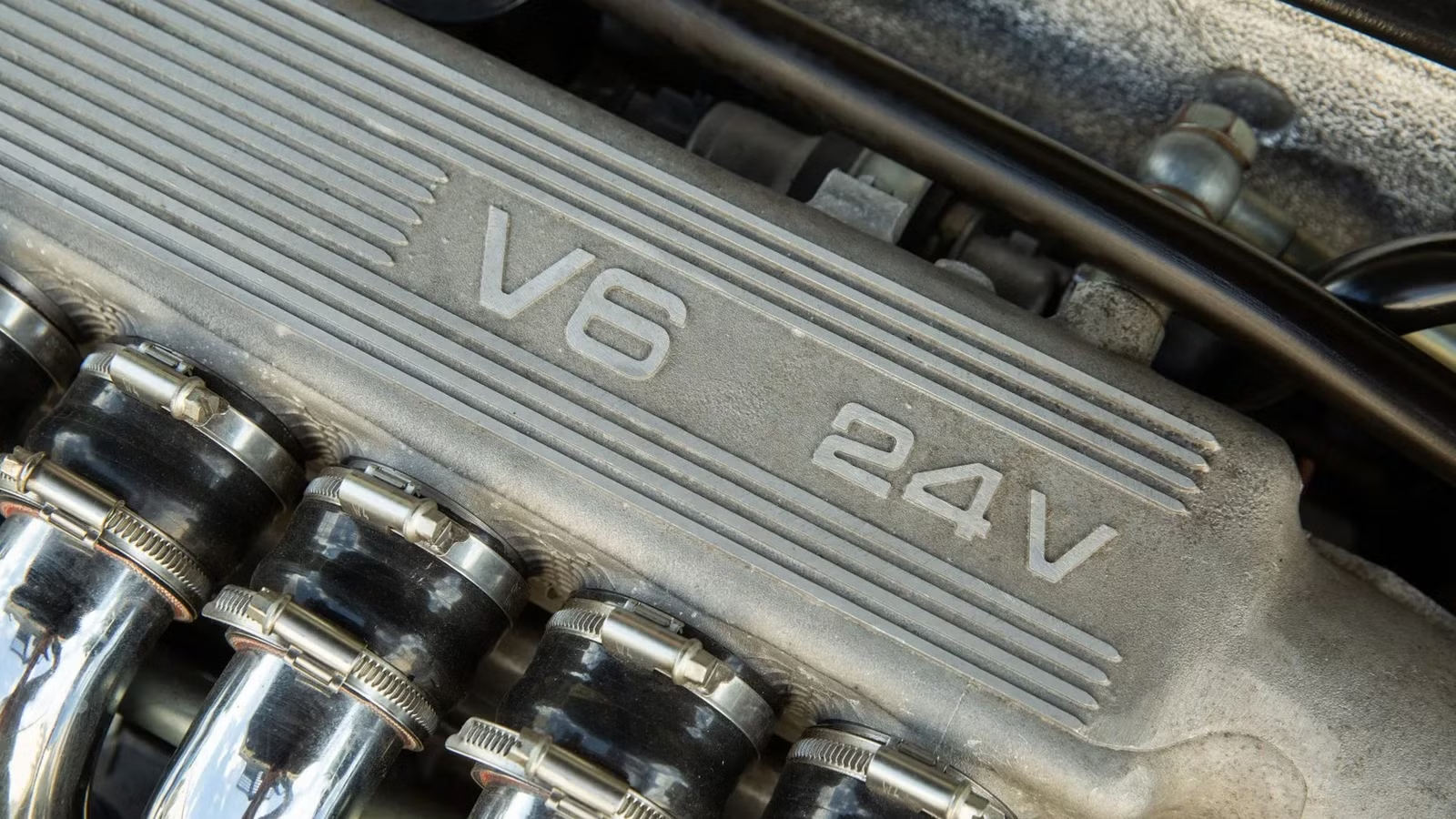
In 1993, the Busso V-6 finally made the jump to dual overhead camshafts and four valves per cylinder. This evolution also introduced one of the engine’s most memorable visual traits: prominent curved, polished intake runners paired with red lettering on the cylinder heads and intake manifold. Even today, the combination makes the Busso one of the most visually distinctive production engines ever built, with the polished hardware serving a functional purpose rather than simply acting as decoration.
The 3.0-liter 24-valve engine produced roughly 200 horsepower in early applications such as the Alfa Romeo 164, bringing modernized cylinder-head technology without sacrificing the character that had defined the original engine. The new design gave Alfa Romeo a more competitive powerplant while preserving the naturally aspirated V-6 formula that had become central to the brand. By the end of the 1990s, the Busso V-6 had already survived multiple generations of Alfa Romeo vehicles, and its final evolution at the start of the new millennium would become the most powerful version ever produced.
The Final Busso Became Its Most Powerful And Memorable Form

Alfa Romeo’s final evolution of the engine arrived just as the company was entering a new era of compact performance cars. The result was a 3.2-liter V-6 that delivered the highest factory output of the entire family and gave two of Alfa’s most memorable modern-era models a mechanical identity of their own.
The 156 GTA Took The V-6 To 3.2 Liters And 247 Horsepower

The final and largest-displacement production variant of the 24-valve DOHC Busso V-6 was introduced in 2002 with the Alfa Romeo 156 GTA. With 3.2 liters of displacement and 247 horsepower, it represented the highest factory output ever achieved by a production Busso V-6. The 156 GTA (Gran Turismo Alleggerita) was a fitting foundation for the engine, featuring a body that was approximately 121 pounds lighter than the standard 156, along with upgraded suspension, brakes, and bodywork.
The 156 GTA was available as both a sedan and Sportwagon, giving buyers the unusual combination of a practical front-wheel-drive family car and a naturally aspirated V-6. Production remained relatively limited, with fewer than 3,000 sedans and roughly 1,700 Sportwagons produced, depending on how production figures are counted. Even without the rear-wheel-drive layout of Alfa Romeo’s earlier sporting models, the Busso V-6 gave the 156 GTA a distinct performance identity that did not disappear with the change in drivetrain.
The 147 GTA Gave The Engine An Even Smaller Playground
Also introduced in 2002 was the Alfa Romeo 147 GTA, which placed the 3.2-liter Busso V-6 into an even smaller chassis. Weighing roughly 3,000 pounds depending on specification, the compact hatchback combined the engine’s 247 horsepower with a factory widebody, larger wheels, and wider tires to give the car a much more aggressive appearance than the standard 147.
Most 147 GTA examples were equipped with a six-speed manual transmission, while a six-speed Selespeed automated manual was also available. Alfa Romeo produced roughly 5,000 examples, making the 147 GTA a relatively rare modern performance hatchback. Tuning company Autodelta took the formula even further, offering modified versions with a bored-out 3.7-liter V-6 producing around 328 horsepower, as well as a supercharged version capable of approximately 400 horsepower. These were aftermarket conversions rather than factory Alfa Romeo variants, but they demonstrated just how much potential remained in the underlying architecture.

The 147 GTA represented the absolute peak of Alfa Romeo’s big-engine, small-car philosophy, while also serving as one of the final applications of the Busso V-6. After roughly 26 years of continuous development from 1979 to 2005, the engine had become far more than a mechanical component. It was the recognizable mechanical signature of Alfa Romeo, appearing across sedans, coupes, sports cars, and hot hatches while surviving major changes to the company’s ownership and vehicle architecture.
The Busso succeeded because Alfa Romeo continued evolving the engine without sacrificing the character that made it special. Its specifications changed dramatically over the years, but the smooth naturally aspirated V-6 configuration and unmistakable sound remained at the heart of the formula. Even decades after the final engine left production, that soundtrack remains instantly recognizable as Alfa Romeo.
Sources: Alfa Romeo, Ferrari, Fiat, Hagerty

Related posts




Latest Post



No Comments