
The Ducati Motorcycle That Ages Like Italian Wine
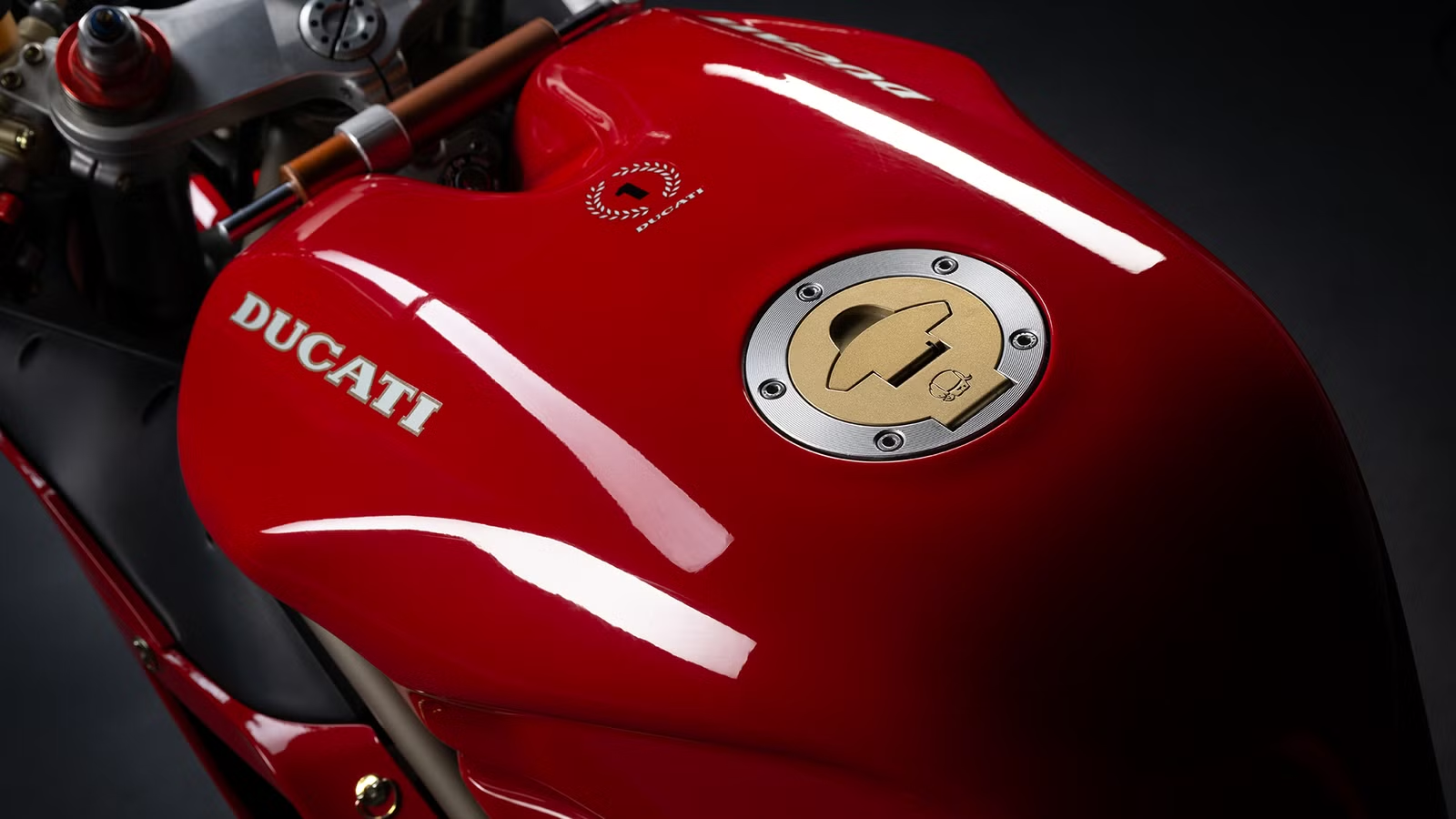
Every manufacturer has a motorcycle it is proud of. Then, priorities shift, engines get replaced, and lineups turn over every few years. So only a handful of manufacturers end up with a bike that survives all of that change and stays as unique as it was on the first day. Ducati happens to have built more of those than most manufacturers manage in a lifetime.

For instance, the Monster single-handedly invented the naked motorcycle category in 1993, the Scrambler proved retro could sell just as well as cutting-edge, and the Panigale continues to redefine what a modern superbike is even allowed to look like. Even inside that lineup, one bike sits apart from the rest. It didn’t just have a good decade and fade gracefully into “classic” status the way most beloved machines eventually do. It has set a bar that even the Italian manufacturer hasn’t managed to surpass in all these years.
Ducati’s Heritage Was Built On More Than Performance
Ask anyone what Ducati is known for, and performance is usually the first answer. That’s not wrong. But it’s not the whole story either. Ducati’s actual legacy is that some of its motorcycles don’t need a race resume at all; they speak for themselves the moment you see them, instead of how fast they go. The Italian brand has always revolved around three pillars – style, sophistication, and performance.

Look at the 750 GT from 1971, the bike that introduced the 90-degree L-twin layout still found in Ducati’s bikes today. It wasn’t the fastest thing on the road, but it looked and sounded like nothing else Japan or Britain was building at the time, and that alone was enough to define the brand’s direction for the next five decades.

Even the Monster, when it arrived in 1993, made its case on attitude rather than numbers. It stripped a sports bike down to its frame, engine, and tank and sold that rawness as the whole pitch. It wasn’t about outrunning anything. It looked like a Ducati and rode like one, and that was the entire argument. None of these bikes needed a championship to matter. They mattered because they looked and felt like something only Ducati could have built.
The Bolognese Brand Has Never Shied Away From Breaking Rules

The same stubbornness ran through Ducati’s engineering, not just its design studio. While the rest of the motorcycle world settled for conventional valve springs, Fabio Taglioni refused to compromise and used the desmodromic valve system, which was quite infamous for high maintenance costs. This stubbornness made Ducati pay a very heavy price, until Cagiva’s 1985 buyout came with a blunt condition to modernize.
Ducati didn’t just copy the winning recipe. Engineer Massimo Bordi looked at an industry moving toward simpler, cheaper valve designs and built a fuel-injected, four-valve desmodromic V-twin anyway, debuting in the 851 in 1987. That platform evolved into the 888, which secured World Superbike titles with Raymond Roche in 1990 and Doug Polen in 1991 and 1992.
However, later in 1993, Ducati lost its title to Kawasaki, which sent the brand back to the drawing board to build something to prove itself; not by joining what others were doing, but by pushing further in the opposite direction. None of those decisions were the easy ones. All of them became the foundation for the bike that was about to walk out of Ducati’s design studio and change what a sports bike was supposed to look like.
The Ducati 916 Refuses To Age
Production Years: 1994 to 1998

That bike is the Ducati 916, and even three decades after it first rolled off the line in 1994, it’s still routinely called the most beautiful motorcycle ever built. Though it wasn’t the most powerful, or the lightest, and neither a comfortable motorcycle, it stood out for its handling, performance, and its beauty. Well, it was a perfectly gorgeous race-bred motorcycle, which was born on a quest to compete with the Japanese sports bikes.
Eventually, this motorcycle became the face of 1990s sports bikes, and even had several imitators, but none of those came close. It was one of the most important bikes in Ducati’s lineup, and eventually started to build some reputation, too. In 2014, Motorcycle News awarded the 916 the “Most Beautiful Bike of the Last 50 Years” title. And most people are still paying for that reputation today.

Its racing pedigree and undeniable aesthetic have completely shielded the 916 from the usual depreciation curve. Instead of aging into a budget used bike, it has matured into a collectible. While a standard early Biposto (two-seat) or Strada model can still be found in the $7,000 to $20,000 range depending on condition, the homologation specials have skyrocketed. The highly coveted SP and SPS (Sport Production Special) variants, loaded with racing internals and specialized chassis components, command a real premium over the standard models.
At the absolute pinnacle sit the Senna editions. Released in three limited-production runs to honor Formula 1 legend Ayrton Senna, who owned the very first 916. These limited-edition models were finished in a striking metallic grey or black with bright red wheels. Finding a pristine Senna edition today often requires writing a check well north of $25,000 to $40,000.
Tamburini Didn’t Design A Motorcycle, He Designed A Standard

Every part of the 916 that people still point to as “timeless” traces back to one man. Massimo Tamburini, who joined Ducati by way of Bimota. He began the project in the late 1980s, under the internal codename “2887”. It took nearly six years and at least three full prototypes before he was satisfied. That’s a long runway for a bike that, on paper, was just meant to replace an aging model.
Tamburini wasn’t just drawing a fairing. He was trying to fix every visual and mechanical compromise sports bikes had been living with for years. Proportions, weight balance, airflow—all of them got the same obsessive treatment. What came out the other side didn’t just look good in 1994. It has begun to shape every faired sports bike since then. Even Ducati’s own lineup never fully moved away from it, and rivals spent years borrowing pieces of it without ever fully owning the idea.
Designed By Rain, Not By Wind Tunnel

The Ducati 916’s design was all about the fairings, and Tamburini was obsessive about them. It was Ducati’s answer to Japanese motorcycles, but with less horsepower, so aerodynamics was the key. To test that, Tamburini once rode a prototype motorcycle in pouring rain. The test ride left him so fixated on the result that he ordered his team not to touch the motorcycle until it had fully air-dried. Then he studied how the water streaked across the bodywork, judging airflow by eye rather than by numbers on a printout. The twin-slit headlights went through an exhausting number of redesigns before he considered them finished. Nothing on this bike happened by accident.
The 50:50 Weight Balance

“The ideal one would be a 750 with the power of a 1000 and the weight of a 500,” Tamburini once said, summing up his entire design philosophy in a single line. Light and agile mattered more to him than raw output, and the 916 was where he finally got to prove it. The L-twin Desmoquattro engine was long, and its lower cylinder kept pushing the front wheel away from the bike’s center of gravity. Unlike the Paso before it, the 916 couldn’t lean on smaller wheels to compensate.
So Tamburini set the wheelbase at 55.5 inches and worked backward from there, figuring out how to fit the engine into that frame without wrecking the steering. He positioned the battery next to the engine’s front cylinder purely to bring the weight distribution closer to 50:50. He also gave the front end an aggressive 23.5-degree rake, which helped keep the front wheel from kicking back under hard braking. Rather than adopt the aluminum twin-spar frames the rest of the industry was moving toward, he reworked his own earlier TT2 race bike frame into a compact tubular steel trellis. The result was a wheelbase shorter than the 888 it replaced.
It Had A Honda’s Touch

Tamburini never hid where the inspiration came from. He saw Honda’s NR750 and scrapped his earlier 916 design on the spot. Three things were carried over directly from the Japanese motorcycle. The single-sided swingarm, built to speed up wheel changes in endurance racing. The under-seat exhaust, which replaced his original side-mounted pipe once he saw how much cleaner the NR750’s tail looked.
And the twin squinty headlights, which turned out to be the hardest part of the whole design. Tamburini wanted the lights to feel like art, not just a fixture. However, all of that was not a simple copy-paste job. Honda held the patent for the swingarm, so Tamburini and engineer Massimo Bordi had to design it by hand, not CAD.
The Desmoquattro Engine Defies Modern Sensibilities

Underneath all of that bodywork sat the engine, the Desmoquattro, a desmodromic four-valve V-twin that mechanically forces both valves to open and close rather than relying on springs. It’s a genuinely stubborn piece of engineering, expensive to service, difficult to tune, and largely abandoned by simpler alternatives elsewhere in the industry. Ducati kept it anyway, because it produces a sound and a delivery nothing else replicates.
On paper, Bordi’s 916cc engine pumped out 114 horsepower and 66.3 pound-feet of torque, and had a top speed of 161.5 mph. Compared to today’s standard, it doesn’t look that fast. But the 916 was never just about peak horsepower; it was about an unfiltered connection that is incredibly hard to find today. There are no riding modes, no slide control, and no variable valve timing to mute the experience. It has that raw character that modern spec sheets simply cannot have.
The 916’s Legacy Is Still Unmatched
Today’s sports bike segment is dominated by 200-plus horsepower machines having six-axis IMUs, wheelie control, slide control, and aerodynamic winglets. The Ducati 916 was unlike any of that. In fact, its legacy was so monumental that it practically cursed its successor. The Ducati 999 that followed was objectively a better motorcycle to ride in almost every regard, but it was relentlessly criticized upon release simply because it could never live up to the 916’s mythical hype.
The 916 transcended the motorcycle industry to become a global cultural icon. It became a celebrity must-have for stars like Ewan McGregor and Ayrton Senna, cemented its pop-culture status in blockbusters like Speed 2 and The Matrix Reloaded (as the visually identical 996), and earned its place as mechanical art at both the Guggenheim and San Francisco’s Museum of Modern Art. It wasn’t just another red Ducati; it was a breakthrough masterpiece that was perfect then, is perfect now, and has truly only gotten better with age.
Source: Ducati

Related posts


Latest Post


No Comments