
Next Lexus LFA Won’t Be Fully Electric, Reports Say
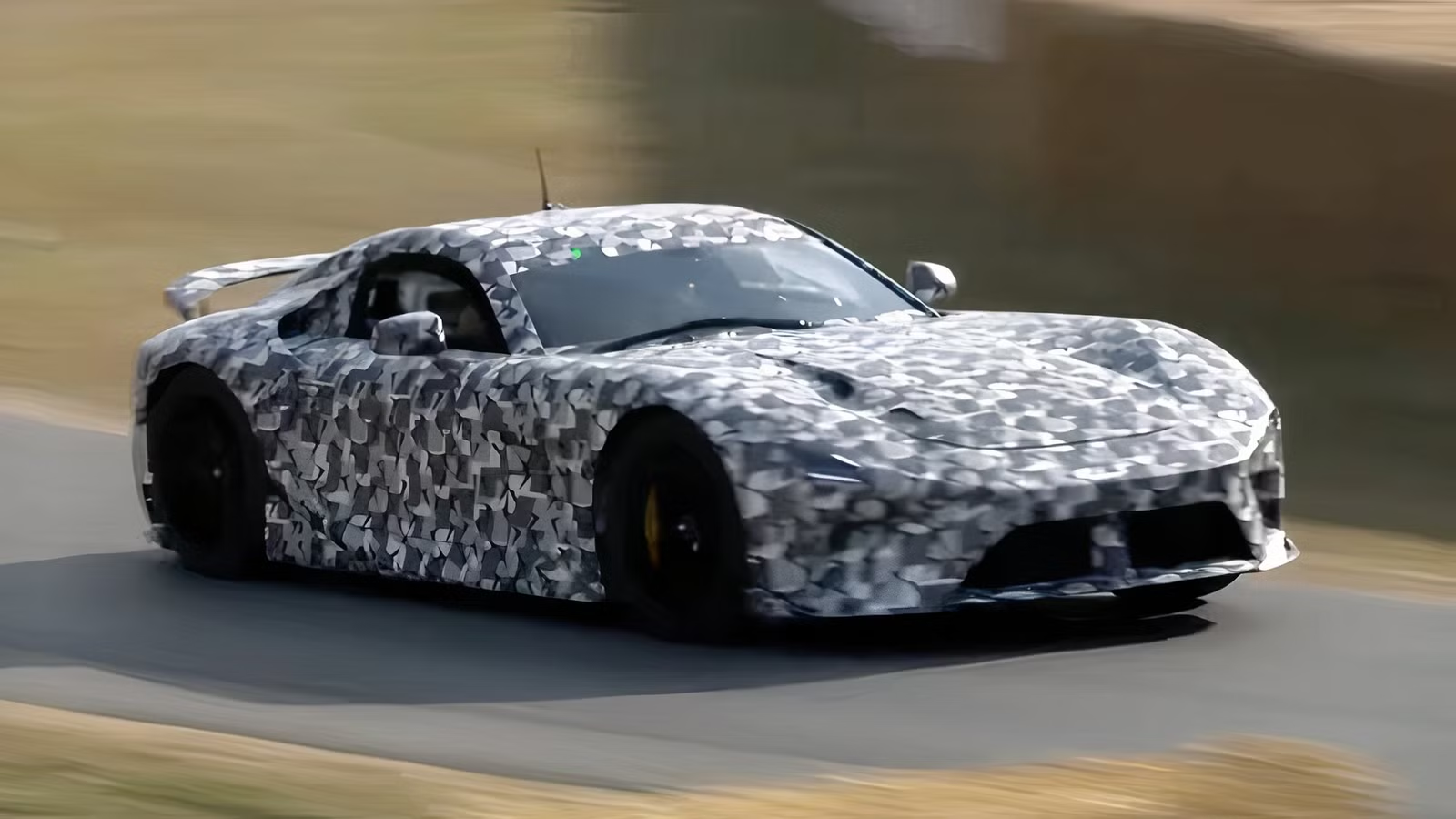
Reports out of Japanese outlet, BestCar, suggest the next-generation Lexus LFA won’t follow the all-electric path that many feared — and for the hypercar community that has been watching this revival closely, that’s the most meaningful powertrain signal yet. The original LFA‘s 4.8-liter naturally aspirated V10 set a standard that a battery-only successor would have struggled to honor, and the suggestion that combustion will survive in some form changes the entire conversation around one of the most anticipated Japanese performance cars in years.

Details are still thin. The report stops short of specifying whether the successor will be a conventional hybrid, a plug-in hybrid, or some other dual-powertrain arrangement — but the headline fact is clear enough: pure EV is off the table, at least according to current reporting. For collectors and purists who have been dreading an LFA that sounds like a refrigerator, this is exactly the kind of news worth paying attention to.
Why The Powertrain Question Matters More For The LFA Than Almost Any Other Car
The original LFA was never just a fast car. It was a statement about what a naturally aspirated, high-revving engine could be in the era of turbos and hybridization. The 1LR-GUE V10 — developed in partnership with Yamaha — displaced 4.8 liters, produced 552 horsepower at 8,700 rpm, and spun all the way to a 9,000 rpm redline. Torque peaked at 354 lb-ft at 6,800 rpm. The Nürburgring Package cars pushed output to 563 horsepower and lapped the Nordschleife in 7 minutes 14.64 seconds in August 2011, a production car record that held for nearly three years until the Porsche 918 Spyder arrived.

The engine was built with forged titanium connecting rods, dry-sump lubrication, and a harmonically tuned titanium exhaust that produced a sound unlike anything else on the road. That acoustic character — that scream approaching the redline — is the thing collectors and enthusiasts have been most worried about losing. An EV successor could match or exceed the LFA’s performance numbers on paper. It could not replicate what that V10 does to the senses. Lexus, it seems, understands this.
The Original LFA’s Rarity Has Made It A Collector Benchmark

Lexus built exactly 500 LFAs between 2010 and 2012. Of those, only 64 received the Nürburgring Package, and just 25 of those were delivered to the U.S. market. Original MSRPs started around $375,000 for a standard car, with Nürburgring Package examples pushing well past $500,000 when options were factored in.
The market has since revalued the LFA dramatically. A U.S.-market Nürburgring Package car with modest mileage sold for approximately $1.9 million in 2023. Right now, a 72-mile example — LFA number 488, finished in Whitest White with the full Ring Package — is being offered through Broad Arrow Private Sales, with expectations that it could challenge the $2 million mark given its near-untouched condition. That kind of collector appreciation reflects how seriously the hypercar world takes the LFA’s legacy. The successor’s powertrain isn’t a spec-sheet detail — it’s a question of whether the nameplate can carry that legacy forward or whether it becomes something else entirely.
What ‘Not Fully Electric’ Could Mean — And What We Still Don’t Know

This is the first potential signal on the new LFA’s powertrain direction, but it leaves the architecture undefined. “Not fully electric” could mean a conventional hybrid pairing a combustion engine with an electric motor, a plug-in hybrid setup offering some EV range alongside a combustion core, or a performance-focused electrified system where the combustion element does the heavy lifting and electric motors fill in torque at specific points in the rev range. Any of those configurations would preserve at least some of the acoustic and mechanical character that defines the LFA name.
What remains unknown is significant: total output figures, the specific hybrid architecture, whether a V10 or any other naturally aspirated configuration survives in the new car, and when Lexus plans to reveal or launch it. There’s also been a separate report noting the new LFA is set to debut Toyota’s solid-state battery technology — which, if accurate, would point toward a sophisticated electrified system rather than a mild hybrid. That detail hasn’t been confirmed alongside the report, and the two threads haven’t been officially reconciled. Enthusiasts should treat both as directional signals, not confirmed specs.

What Lexus hasn’t done is commit to a reveal date or release official powertrain details. Until that happens, the community is working from fragments. But the fragment that matters most — that the combustion engine isn’t dead in the LFA successor — is the one that changes the stakes entirely.
The original LFA took nine years to develop and only 500 were ever built. Its successor carries the weight of that legacy into an era when every performance brand is under pressure to electrify. If the reporting holds, Lexus has decided that honoring the LFA name means keeping a combustion element in the mix — and that’s a decision gearheads have every reason to get behind. The details still need to come. But the direction, at least for now, is pointing the right way.

Related posts


Latest Post


No Comments