
This Motorcycle Ages Better Than Almost Anything Else
Expensive touring motorcycles have a strange problem. Technology moves quickly, styling trends move even faster, and a machine that once looked cutting-edge can start looking old the moment its replacement arrives with a larger screen, sharper LEDs, smarter electronics, and another acronym nobody asked for. Yet some bikes seem strangely resistant to that cycle. Their proportions and purpose are strong enough that even older examples still make sense beside something brand new.
Why Touring Motorcycles Are The Hardest Test Of Lasting Design

Longevity isn’t simply a matter of keeping the same motorcycle in production for decades. A bike can stick around because it’s cheap to build, familiar to customers, or too important to replace. Truly enduring design is harder. It has to survive changing tastes without looking trapped in the year it was created. That’s difficult enough with a naked bike or cruiser, but touring motorcycles make the challenge considerably worse.
A big tourer has nowhere to hide its age. There’s bodywork everywhere, plus windshields, hard luggage, lights, switchgear, seats, speakers, dashboards, and increasingly elaborate infotainment systems. All of those things are useful, but they’re also giant timestamps. A once-futuristic dashboard can become painfully old-fashioned within a decade, while an oddly shaped fairing can lock an entire motorcycle into one particular era.
Technology Ages Faster Than The Motorcycle Underneath It

Electronics are usually the first giveaway. Navigation systems that once seemed luxurious can look primitive next to a modern smartphone. Small LCD displays become giant touchscreens, analog gauges disappear, Bluetooth becomes expected, and rider aids that once belonged on superbikes spread into everything else. None of this makes an older motorcycle worse, but it does expose how quickly the equipment surrounding the basic machine can age.

That means the motorcycles that hold up best tend to rely on something deeper. The silhouette has to work. The riding position has to make sense. The mechanical layout needs enough character that buyers still care about it once the gadgets have been superseded. Most importantly, the motorcycle has to know exactly what it wants to be. That’s something Harley-Davidson’s touring lineup has understood for a very long time. What’s unusual is that one Harley model has taken this further than the rest of the lineup — and it’s done it by preserving something most manufacturers would have redesigned years ago.
How Harley’s Refusal To Reinvent Its Touring DNA Became Its Biggest Competitive Advantage

Harley’s Grand American Touring motorcycles aren’t designed around winning horsepower-per-dollar comparisons or shedding every possible pound. They’re built around a very specific idea of crossing enormous distances. Big V-twins sit inside long, low chassis with generous fuel tanks, hard luggage, substantial fairings, relaxed ergonomics, and enough road presence to make even a gas-station stop look like part of the trip.
The notable aspect is how little that core idea has changed. Engines have grown stronger, chassis have improved, electronics have multiplied, and infotainment has gone from radio dials to high-resolution displays. Yet a modern Harley tourer still looks immediately related to its ancestors. Instead of repeatedly tearing up the blueprint, Harley tends to adjust the proportions, refine the details, and modernize what’s underneath.

That continuity gives these motorcycles an unusual advantage. An older Harley touring bike doesn’t necessarily look obsolete simply because a newer one exists. The basic shape still makes visual sense because Harley hasn’t spent the last few decades trying to convince everyone that the previous generation was wrong. Nowhere is that more obvious than with one particular member of the family.
The Road Glide’s Fixed Fairing Is Its Secret Weapon — And Harley Has Never Abandoned It

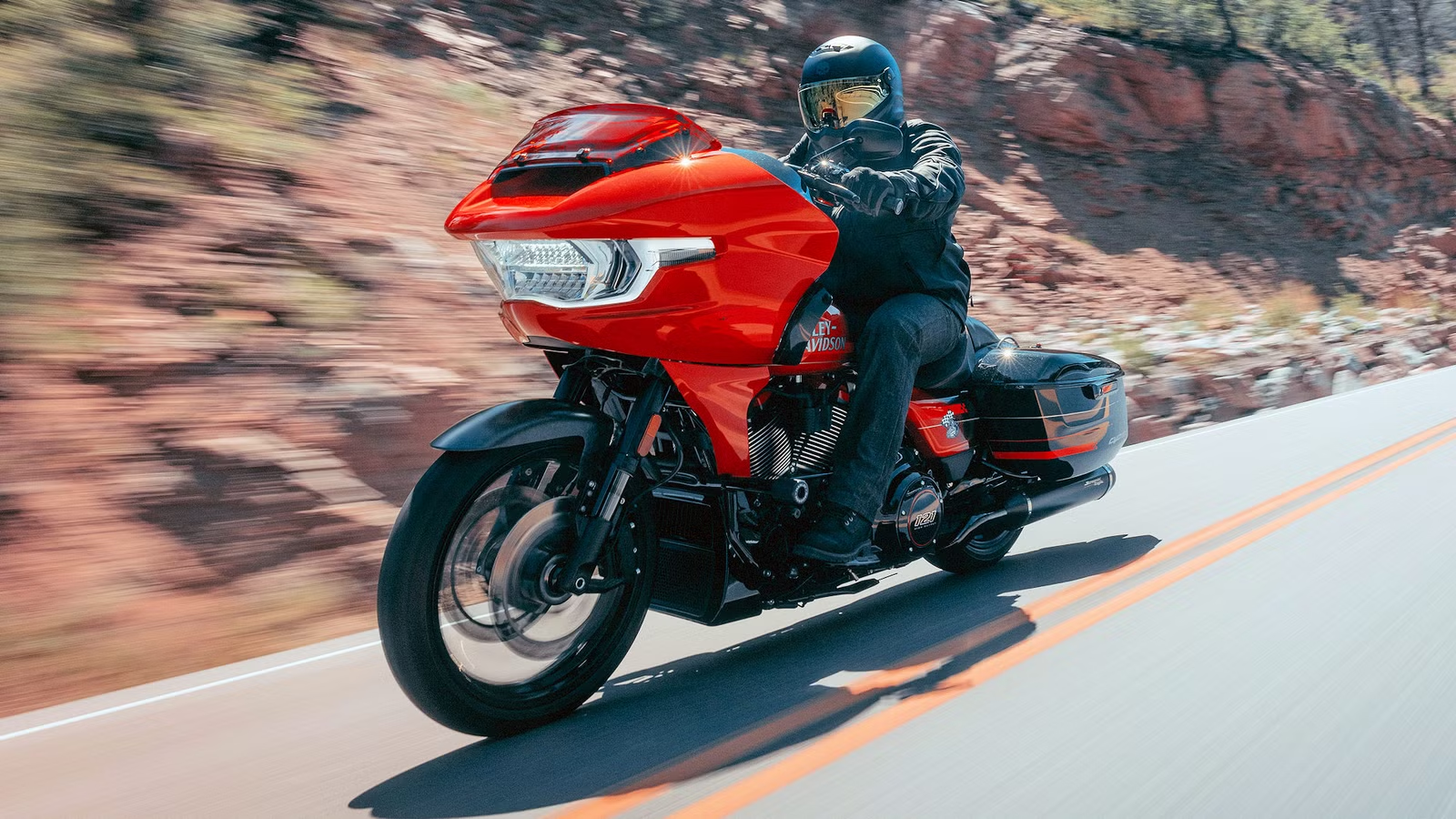
The Harley-Davidson Road Glide is perhaps the clearest example of how careful evolution can beat constant reinvention. Its defining feature remains the frame-mounted Sharknose fairing, which stays fixed to the chassis instead of turning with the handlebars. That arrangement gives the Road Glide its unmistakable profile, separates the mass of the fairing from the steering, and has become one of Harley’s most recognizable design signatures.
Look at an older Road Glide and then look at the current bike. The details are very different, but the relationship is obvious. Harley didn’t keep that identity alive by freezing the motorcycle in time, either. The latest Sharknose fairing was developed using computational fluid dynamics to improve aerodynamic efficiency and reduce helmet buffeting, while integrated LED lighting cleans up the front end without changing what the bike fundamentally is.

The result is a motorcycle that manages to look current without pretending its past never happened. Its proportions remain familiar, its one-piece saddle follows the same long-distance mission, and the handlebars offer 27 degrees of adjustment so riders can tailor the cockpit to themselves. Even the 19-inch front and 18-inch rear cast-aluminum wheels fit naturally into the silhouette rather than screaming that this is the newest version.
A 117-Cubic-Inch V-Twin, Variable Valve Timing, And A 12.3-Inch Touchscreen Inside A Classic Shell

Underneath that familiar shape, the 2026 Road Glide has moved considerably forward. It starts at $25,999 and uses Harley’s Milwaukee-Eight 117 V-twin, with liquid-cooled cylinder heads, electronic sequential-port fuel injection, and a 10.3:1 compression ratio. Harley rates it at 105 horsepower at 4,600 rpm and 130 pound-feet at 3,250 rpm, with power sent through a six-speed transmission.
It’s still a substantial motorcycle. Running-order weight is 838 pounds, the wheelbase measures 64 inches, and the laden seat height is a low 26.6 inches. Fuel capacity is six gallons, while the two saddlebags provide 2.42 cubic feet of luggage capacity. Harley lists ground clearance at 5.7 inches, rake at 26 degrees, trail at 6.8 inches, and lean angle at 32 degrees on either side.

The technology is where the gap between old and new becomes obvious. A 12.3-inch TFT display running Skyline OS handles infotainment and vehicle information, with Bluetooth connectivity, Apple CarPlay support, navigation capability, and selectable ride modes. Rider Safety Enhancements include ABS and traction-related electronic aids, with cornering-aware functions available to help manage braking and grip when the bike is leaning into a corner.
From $25K To $52K: Every Harley Tourer Shares The Same DNA
The Road Glide also makes more sense when viewed as part of Harley-Davidson’s broader Grand American Touring lineup. For 2026, the Street Glide starts at $24,999, placing it just below the Road Glide’s $25,999 base price. The two share the same general touring mission, but the Street Glide uses Harley’s fork-mounted Batwing fairing while the Road Glide sticks with its frame-mounted Sharknose.
Above them sit the Street Glide Limited and Road Glide Limited, both starting at $32,999. From there, Harley stretches the formula into much more expensive CVO territory. The CVO Street Glide ST and CVO Road Glide ST both start at $44,999, while the CVO Street Glide begins at $49,999 and the CVO Street Glide Limited reaches $51,999. That’s quite a spread built around broadly familiar touring architecture.
The CVO Road Glide ST Makes 127 Horsepower And Still Looks Like A Road Glide

The Road Glide Limited shows how far Harley can push comfort without abandoning the basic idea. Its Milwaukee-Eight VVT 117 produces 106 horsepower and 131 pound-feet, while a Grand Tour-Pak adds serious two-up luggage capacity. Heated rider and passenger seats, a taller windshield, embedded navigation, and a four-speaker, 200-watt audio system push it toward full luxury touring.
Then there’s the CVO Road Glide ST, which takes the same recognizable shape in a completely different direction. Its Milwaukee-Eight 121 High Output engine produces 127 horsepower and 145 pound-feet, yet it still carries a six-gallon tank, a 64-inch wheelbase, and the Road Glide’s signature fairing. Even at the performance end of the range, Harley hasn’t needed to abandon the visual formula to make the motorcycle more extreme.

And that’s probably the Road Glide’s most underrated quality. It doesn’t age well because Harley refuses to change it. It ages well because Harley changes nearly everything around the core identity without erasing it. Engines get stronger, electronics get smarter, aerodynamics improve, and dashboards become enormous touchscreens, but the motorcycle still looks unmistakably like itself.
Source: Harley-Davidson

Related posts

Latest Post


No Comments