
10 Coolest Stock Cars to Win the Daytona 500
From the very beginning of NASCAR, the driving force for manufacturer-sponsored racing teams was “win on Sunday, sell on Monday,” because fans wanted to own the cars their favorite drivers were taking the checkered flags in. Thanks to the fact that NASCAR used to actually have stock cars in their races, this was entirely possible. Tyler Reddick won the 2026 Daytona 500 driving what is described as a Toyota Camry, and while you can certainly buy a Toyota Camry it won’t look anything like the car that won, nor will it have the same performance. Back in the day, however, you could head down to your local dealer and buy the exact same car your hero crossed the finish line in, and many times with the same engine. Here are the 10 boldest cars that ever won the Daytona 500 that you could, without question, buy on Monday.
10
1959 Oldsmobile Super 88
Lee Petty

Because Richard Petty is such a racing legend, people often forget that his dad Lee was exceptionally talented and started the family’s racing legacy. With 54 wins, 231 top fives, and 3 championships, Lee Petty was NASCAR’s first superstar. He also won the inaugural Daytona 500 in 1959 en route to his third series championship. He made history behind the wheel of a 1959 Oldsmobile Super 88, beating Johnny Beauchamp in a race so close that it took officials three days to certify. That Olds Super 88 was equipped with a 394ci engine that produced 315 hp and 435 lb-ft of torque in the civilian version, though it was obviously modified for the race car. This was a car that anyone with $3,328 could have, and it turns out a lot of them wanted one, with over 100,000 Olds Super 88s leaving the lot in 1959.
9
1960 Chevrolet Impala
Junior Johnson

The 1960 Daytona 500 was one of the wildest races in history with no less than 13 lead changes. It was ultimately won by Junior Johnson in his underpowered Chevrolet Impala, that was easily 10 MPH slower than the dominant Pontiacs that year. Johnson’s Chevy had a 348ci V-8 that was factory rated at 335 hp and 362 lb-ft of torque, though it was probably more powerful than that. It was, on the other hand, not in the same league as the other cars, so he figured out that if he got right behind a faster car, the aerodynamic flow would carry him, allowing him to go faster. This is a common practice in racing now called drafting, but Junior Johnson was the first to figure it out, and it worked out as he was able to slingshot to the front at the end of the race and take the checkered flag.

8
1962 Pontiac Catalina Super Duty
Fireball Roberts

At the 1962 Daytona 500, Fireball Roberts went wire-to-wire, starting in the pole position and taking the checkered flag. He led 144 of the 200 laps with an average speed of 152.529 MPH and crossed the finish line 27 seconds before 2nd place Richard Petty. His #22 car was a ’62 Pontiac Catalina Super Duty, prepped by legendary mechanic Smokey Yunick. Equipped with a 421ci Super Duty V-8 with dual quads, this big block was rated at 405 hp, but was probably closer to 500 hp after Smokey finished with it. As luck would have it, NASCAR had a homologation requirement, which meant Pontiac had to sell a certain number to the public, so 162 fortunate race fans were able to purchase one. 155 were equipped with the 421, while another seven got the 389 that would eventually power the GTO a couple of years later.
7
1964 Plymouth Belvedere
Richard Petty

The 1964 Daytona 500 gave birth to not one, but two of the all time greatest legends: Richard Petty and the 426ci Hemi V-8. Chrysler developed the 426 Hemi specifically as a race engine to make Petty the most dominant NASCAR racer of all time, and it worked. Under the hood of his ’64 Plymouth Belvedere, Petty led 184 of the 200 laps, winning by nearly a mile, and went on to take the NASCAR championship, his first of 7 Cup Series titles. A Hemi-powered Belvedere was not available to the public in 1964, but after Ford complained that the race engine was too fast, NASCAR temporarily banned it until it could be homologated. Chrysler could have produced a 500-unit special edition to meet the requirements, but instead decided to make it available in all Dodge and Plymouth intermediate cars, which outperformed every Ford on the street throughout the entire Golden Age of American Muscle.
6
1967 Ford Fairlane
Mario Andretti

Mario Andretti is easily one of the most famous race car drivers in history, but is primarily known for his Formula 1 and Indy Car championships, not NASCAR. It turns out that Andretti drove in a total of 14 NASCAR races between 1966-1969, winning just once. The solitary checkered flag, however, was huge, as it was the 1967 Daytona 500. Andretti drove a 1967 Ford Fairlane, which is easily the most forgotten classic muscle car, featuring a 427ci V-8 rated at 425 hp. The engine was race-prepped by Holman-Moody, so it was definitely way above that. Ford actually sold some, about 92 units, ’67 Fairlane R-Code cars with the 427 “Side Oiler,” which meant this was an almost exact car fans could own. The only problem was that it was extremely limited in production, and most went to drag racers, so there were probably very few daily drivers with this one.
5
1968 Mercury Cyclone
Cale Yarborough

Though it is one of many races in a NASCAR season, which has almost always come at the beginning, the Daytona 500 is pretty much the Super Bowl of racing. It is also a legend maker that has launched many iconic careers. In 1968, Cale Yarborough, who had only one previous win, took the checkered flag at Daytona, which propelled him to become an 83-win, 3-championship racing legend. He kicked off his Hall of Fame career driving a 1968 Mercury Cyclone with a Ford 427ci Side Oiler V8. That was enough to beat LeeRoy Yarbrough by a nose in one of the most dramatic finishes ever. For the record, these two are not related and in fact don’t have the same last name as LeeRoy is “Yarbrough” and Cale is “Yarborough.” Sadly, Mercury didn’t sell any 427 Cyclones in ’68, though there was a limited number of Cougar GT-Es available, but the Cyclone was just as striking as the Daytona 500 winner, so fans could still enjoy it.
4
1970 Plymouth Superbird
Pete Hamilton

The 1970 NASCAR season was the most extreme on record, with almost exclusively aerocars on the track. Ford had the Torino Talladega, Mercury ran the Cyclone Spoiler II, and of course, the Mopar “Winged Warriors” with the Dodge Daytona as well as the Plymouth Super Bird. The extreme nose cone and rear wing of the Mopars gave them both wind-cutting aerodynamics and hyper-stability at top speeds. At the 1970 Daytona 500, Pete Hamilton piloted a Road Runner-based Superbird to a first place finish by 20 car lengths over David Pearson in a Ford. The Superbird, as well as the Daytona were actually sold to the public to homologate them for competition, but it didn’t matter because NASCAR effectively banned them and all other aerocars after 1970. Still, this was probably the coolest stock car of all time that fans could actually own.
3
1971 Plymouth Road Runner
Richard Petty

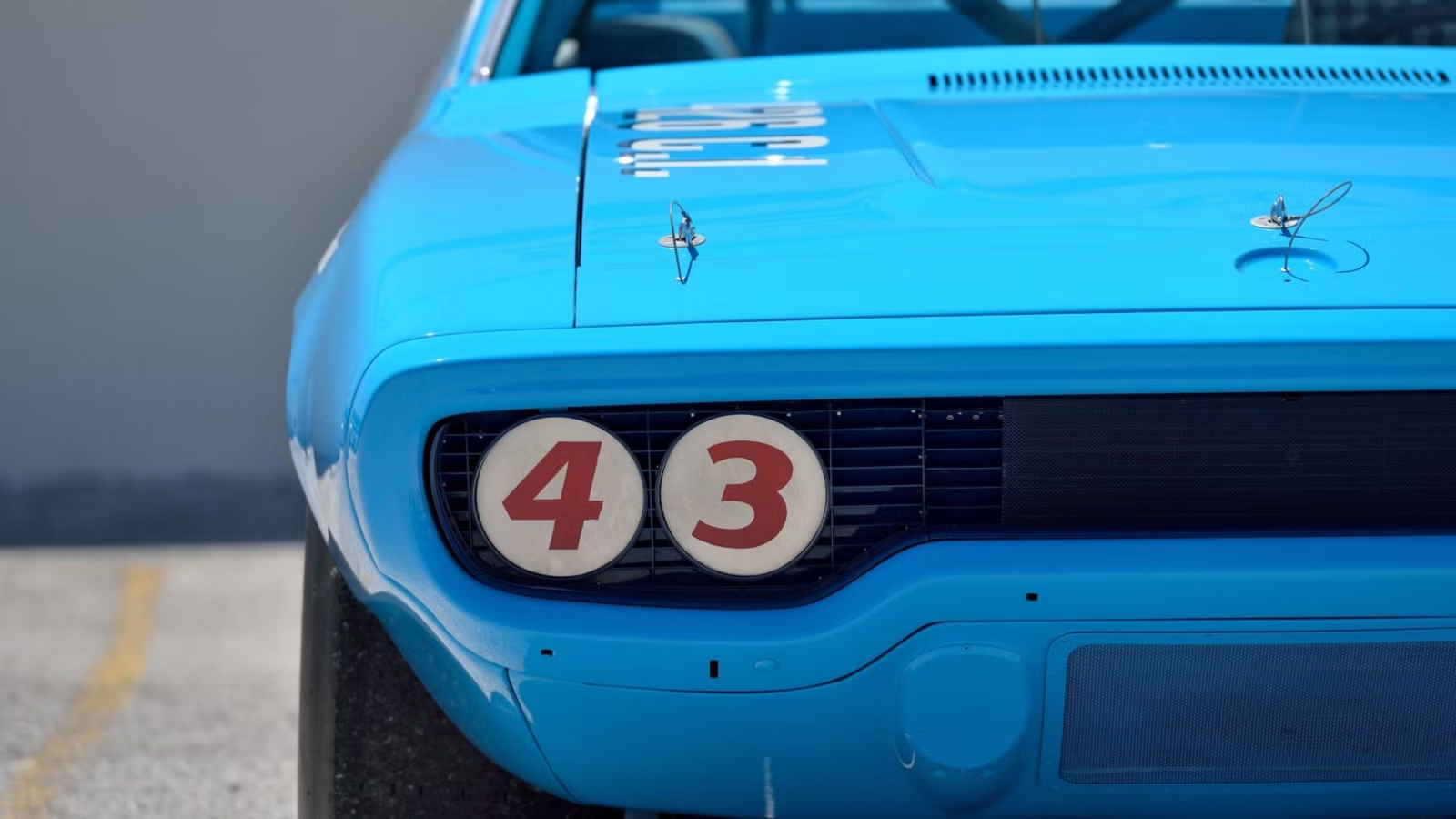
By 1971, Richard Petty was a living legend, and he still had so much more to accomplish at that point. He took the ’71 Daytona 500, his third victory in the iconic race, and then went on to win the NASCAR Championship, which was renamed the Winston Cup Series that year. After a brief stint driving for Ford in the late ’60s, Petty came back to Plymouth in 1970 and would be a Mopar guy for most of the decade, racking up wins and championships. His ’71 Daytona 500-winning car was a 1970 Plymouth Road Runner, which featured the striking second-gen Chrysler B-body “fuselage” body style. Unlike his ’64 Hemi Belvedere that wasn’t available with a 426 to the public, his ’71 Hemi-powered Road Runner could be purchased by anyone. Even better, the actual car he drove is available to fans, as that Petty Blue beauty pictured above is the actual Daytona 500-winning car, and it sold at Mecum Harrisburg 2019 for $412,500, which is a remarkable value.
2
1973 Dodge Charger
Richard Petty

If it seems like this list is getting Mopar-centric, that is because Richard Petty, also known as “The King,” dominated the Daytona 500 behind the wheel of Plymouth and Dodge cars, which were the most impressive-looking vehicles of the Golden Age and beyond. Petty had actually wanted to drive a ’69 Dodge Daytona, but Chrysler insisted he stay with Plymouth, so they hooked him up with the Super Bird. Then, in 1973, #43 was transferred to the doors of a third-gen Dodge Charger. Petty has said this was his favorite car he ever drove, and he stuck with it until 1978, which was four years after the third-gen Charger was discontinued. Petty racked up 29 wins and two championships in this car, and while fans could certainly own one from 1973 to 1974, after that it was no longer an option because Dodge stopped making it. The fourth-gen Charger was not NASCAR compliant, which is why Petty clung to the third-gen as long as he could.
1
1975 Chevrolet Chevelle Laguna
Benny Parsons

You may notice a huge gap between Chevrolet Daytona 500 winners and that is because, in 1963, GM banned all of its divisions from participating in racing activities and even implemented an under 400ci engine limit on intermediate cars, crippling them for most of the Golden Age of American Muscle. GM lifted that ban in 1970, but it would take another five years before the Bowtie brand would break through. The 1975 Daytona 500 was won by Benny Parsons, driving a ’75 Laguna S3 that took the checkered flag for Chevy’s first victory in 15 years. For those of you wondering what the heck a Laguna S3 is, it’s what became of the Chevelle, and in fact, it was actually badged as such. The coolest thing about the Laguna S3, besides the fact that it was a surprisingly aggressive-looking ride, was that you could still get it with a 454 big-block.
Sources: Mecum

Related posts
Latest Post


No Comments