
10 Sports Cars You Can Still Buy With A Manual In 2026
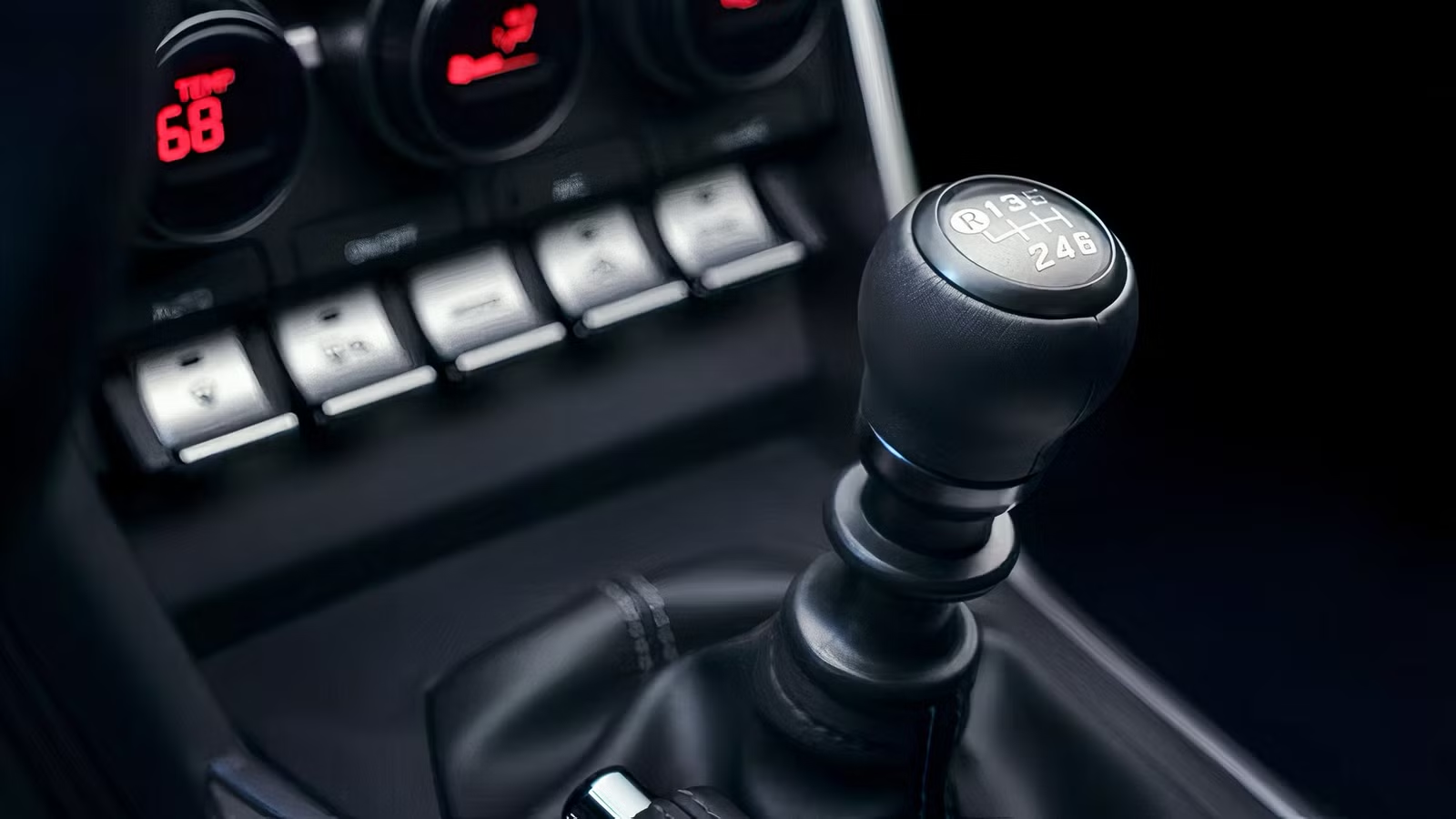
The stick shift was supposed to be dead by now. Automakers kept telling us nobody wanted it, dual-clutch gearboxes shifted faster, and CVTs were cheaper to build. Yet here in 2026, a surprisingly deep bench of manual sports cars is still standing, ranging from a turbocharged six-cylinder coupe to a featherweight roadster that costs less than a loaded pickup truck. These are the ten still on sale, with all three pedals fully intact for enthusiasts to enjoy while they still are.
Toyota GR Supra 3.0 — $58,300
A BMW-based inline-six with a Toyota badge and, finally, a proper manual gearbox.

Toyota didn’t offer a manual when the GR Supra launched in 2019, a decision that enraged the enthusiast crowd it was courting. The fix arrived a few years later, and it stuck. The 3.0 still pairs its BMW-sourced B58 turbo six with a proper stick in the 2026 final edition. With 382 hp and a limited-slip differential out back, it’s the most powerful car on this list by a wide margin, and the inline-six’s mid-range shove makes rowing your own gears feel almost unnecessary—until you do it anyway because it’s genuinely satisfying.

The manual option didn’t arrive until the 2023 model year, a full three seasons after launch, and Toyota had to work with BMW to adapt the ZF-sourced internals to a proper clutch pedal. That delay makes the current car something of a redemption arc. Chassis tuning has also matured since the automatic-only debut, with recalibrated dampers and steering that feel noticeably sharper than the early cars. Residual values have held up better than most modern Toyotas too, partly because manual GR Supras are already becoming the version enthusiasts specifically hunt for on the used market.
Acura Integra Type S — $53,900
The Civic Type R’s engine wearing a tailored suit and an Acura badge.


Acura took the Civic Type R’s turbocharged 2.0-liter and front-wheel-drive chassis, then wrapped it in a more grown-up shell with a longer wheelbase and a quieter cabin. The result loses none of the Type R’s mechanical honesty. A helical limited-slip diff manages the 320 hp up front, and the short-throw shifter is one of the best in the business, weighted just enough to reward precision without feeling like a chore in daily traffic. It’s the manual sports sedan for buyers who’ve aged out of screaming red brake calipers but not out of driving for the sake of it.

Unlike the Civic Type R it’s mechanically related to, the Acura Integra Type S carries a longer wheelbase and more sound-deadening, which mutes some of the raw edge without dulling the steering response. Acura also fits Brembo brakes as standard, a detail that matters more than horsepower figures once you’re actually pushing the car on a mountain pass. The badge itself carries weight in North America that Honda’s own lineup doesn’t quite match, giving the Type S a slightly more premium ownership experience, complete with a nicer interior and a longer warranty, without abandoning the driving character that justifies the manual in the first place.
Ford Mustang GT — $48,795
The last new V8 you can still buy with a clutch pedal.

While rivals have quietly dropped stick-shift options or gone fully electric, Ford kept the Mustang GT’s Getrag six-speed as a no-cost choice against the 10-speed automatic. It’s paired with the naturally aspirated 5.0-liter Coyote V8, an engine that still revs to nearly 7,000 rpm and announces itself through an active exhaust system with genuine menace. This is muscle car authenticity without irony: a big, torquey V8 up front, rear-wheel drive, and a manual gearbox that lets you decide exactly when the 480 hp arrives.

Ford’s decision to keep the manual alive wasn’t guaranteed. The seventh-generation Mustang could easily have gone automatic-only like most of its rivals, and the EcoBoost four-cylinder already has. Keeping the Getrag gearbox exclusive to the V8 models was a deliberate signal about who the GT is built for. The rev-matching system, which blips the throttle automatically on downshifts, can be switched off entirely for purists who want full control, a rare concession in an era when most manufacturers bake driver aids in permanently. It’s also one of the few V8s left that doesn’t need forced induction to make big numbers.
Honda Civic Type R — $47,395
Front-wheel drive’s best argument for why it still matters.

The current FL5 Civic Type R is the culmination of an obsession to prove that front-wheel drive doesn’t have to mean compromise. Dual-axis front struts are a solution borrowed conceptually from the old Acura RSX Type-S, but refined considerably here to tame torque steer that would otherwise overwhelm 315 hp routed through the front wheels. The rev-matching manual gearbox also remains one of the most mechanically satisfying units sold today, with a shift action so precise it borders on addictive. Track enthusiasts treat it as a benchmark for a reason: it laps circuits faster than cars with twice its price tag, manual included.

The result of this FWD obsession is a car that puts down its power without the wheel fighting your hands under hard acceleration, something few front-wheel-drive hot hatches manage convincingly. The Type R also holds a front-wheel-drive lap record at the Nürburgring, a statistic Honda leans on heavily in marketing but one that genuinely reflects how the chassis behaves at the limit, not just in a straight line.
Nissan Z Sport — $42,970
Old-school front-engine, rear-drive theatre with a twin-turbo six doing the talking.

Nissan resisted the urge to modernize the Z into something softer, and the result is refreshingly unfiltered. Borrowed from the Infiniti Q60 Red Sport, the twin-turbo V6 sends 400 hp to the rear wheels with a wall of low-end torque that makes the manual gearbox feel almost necessary just to keep the tail in check. The retro-inspired cabin, complete with analogue-style gauges, reinforces the point that this is a car built for driving, not commuting. It remains one of the few affordable ways to get 400 hp, rear-wheel drive, and a clutch pedal in the same package.

Underneath the retro sheet metal sits a chassis borrowed heavily from the 370Z, updated rather than reinvented, which keeps costs down but also means the underpinnings are a known quantity with a long reliability track record. The twin-turbo V6 itself comes essentially unchanged from the Infiniti Red Sport application, giving Nissan a shortcut to a proven, high-output engine rather than developing something bespoke. Interior quality has improved significantly over the car it replaces, though some switchgear still betrays its more affordable origins, a reminder that the Z’s value proposition still leans heavily on the drivetrain rather than outright polish.
Subaru BRZ — $35,860
A lightweight coupe engineered around the idea that handling balance beats horsepower.

Co-developed with Toyota, the Subaru BRZ trades outright power for a chassis that rewards commitment. Its low center of gravity, courtesy of Subaru’s flat-four boxer engine, and near-perfect 53:47 weight distribution mean the car communicates constantly through the wheel and seat. Fitted with a 2.4-liter engine that finally cured the previous generation’s mid-range torque dip, it doesn’t need to be driven at ten-tenths to feel alive. For enthusiasts who value a manual gearbox that’s actually the fastest way to drive the car, not just the most engaging, the BRZ remains a benchmark.

The second-generation BRZ addressed the original’s biggest criticism almost point for point: more displacement, a stiffer chassis, and a wider track, all without the car gaining significant weight. Subaru also resisted the urge to add a turbocharged variant, despite persistent rumors, keeping the naturally aspirated formula intact for buyers who prize long-term reliability and predictable, linear power delivery over outright pace. Track day communities have embraced the platform heavily, and aftermarket support is now extensive enough that a stock BRZ and a heavily modified one can look almost unrecognizable from each other within a single season.
Subaru WRX — $32,495
A turbocharged all-wheel-drive rally car for the road, at a genuinely attainable price.

The Subaru WRX carries a bloodline stretching back to World Rally Championship homologation specials, and it still drives like it remembers. All-wheel drive and 271 hp from the turbocharged boxer engine make it usable in weather that would sideline most manual sports cars, while the gearbox’s mechanical, slightly agricultural shift action feels perfectly at home with the car’s rally-bred character. It’s less polished than some rivals here, and that’s the point. This is a car built to be thrashed, not admired from a distance.

The current 2026 WRX moved to a larger, more torque-rich 2.4-liter engine after previous generations relied on a smaller, peakier 2.0-liter unit, a change that makes the car noticeably easier to drive quickly without constantly working the gearbox. Subaru’s Symmetrical All-Wheel Drive system remains the car’s defining feature, distributing torque in a way that keeps the WRX composed on loose or wet surfaces where rear-drive rivals on this list would struggle. It’s also one of the few cars here still offered with a manual across its full model range, rather than restricted to a single base trim.
Honda Civic Si — $31,495
Proof that a manual sports sedan doesn’t need three-digit horsepower to be fun.

The Honda Civic Si sits a rung below the Type R in both price and power, and it’s arguably the more honest expression of what makes a manual worthwhile. With 200 hp from a turbocharged 1.5-liter engine, a helical limited-slip diff, and adaptive dampers borrowed from the segment above, it’s a car that’s genuinely quick without demanding a racetrack to enjoy. The shifter carries Honda’s usual precision—short throws with a mechanical click into each gate—making even routine errands feel like an occasion.

Honda positions the Si deliberately between the standard Civic and the Type R, and the gap is narrower than the price difference suggests. It borrows the Type R’s adaptive dampers in a detuned form and shares much of the interior’s sport-focused design, without the more aggressive aerodynamic body kit that makes the Type R conspicuous in a parking lot. That restraint appeals to buyers who want genuine performance credentials without the visual statement, and the Si has quietly built a reputation as the enthusiast’s choice for a daily driver that doesn’t draw unwanted attention from insurers or traffic enforcement.
Toyota GR86 — $31,400
The GR Supra’s smaller, cheaper sibling, built for the same reason: driving pleasure over outright speed.

Mechanically identical to the BRZ, the GR86 wears sharper Toyota styling and a marginally different suspension tune, but the philosophy is unchanged. It’s light, rear-wheel drive, and built around a naturally aspirated flat-four that needs revs to give its best, which is exactly why the manual gearbox matters so much here. There’s no turbo lag to manage and no torque converter to mask driver input, just a direct mechanical connection between right foot, clutch, and rear tires. Few new cars under $35,000 offer this much unfiltered feedback.

Toyota and Subaru’s joint development arrangement means the GR86 and BRZ share nearly every mechanical component, right down to the engine, yet the two brands have managed to give each car a distinct character through suspension tuning and steering calibration. Toyota’s version leans slightly more playful at the limit, with a marginally looser rear end that rewards confident inputs. The GR86 also benefits from Toyota’s broader GR performance sub-brand, which has brought increased dealer attention and enthusiast credibility to a car that might otherwise have been overlooked next to flashier siblings like the GR Corolla.
Mazda MX-5 Miata — $30,430
The cheapest car on this list is also the one that arguably invented the modern affordable manual sports car.

Mazda has spent over three decades refining a simple formula. Keep it light, keep it rear-wheel drive, and keep the driver connected to everything happening beneath them. At just over 2,300 lbs, the Mazda MX-5 Miata doesn’t need 400 hp to feel quick; its 181-hp four-cylinder and six-speed manual are enough to make every backroad feel like an event. The shifter itself is often cited as the best in the industry, a short, notchy unit that moves with almost mechanical inevitability between gates. For the price of a well-optioned family sedan, it remains the purest manual sports car experience on sale.

Mazda has never chased horsepower with the Miata, and that restraint is precisely why it has survived four generations while rivals like the Toyota MR2 and Honda S2000 came and went. Every redesign has focused on shedding weight rather than adding power, and the current ND-generation car is lighter than the original NA from 1989, a genuinely rare achievement in an industry where each new model generation typically gains mass. Parts availability and mechanical simplicity also make it one of the cheapest sports cars in the world to maintain long-term, reinforcing its reputation as the entry point into manual sports car ownership.
Between them, these ten cars prove the manual transmission isn’t dead—just concentrated in the cars built specifically for people who still want to do the shifting themselves. Whether that’s a $30,000 roadster or a $58,000 turbocharged coupe, the clutch pedal survives because enough buyers keep asking for it—and we hope it stays that way.
Sources: CarBuzz, Cars.com, Edmunds & Kelley Blue Book

Related posts


Latest Post


No Comments