
2003 Mercedes E55 AMG Wagon: 469 HP, Rear-Drive Legend
There was a time when huge SUVs didn’t hog every fast lane on the planet. In this ancient era — otherwise known as the ’90s — the SUV tended to still be an off-roader that someone had thrown the whole Horchow Collection at. If you were flexing an SUV in the ’90s, you were proud that it could cruise across a plowed field on the way to a hunt, rather than boasting about how it could blitz a supercar in a drag race.

Leading into the 2000s, if you wanted something fast for the whole family, you needed to look elsewhere. It was called the fast wagon, and offered eye-watering sports car performance combined with every day grocery-getting practicality. But who nailed the concept first?
Fast Wagons Took Off In The ’90s — But Didn’t Nail The Concept
When the Audi RS2 arrived in 1994, it changed everything. Audi had been looking at the BMW M3 and wondered how it could develop a model to boost the company’s image. Rather than taking on the M3 head-on, Audi decided on something different. With the help of Porsche, Audi took the aging 80 Avant and turned it into the one of the ultimate Sleeper Cars. The RS2 was the world’s fastest estate (it was also the first Audi to smash the 155 mph barrier), with a top speed of 163 mph. Up until now, car enthusiasts had to have two cars — a sports car and a family wagon — but the 315-hp RS2 meant that they only needed one.
Another Porsche collab launched the same year — the legendary Volvo T-5R. This Volvo had a five-pot (just like the Audi) but it was a touch larger at 2.3 liters. It didn’t pack quite the same punch, with 240 hp on tap, but there was a good reason. The Volvo 850 was front-drive, whereas the Audi naturally channeled power to all four wheels. The problem with both cars, if we were to nitpick is the fact that if you were a purist used to old school sports cars, neither were rear-wheel-drive. The idea of a big slidey rear-drive wagon with a ton of power didn’t really exist at that point. So Mercedes decided to fix that.
The 2003 Mercedes-Benz E55 AMG Wagon Is A Sports Car For The Whole Family

Mercedes and former tuner AMG had only really started to work together by the end of the ’90s, with the 1993 C 36 AMG being the first jointly developed vehicle since they signed a cooperation agreement. In 2003, Mercedes was on the brink of a full acquisition of AMG, and wanted a model that would knock the ball out of the park. That would be the 2003 Mercedes-Benz E55 AMG Wagon. It’s worth noting that Mercedes-AMG also offered a sedan version, but that is too obvious, not as practical, and (as we will find out later) not as fast.
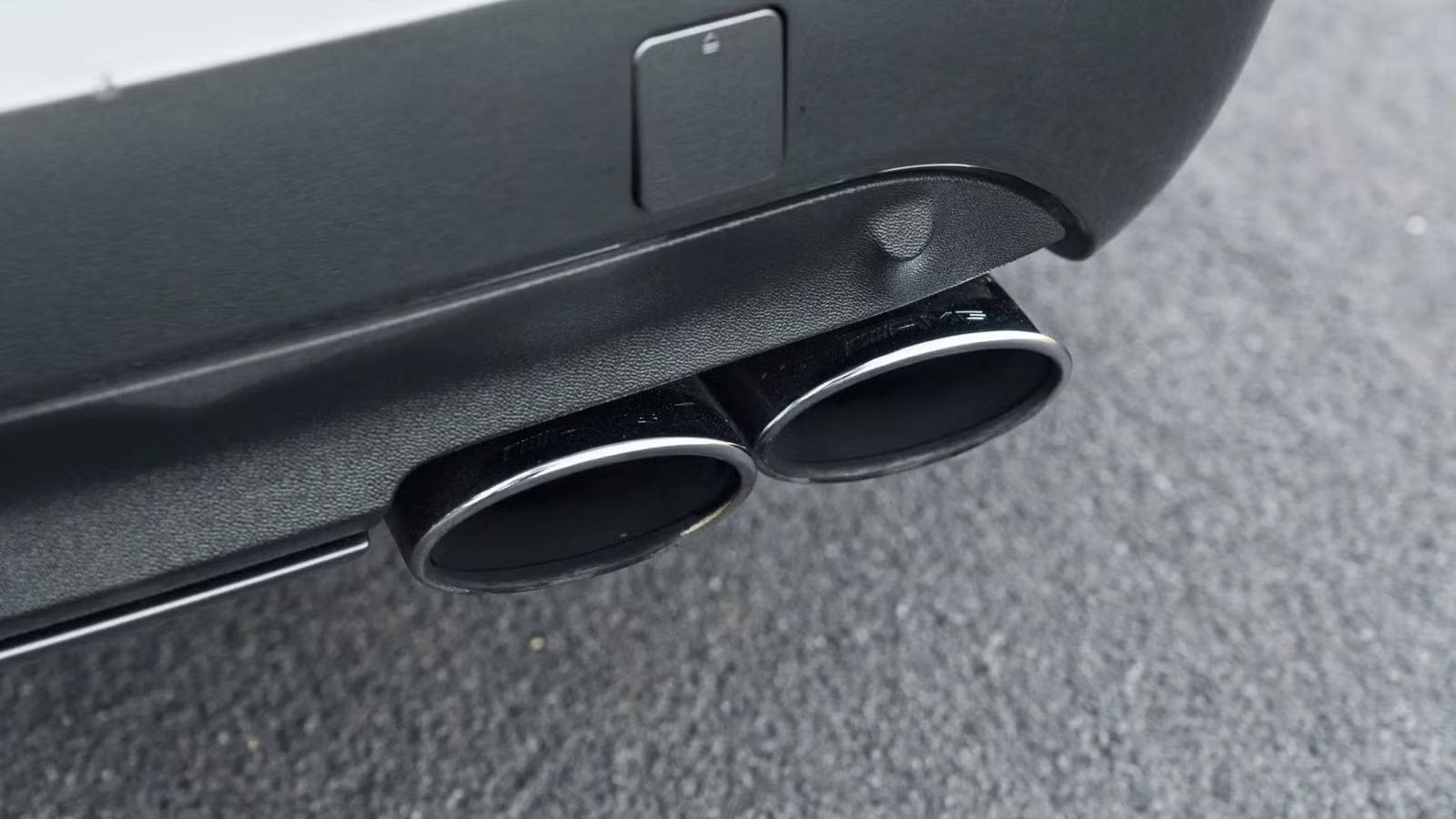
The W211-era E55 wagon was as astonishing as it was innocuous looking, with very little in the way of go-faster adornment. Under the hood lurked a supercharged intercooled 24-valve V8 packing 469 horsepower and 516 lb-ft of torque. The fact that it is rear-drive and the 5.5-liter V8 is hand built puts it right into the exotic sports car world. Plus, you can carry your family, dog and/or a small cabinet.
The Wagon Outperformed the sedan version

The wagon makes for an astonishingly quick supermarket commuter. You could talk all day about the performance attributes of this big German wagon (it is incredibly fast), but there were a couple of figures that really stood out. It turned out the wagon was faster and faster to stop than the sedan. In one test, the wagon, despite weighing 256 pounds more, was 0.2 second quicker to 60 mph than the sedan, thanks to more weight pushing the rear wheels into the asphalt. The wagon handled better too, for the same reason, with a skidpan rating of 0.85g compared to the four-door’s 0.83g. It even stopped slightly faster than the sedan too.
The E55 Load Lugger Had Supercar Performance In Its Time

One magazine noted that the E55 wagon accelerated to 60 mph in the same time as the Porsche 911 Carrera S (4.1 seconds) of that time, and covered the quarter in the same time as a Ferrari 612 Scaglietti (12.5 seconds). Or to put it another way, the E55 Wagon would be exactly neck-and-neck with a Ferrari F40 up to 60 mph. Imagine being drag raced by a Mercedes wagon in your F40 (the first car to hit 200 mph), and probably losing if you botched one gear change (the Merc had a 5-speed automatic with manumatic shifting). There was virtually nothing on the planet that could boast rear-drive, F40 performance, and a useful way to go to the hardware store on a Saturday morning.
The E55 Paved The Way For Fast Modern Wagons

This being the 2000s, the fast wagon (and sedan) was having its day, blissfully unaware that SUVs were about to take up the duties. The Audi C5 RS6 was launched in 2002, but again this brute had quattro all-wheel drive. The Audi, with its 4.2-liter twin-turbo V8 producing 450 horsepower, was a formidable sledgehammer, but it could be argued that the rear-drive E55 offered a more old-school purity for drivers. BMW had produced the M5 Touring in 1992, describing it as a “superlative sportscar, packed in a sporty, but never showy bodywork.” But that 340-hp M load-lugger was never sold in America, and just 891 were built in total.
The E55 wagon was sold in America, and it was big seller in Europe — it was designed to be pretty much like any other Mercedes, just a lot quicker. The Audi RS6 didn’t go on sale in America until 2020. The Dodge Magnum SRT8, a wagon version of a muscle car, was similar in concept to the Merc, but it was slower and didn’t go on sale until 2006. But there was a slight catch for the groundbreaking E55 estate…
The E55 Wagon Is A Rare Secondhand Find

The S211 E55 wagon remained incredibly rare. Sources suggest that between 125 and 193 wagons were officially imported to the United States during the 2005 and 2006 model years. This means that prices are high and can vary greatly. A low-mileage 2006 E55 wagon sold on Bringatrailer in 2023 for $52,500. More recently, a couple of cars sold for a shade under $40,000. It’s not cheap, but it is a lot cheaper than a Ferrari 612 Scaglietti. And you’ll get more stuff in an E55 Wagon too.
Fast wagons may be a moment in history, and all but forgotten in a world of hybrids and EVs, but they hark back to a certain time when manufacturers were running free in regard to engine tech and output. Collectors have clearly cottoned on, and the E55 wagons are highly sought-after — especially if you only have room for one car in your garage.

Related posts



Latest Post


No Comments