The Naturally Aspirated Engine That Still Has An Answer For Turbocharged Rivals
8 minutes reading
Wednesday, 23 Sep 2026 09:31 0 52 autotech
Forced induction is now the default choice for most manufacturers across sports car and mass market segments. This technology has proven to be more effective at reducing emissions and improving fuel economy without sacrificing power. Automakers adopt turbocharging to replace large displacement naturally aspirated engines with smaller, lighter, lower-displacement engines.
Despite the power and efficiency benefits, many enthusiasts argue that downsized engines don’t offer the same level of enjoyment as the larger naturally aspirated engines formally found in popular performance models. Thankfully, one American muscle car legend retains its free-breathing, thoroughbred V-8.
Toyota GR Corolla 1.6-liter turbo engine, closeup in bayToyota
Engine downsizing combined with turbocharging delivers impressive performance and efficiency benefits for vehicles. For many brands, this is a necessity in order to meet the stringent emissions standards being set by global lawmakers. Replacing a large-displacement, naturally aspirated engine with a smaller turbocharged alternative reduces internal pumping losses and total engine mass. The turbocharger compresses the intake air density into the combustion chamber, creating strong torque across the rev range, especially at the low end.
The result is rapid acceleration and responsive power delivery lower in the rev range, enhancing drivability. Lowering fuel consumption is the primary goal. Turbochargers and smaller engines aid automakers in meeting strict global fleet emissions mandates and fuel economy regulations. There are also significant safety benefits. Smaller engine blocks free up engine bay space, allowing for improved vehicle packaging, weight distribution, and crumple zone safety designs. Extracting high power outputs from low-displacement engines ensures modern vehicles maintain strong performance without incurring the weight and efficiency penalties associated with larger, naturally aspirated engines.
Significant Downsides Associated With Smaller Turbocharged Engines
Honda Civic Si engine close-upHonda
Despite these efficiency and performance improvements, downsized turbocharged engines present distinct operational and durability drawbacks. Operating under regular high boost pressure subjects internal engine components to increased thermal load and cylinder pressure. This accelerates wear on bearings, pistons, and valve trains, often reducing total engine lifespan compared to stress-free, large-displacement engines.
As a result, turbocharged systems require more frequent and dedicated maintenance, as oil degrades faster under high operating temperatures, increasing the risk of turbocharger bearing failure. Downsized engines also require a specific driving style in order to enjoy fuel-saving benefits. Real-world fuel economy typically drops when pushing these engines hard, as rich air-fuel mixtures are required to cool combustion chambers under high load. Furthermore, downsized engines require complex systems, including intercoolers, electronic wastegates, and complex piping. This increases manufacturing costs and creates additional points of mechanical failure over time.
Ford’s Answer To Reliable V-8 Performance
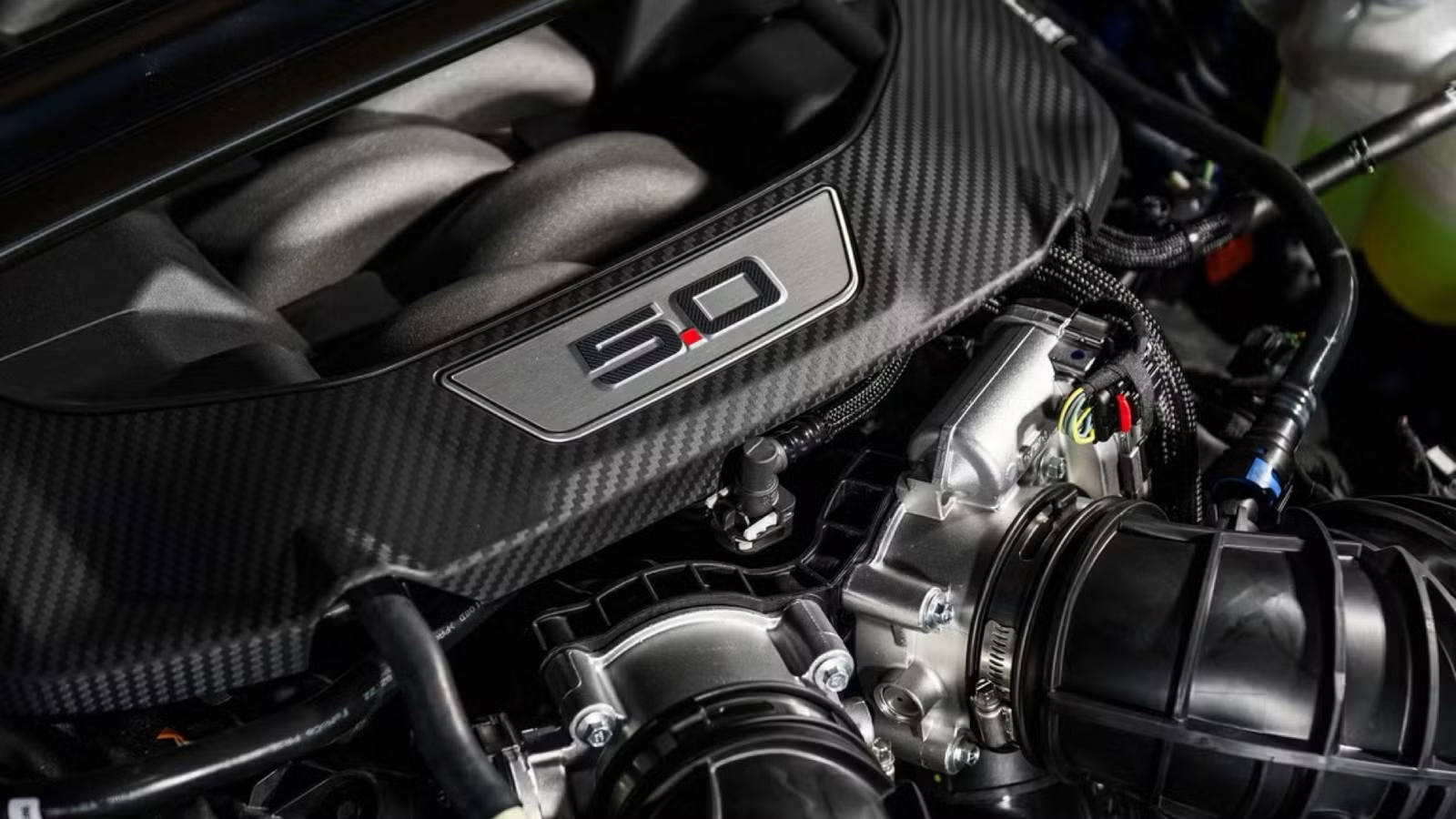
5.0-liter Coyote engine, view of top in bayFord
The Ford 5.0-liter Coyote V-8 remains the Mustang’s most popular engine option, despite the design being more than 15 years old. The Blue Oval adopts a naturally aspirated design that relies on atmospheric pressure and exceptional volumetric efficiency to generate high output. The engine features Twin Independent Variable Camshaft Timing, built into a dual overhead camshaft architecture with four valves per cylinder.
This technology compensates for a lack of forced induction by continuously adjusting the intake and exhaust valve operation independently, optimizing airflow, combustion, and power delivery across the rev range. The Coyote also maintains a high compression ratio close to the rev limit, thanks to a high-pressure direct injection system that works alongside low-pressure port injection. This enables high horsepower figures without relying on forced induction components. However, the torque output is slightly lower by comparison.
Gen 4 Coyote EngineFord
The Coyote is made from a lightweight aluminum block and matching aluminum cylinder heads to minimize total weight. A deep-skirt block design with cross-bolted main bearing caps provides structural rigidity for high-RPM operation. Internal components include a forged steel crankshaft paired with sintered powdered-metal connecting rods, ensuring structural strength under severe stress. Modern iterations feature Plasma Transferred Wire Arc thermal spray cylinder liners, which replace heavy traditional iron sleeves to reduce engine weight while increasing cylinder bore size and aiding heat dissipation.
Despite its age, the Coyote remains highly competitive thanks to its instant and linear throttle response. It also benefits from a distinct exhaust note that turbocharged engines cannot replicate. Without the additional thermal stresses, higher exhaust back pressure, and more complex piping associated with forced induction, the V-8 maintains mechanical simplicity and high long-term durability. Ford also applies continual updates, showcasing its dedication to the technology. This includes dual throttle bodies, improved intake runners, and direct injection. These allow the engine to produce competitive horsepower figures while meeting current vehicle emissions standards.
The Coyote Makes The 2026 Mustang GT A Competitive Muscle Car
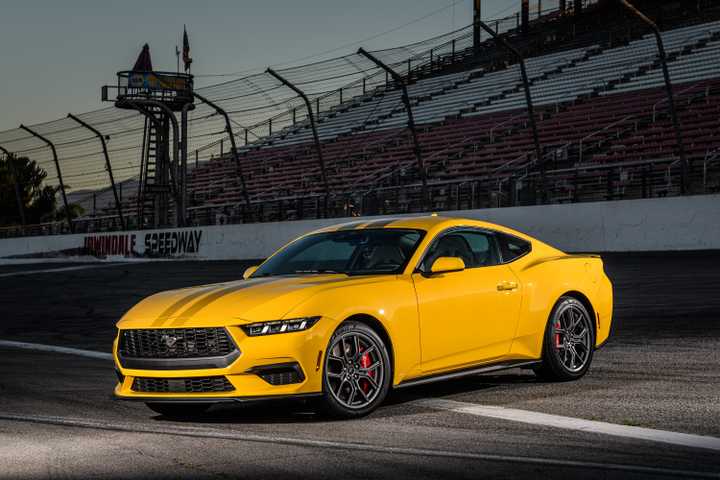
Front 3/4 action shot of 2026 Ford Mustang GT driving on roadFord
The 2026 Ford Mustang GT utilizes the 5.0-liter Coyote V-8 paired with a standard six-speed manual transmission or an available ten-speed SelectShift automatic transmission. The engine generates 480 horsepower and 415 pound-feet of torque in standard configurations, which increases to 486 hp and 418 lb-ft of torque when equipped with the optional active valve performance exhaust system.
This powertrain configuration launches the Mustang GT from 0 to 60 MPH in 4.2 seconds. Independent track testing demonstrates a quarter-mile completion time of 12.5 seconds at 115 MPH. Electronically limited top speed reaches 155 MPH.
Fuel Efficiency Is Where Its Biggest Compromise Lies
Rear 3/4 action shot of 2026 Ford Mustang GT Convertible drivingFord
As a naturally aspirated V-8, the Mustang GT may not offer the best long-distance driving range. The EPA estimates this model consumes 16/24/19 MPG if you opt for the 10-speed automatic. The 16-gallon tank helps it cover a range of 304 miles per tank. This means you’re likely to spend $5,250 more on fuel over the course of five years compared to the average new vehicle currently sold in the U.S. Expect to spend $3,250 on fuel every year, $5.39 to drive 25 miles, and $66 to fill the tank up.
Choosing the manual worsens consumption to 15/23/18 MPG and lowers the estimated range to 288 miles. You’ll spend $6,000 more on fuel over five years, $3,400 on fuel every year, and $5.69 to drive 25 miles.
The V-8 Mustang Wins Favor From Its Owners
2025 Ford Mustang GT rear 3/4Ford
The 2026 Ford Mustang GT wins the hearts of many thanks to its ability to balance comfort and performance. It currently holds a 4.3/5 average score on the Edmunds consumer review section, with its engine performance, driving experience, and ride quality being some of its strongest points.
J.D. Power echoes this reputation with an 85/100 consumer-verified overall score, including 85/100 for quality and reliability, 92/100 for the driving experience, 83/100 for resale value, and 80/100 for the dealership experience.
The Mustang GT is also valued for its long-term reliability. iSeeCars indicates that it benefits from an average lifespan of 18.2 years or 156,788 miles, with a 20.7 percent probability of reaching 200,000 miles.
A Sharp Suspension Brings The V-8 Alive
2025 Ford Mustang rear 3/4 shotFord
The 2026 Ford Mustang GT sits on a double-ball-joint MacPherson strut front suspension featuring an integrated stabilizer bar. The Blue Oval’s engineers pair this configuration with an independent integral-link rear suspension setup and heavy-duty aluminum control arms. The setup lowers the Mustang’s unsprung weight to increase steering responsiveness and road compliance. Standard models utilize passive gas-pressurized twin-tube dampers and progressive coil springs calibrated to absorb highway road imperfections without inducing excessive body roll.
Upgrading to the available MagneRide active damping system introduces magnetorheological fluid within the shock absorbers. This allows electronic sensors to adjust damping forces up to 1,000 times per second. Ford claims that the system offers real-time active adjustment that dynamically stiffens the suspension during hard cornering to eliminate pitch and roll, then immediately softens the ride during straight-line cruising to maintain daily driver comfort.
Ford’s Comprehensive Warranty Shows Faith In The V-8
2024 Ford Mustang GT, front 3.4Ford
Ford covers the 2026 Mustang GT under a standard three-year or 36,000-mile bumper-to-bumper warranty and a five-year or 60,000-mile powertrain warranty. Ford does not offer complimentary scheduled maintenance, leaving routine service costs entirely to the owner. Vehicle servicing is aided by an Intelligent Oil-Life Monitor, which tracks engine load, temperature, and operating conditions to calculate oil degradation.
The monitor alerts drivers when an oil change is necessary, though Ford mandates an absolute service limit of 12 months or 10,000 miles. Standard maintenance involves tire rotations every 10,000 miles, cabin air filter replacements every 20,000 miles, and engine air filter replacements every 30,000 miles. Routine oil changes and inspections average between $75 and $120 per visit, though total yearly maintenance costs scale upward if drivers frequently track the vehicle or wear down performance tires and brake pads.
The Coyote Is Subject To A Noteworthy Recall
3/4 side view of 2025 Ford Mustang GT ConvertibleFord
Regarding safety campaigns, specific 2026 Mustang GT models face safety recalls that directly target internal engine components. According to documentation on the NHTSA, Ford issued a safety recall for select 2026 Mustang variants due to incorrectly installed engine piston circlips and defective piston domes, which can cause internal engine damage or catastrophic piston failure. Dealerships perform these engine inspections and replace the entire long block assembly free of charge if necessary.
Additionally, an electrical recall affects the engine compartment, where fractured wiring harness ground terminals can cut power to the engine cooling fan or cause a sudden loss of drive power. Beyond these engine-specific issues, secondary recalls affect non-engine driveline and structural hardware, including halfshaft retention circlips in the rear differential and B-pillar trim panels.
Base Trim Engine
EcoBoost 2.3L ICE
Base Trim Transmission
10-speed automatic
Base Trim Drivetrain
Rear-Wheel Drive
Base Trim Horsepower
315 HP @5000 RPM
Base Trim Torque
350 lb.-ft. @ 3000 RPM
Base Trim Fuel Economy (city/highway/combined)
21/32/25 MPG
Base Trim Battery Type
Lead acid battery
Make
Ford
Model
Mustang
Sources: Ford, Edmunds, J.D. Power, iSeeCars, and the EPA.










No Comments