
Chrysler’s Wood-And-Chrome Luxury Sedan Hid A 360-HP Wedge And A Stick
Muscle cars were the biggest thing to hit America since Elvis Presley. They had quite a lot in common too, both appealing to a rebellious youth who wanted to move out of the shadow of their parents and embrace their own way of living in the fast lane. But while dealerships couldn’t sell muscle cars quickly enough, they still had to shift other types of cars too. Unsurprisingly, the muscle car spirit started to seep into all genres of car, but this treatment suddenly turned one sensible luxury machine that your pop would buy into something of an outsider. Was this just a step too far for the muscle car era?
Manual Gearboxes Were Dying Out Even In The ’60s

OK, not in the muscle car segment, or imported sports cars, but certainly in more mainstream models. Luxury cars generally had one luxury as standard: the lack of that taxing movement of your right hand as you select gears. That’s right, domestic luxury brands overwhelmingly installed auto gearboxes as standard equipment, with few people needing the urgency or control that comes with self-shifting when just cruising to the golf club.
Manual-transmission full-size luxury cars were exceptionally rare or non-existent because a stick shift didn’t really suit their lazy character. Of course, these days we are used to the slow death of the manual gearbox in powerful cars. In 2026, there are very few 400 hp plus machines that come with a proper stick. Clever automatics with paddle shifters have started to outshine the manual in a lot of people’s eyes, which is a shame for those who cherish the engaging experience you get from a self-shifter. In the ’60s, an unlikely model tried to bring the manual experience to a luxury car — but would anyone actually want it?
A 4,700-pound Chrysler Had A Manual Option


The Chrysler 300 letter series started in the mid ’50s as a perfect blend of luxury and performance. By 1965, the letter series was in its final year, but Chrysler wasn’t content to just let this iconic line end without a bang. The 300L was a full-on land yacht, with contemporary Elwood Engel styling featuring lines and angles in place of curves, available as a coupe or convertible. The car had grown too, measuring 218.2 inches in length, with a wheelbase of 124 inches for added legroom. It was also around 300 lbs heavier than the previous car, but that wasn’t really a problem if you pick the right engine.
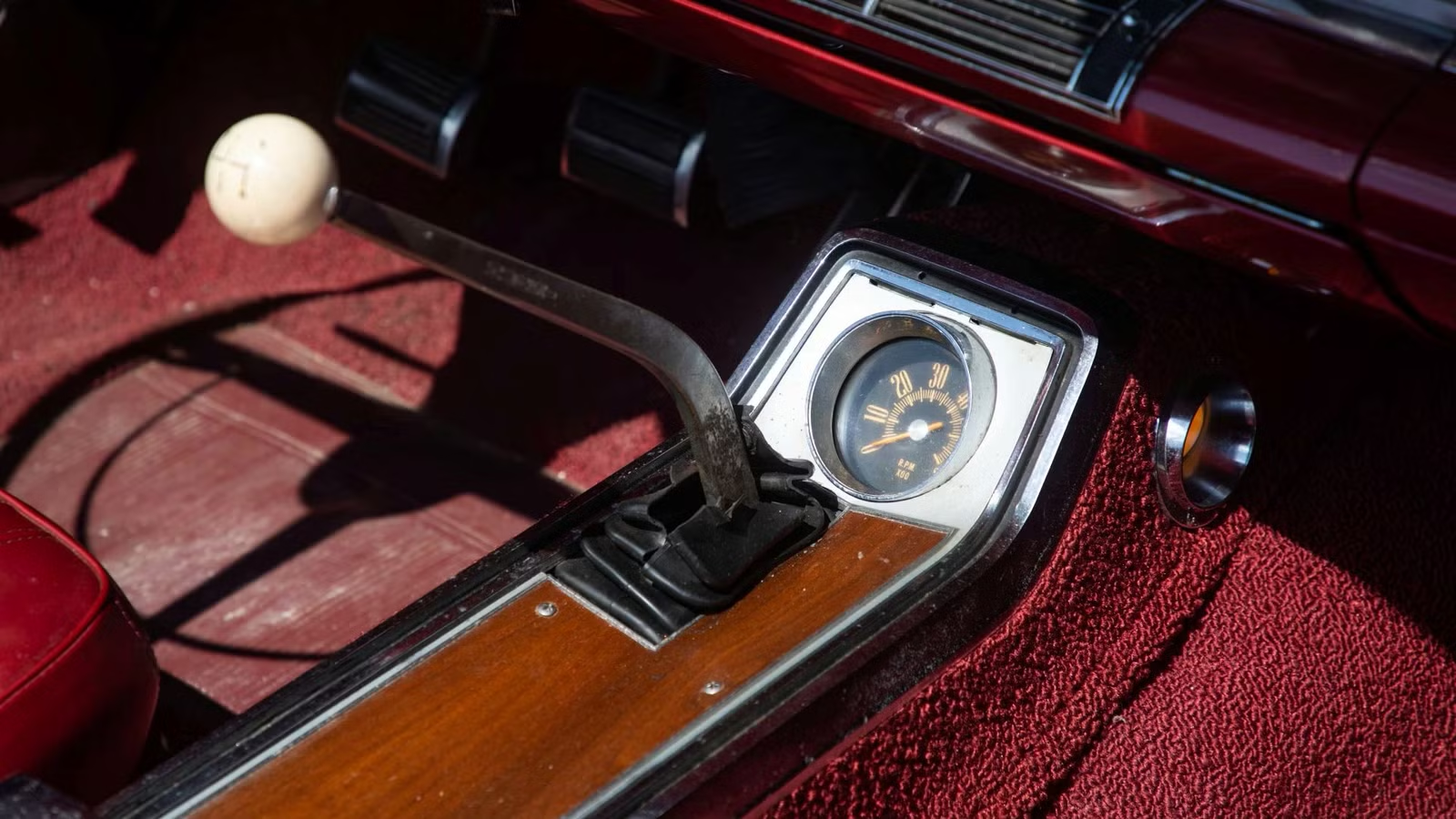
The 300L could be had with a 413-cubic-inch (6.8-liter) Golden Lion wedge head unit, with 360 hp to the rear wheels at 4800 rpm with a 10.0:1 compression ratio. The 300 sedan could also be fitted with this engine, making it something of a sleeper of its day. It’s not unusual to hear people describe these big comfy Chryslers as luxury muscle cars, but the company took this literally when they decided to offer a New Process A-833 four-speed manual (order code 363), a factory option that persisted in limited form on the C-body platform. This was an unusual move for a luxury barge, but perhaps Chrysler hoped to scoop up a few muscle car fanatics who wanted a bit of comfort as they approached middle age.
The 300 And 300L Needed Serious Engineering To Make A Manual Happen

Even more interesting was that the manual gearbox didn’t just slot in, it needed a bit of crowbarring. The C-body A-833 transmissions reportedly required specific engineering, apparently utilizing a long tailshaft housing that placed the shifter pad ahead of the cross member mount flange. The 1964 and 1965 C-body tailhousings (casting C-95638) had a ball and trunnion driveshaft attachment. This differed from B-bodies by the location of the speedometer cable hold-down and wider transmission mount holes.
Chrysler Wanted Some Muscle Car Magic In A Full-Size Premium Sedan

The 4-speed manual (Code 363) could be mated to the 413-ci 4-barrel V8 featuring a special cam and dual exhaust, meaning that the 300 offered a slice of muscle car with the luxury of a more upmarket model. On paper, it sounds great, but the idea kind of fell flat. It would be similar to Mercedes or BMW suddenly offering a manual in an S-Class or a 7-Series. We enthusiasts would love it, but when it comes to buying one, you’re probably going to realize an auto makes more sense in the real world.
With 415 lb-ft on tap from the 6.8-liter V8, the Chrysler 300 had enough grunt to scare more sporting machinery. One period review measured 0 to 60 mph in 9.0 sec, with a quarter-mile time of 16.5 seconds. Considering the 300 weighed around the same as a large family EV, getting that kind of performance in 1965 from a V8 is impressive. A 1965 Porsche 911 would be hitting 60 mph in 7.0 seconds, for comparison.
Sadly Not Many People Actually Wanted A Manual

While we mourn the loss of manuals, the truth is that even in the ’60s they were a hard sell. Registry records suggest fewer than 150 were built, with another source suggesting that the manual found its way into only 108 300Ls. Of those, only 96 hardtops are believed to have been equipped with the 413/manual combo. The 300L was rare anyway compared to the 300, with only 2,845 of 27,678 1965 300s being 300Ls. It is a rare thing to see a two-door 1965 300L with the manual option, but it’s almost impossible to find a 300 sedan with that transmission. But the good news is that even if you did find one of these unicorn overgrown muscle cars, it still wouldn’t be very expensive.
Buying A 1965 Chrysler 300 And 300L Today

Hagerty’s Valuation Tools doesn’t break down prices for the auto and manual options, instead grouping them all together. The 1965 Chrysler 300 with the 413 in good condition will cost you just $8,100. A 300L hardtop coupe with the same engine will cost $20,000, while the two-door convertible costs $29,600. So how much more would you expect to pay for one of the ultra-rare manual versions?
A rare 1965 Chrysler 300L hardtop equipped with a factory 4-speed manual transmission sold for $82,500 at the Mecum Kissimmee 2024 auction. That’s a considerable markup, but when you consider how few there must be of this car in this configuration, it’s still a bargain. This was the same auction where a HEMI-equipped Plymouth Barracuda from 1970 sold for more than $2million. It is thought that only 14 left the factory with a soft top. You can bet there aren’t that many soft-top or coupe versions of the 300L with a manual gearbox around either. Sadly, the manual 300 and 300L didn’t do much to keep the self-shifter popular in luxury cars — but it is definitely a standout model.
Sources: Slantsix.org; Hagerty.com

Related posts

Latest Post


No Comments