
The 300-HP Lexus Q-Ship Hiding A Bulletproof V8 Under Anonymous Sheetmetall
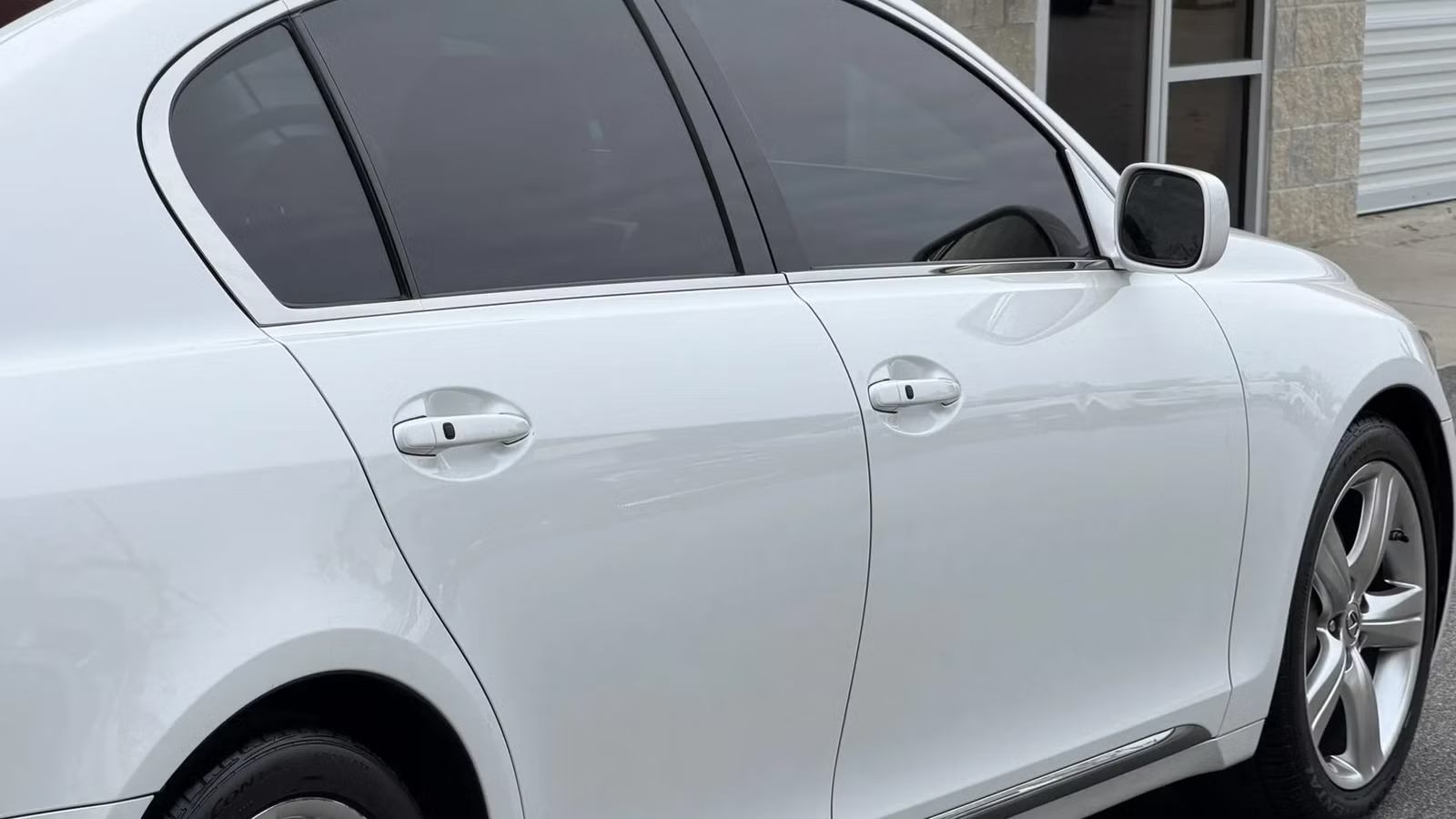
By the late 1990s, Japanese brands had mastered the art of creating cars that were more than met the eye. Their European competitors were going big and bold, setting out their stall for what type of audience this car was going for. But Japanese luxury was more understated, quiet, and subtle. Sophisticated engineering, powerful engines, and surprising capability could all be hidden underneath more ordinary styling, creating a contrast between performance and appearance. But for those who knew, there was an exciting car underneath.
When Japanese Luxury Cars Learned To Keep Their Secrets

By the late 1990s, Japanese automakers had spent years proving that they could match European manufacturers’ quality and technology. European brands like Mercedes-Benz and BMW had built sportier models with reputations for aggressive styling and impressive performance — cars like the BMW E46 M3, E39 M5, or Mercedes-Benz E55 AMG — while Lexus instead focused more on subtlety, restraint, and a more anonymous aesthetic.
This philosophy was very evident in the luxury sedan market. Where BMW and Mercedes-Benz’s offerings would attract attention wherever they went, Lexus more commonly flew under the radar despite packing sophisticated engineering and, increasingly, powerful V8s under their hoods. It was a stark difference to their European counterparts, and helped to create something exciting: sleepers.
Quiet confidence is what a sleeper is all about. It’s knowing that you have far more power and capability than you let on, safe in the knowledge that you could deploy it whenever you wanted. And while European brands favored stylistic choices that announced their power, Lexus was comfortable obscuring theirs under unassuming bodywork and conservative exterior choices. In doing so, they created something far more interesting.

Why The Ultimate Performance Car Didn’t Need To Look Fast

For some, there’s always been something compelling about a car that hides its true potential. Something that doesn’t look as fast as it truly is. And during the late 1990s/early 2000s, cars were definitely trying to look every bit as quick as they were. Big wings, flared arches, and loud exhausts were the order of the day. But sleepers deliberately went in the opposite direction, blending into traffic and letting their performance do the talking.
This was also a perfect option for executive, luxury sedans. Their restrained styling and business-like demeanor meant that a driver could have both comfort and power, should they want it, while the untrained eye would look over the car with no indication of what it was capable of. And while some brands opted for this method, it was Lexus that was arguably the best at it.
The Japanese brand’s cars were never the showiest, nor the loudest, but the V8 engines they concealed gave them an intriguing personality. They were more than happy to provide refinement and elegance when required, while also quietly providing straight-line speed that would make many performance cars blush. And there was one car that did this with devastating efficiency.
The Lexus GS 430 Was A 300 HP V8 Wolf In Executive Clothing

The first-generation GS, which was Lexus’ answer to the European executive sedan and was known as the Toyota Aristo in Japan, arrived in the early 1990s. Designed by Italdesign Giugiaro, it was a good if not particularly sporty alternative. The second generation refined the formula, improving on the chassis and bringing in the 430 nameplate, though the car remained somewhat easy to overlook in a crowded marketplace. But by the third generation, the car had come into its own.
It started with the chassis. The S190 chassis used in the third-gen GS 430 was more rigid than its predecessor, had a more sophisticated suspension setup (using double-wishbones rather than the MacPherson struts), and allowed for a greater rear-wheel-drive balance.
But the chassis was only part of the equation, and another crucial improvement came in the car’s engine. The 4.3-liter 3UZ-FE V8 provided 300 horsepower and 325 lb-ft of torque at a time when competing cars like the E39 BMW 540i made around 282 hp and 325 lb-ft. Power was, naturally, sent exclusively to the rear wheels, which gave it a decidedly more sporting edge than one might have expected. The car wasn’t exactly a lightweight, coming in at over 3,700 pounds, but it could still hit 60 mph in 6.0 seconds en route to an electronically limited 155 mph. And it did all this while wearing the sheet metal of a sensible banker, rather than a dominating performance vehicle.

The car’s aesthetic was one of what Lexus called “L-finesse”, or “Leading-Edge Finesse”. A corporate design philosophy, it aimed to turn Lexus cars from their traditionally understated designs into something far bolder and more modern. It prioritized simplicity, elegance, and a driver-first approach that tried to place controls in positions that were instinctive to the driver. The third-generation GS 430 was the first production car to employ this new take, with elements like the sloping roofline and stance aimed squarely at its European contemporaries. The wood veneer and touchscreens on the interior offered improved ergonomics to the driver, too, placing them at the center of the driving experience.
It made for the ultimate sleeper. People looking in their rearview mirror and seeing a GS 430 might presume that it wouldn’t be able to keep up, but would soon be surprised as the unassuming sedan not only blasted past, but did so with its driver seated in luxurious comfort. But while the interior was good, it was the engine that was the real star of the show.
The 3UZ-FE Was The Real Secret Weapon

Being a subsidiary of Toyota, the Lexus engineers didn’t need to reinvent the wheel when it came to powering the third-gen GS 430. They simply took one of the most proven engines in Toyota’s arsenal — the 3UZ-FE — and deployed it with devastating efficiency.
A naturally-aspirated V8, it came from the already-popular UZ lineup and had been popular in the LS 430. Its aluminum block helped to keep weight down, while dual overhead cams and Variable Valve Timing with Intelligence (VVT-i) allowed it to benefit from Toyota’s hard-earned reputation for reliability. Being NA also meant that power delivery was immediate and predictable, as there was no waiting for turbos to spool or superchargers to work after asking the throttle for more.
This was important, because the car wasn’t designed to be a stripped-back performance machine: it was supposed to be ready to both cruise effortlessly between meetings and then eat up back roads, depending on what the day called for. That dual-purpose character was what the car was made for, and which made it the executive sedan sleeper icon it is today.
The GS 430’s Legacy Is Bigger Than Its Performance Numbers

The GS 430 never gained the mainstream success of cars like the BMW 5 Series or the Mercedes-Benz E-Class. And that’s arguably part of its charm. It’s a hidden gem among car enthusiasts, a V-8-powered monster without the additional drama.
The car also laid the foundations for the continuation of Lexus’ V-8 GS lineage, and the L-Finesse philosophy. The GS 460 would iterate on what the GS 430 started, taking power up to 342 hp and adding an eight-speed automatic transmission compared to the GS 430’s six. But the GS 430 was the one that started it.
Today, the car remains an affordable, reliable, discreet option for those who know what they’re looking at. It’s not going to generate the most attention, but it’s not supposed to. It does the job, and it does it very well.
Sources: Fastest Laps, Lexus

Related posts



Latest Post



No Comments