
The AWD Japanese Sedan That Could Keep Up With American Muscle Cars In The ’90s
Long before the Lancer Evolution became a rally legend and a bedroom-wall poster staple, Mitsubishi quietly built one of the most technically audacious sedans of its era — a car that most enthusiasts still haven’t heard of. In an age when American muscle ruled the stoplight and Japanese performance meant lightweight coupes, a boxy mid-size family sedan from Mitsubishi was matching the Mustang GT on acceleration while doing it with all four wheels pulling. That car was the Galant VR-4, and its story is overdue for a proper telling.

All that Evo-mania began in 1992, decades after Mitsubishi had established itself, and years after what we think is their most important car of all. While the Lancer was certainly the brand’s most successful endeavor on the rally stages, it was only possible thanks to a goofy mid-size sedan that, in the late 1980s, wrote the book from which the Evo would draw its victories.
And what’s more, this little sports sedan was breaking American muscle hearts years before the likes of the FD RX-7, A80 Supra, or Skyline GT-R ever did.
The Mitsubishi Galant VR-4: Japan’s Forgotten AWD Sleeper

In the late 1980s, rally racing was changing. The ferocious, unrestricted, and ultimately deadly Group B era had become terrifying and eventually came to a close in 1987 after a series of tragic incidents. Rally, as the world knew it, had to change. Group A was becoming the primary series at the time, and Mitsubishi needed a way to get in on the action without starting from scratch.

The Mirage coupe would be too small and prone to spinning out given its short wheelbase, and the larger Cordia coupe would likely be unable to house the technology they needed for a rally stage. So they settled on the tame but highly regarded Galant sedan. It came in several trims, including the base model, LS, GS, GS-R, and GS-X.
But in order to race in Group A, the team at Mitsubishi had to sell 5,000 road-going versions of the rally car they would build, so a new trim based on the race-spec car would have to be created. The regulations also required competitors’ engines to be limited to four cylinders and 2.0 liters of displacement.
How The Galant VR-4 Came To Be

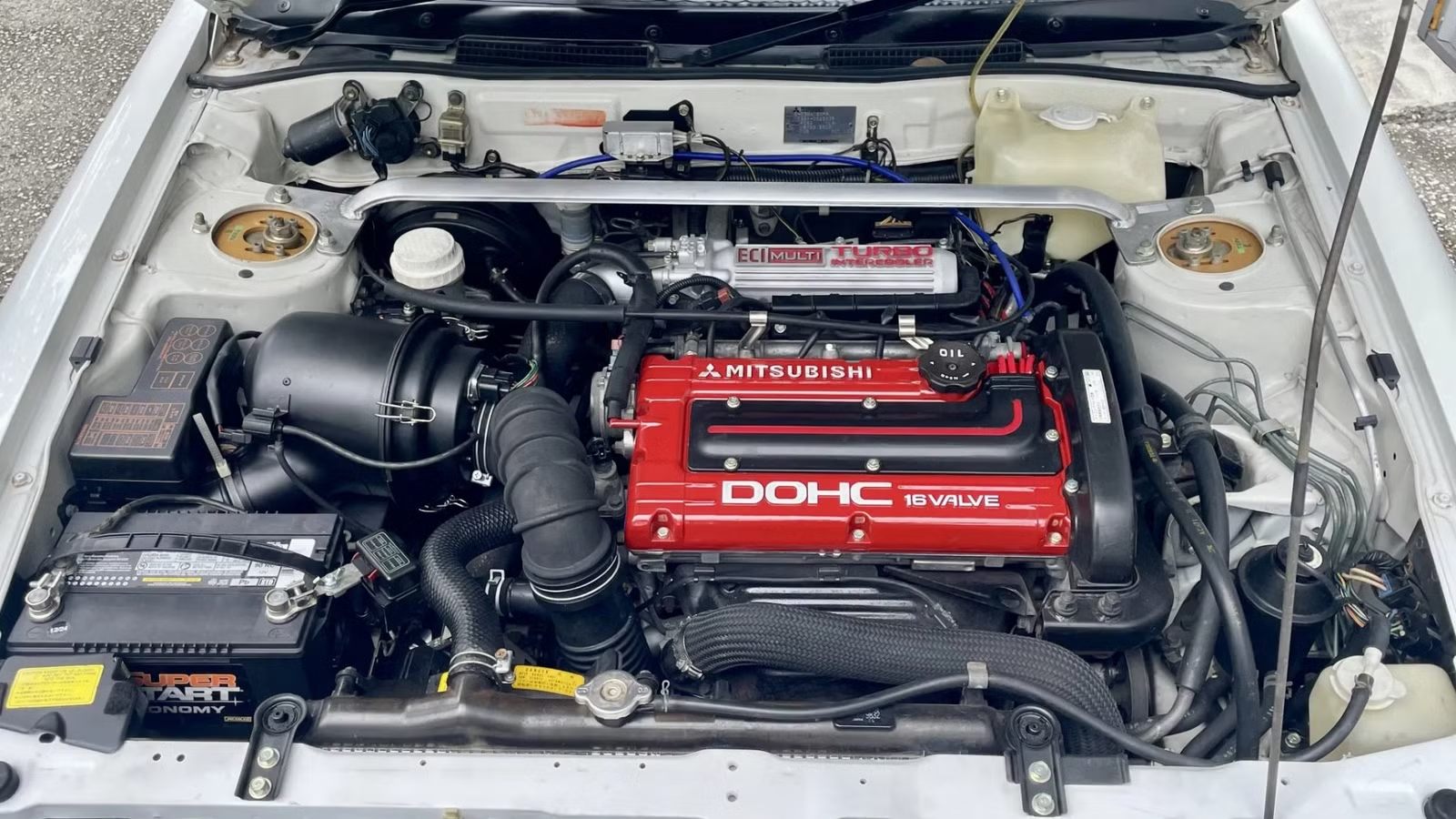
Mitsubishi started with the engine — the best candidate was their existing 4G63T, a single-cam, 1,997cc turbocharged four-cylinder that had previously powered the Lancer EX2000 Turbo. In that configuration, however, the 4G63 produced only around 168 horsepower, so engineers converted the turbo-four to a twin-cam, 16-valve setup to extract more power and efficiency.
Next, they needed traction. The days of rear-wheel drive rally cars had been gone for years, thanks to the domination of all-wheel drive machines like the Audi Sport Quattro S1. Fortunately, the upper-trim Galants were already fitted with an AWD system that could serve as the foundation for something more sophisticated.
The new Galant would feature a full-time AWD system with a viscous center differential and a 50/50 torque split between the front and rear differentials that could be electronically modulated depending on conditions. Mitsubishi also introduced a ground-breaking four-wheel steering system. It used hydraulic toe-control links to steer the rear wheels by a degree or so, preserving stability at higher speeds.
Keeping all that hardware planted was an updated suspension with a MacPherson strut front end and multilink rear that helped manage the turbo-four’s newfound torque. The team also fitted four-wheel disc brakes with ABS, special body-colored 15-inch wheels, and additional ground clearance.

When all was said and done, Mitsubishi debuted this new Galant in 1987, dubbing it the “VR-4.” Its 2.0-liter turbocharged engine made 195 horsepower and 205 pound-feet of torque in U.S. specification — and that’s right, it was immediately available in the States. Power went through a five-speed manual (Japanese buyers also had the option of a five-speed automatic), which drove the advanced AWD and 4WS systems.
From the outside, it was subtle. Only a small rear wing, side skirts, and a “4WS 2.0i DOHC 16V Intercooler Turbo” decal set it apart from the other Galant trims. Inside, much of the same story: understated, very ’80s, and deliberately simple — a direct result of its racing intentions.
And when it did go racing, things didn’t go quite as planned.
Motorsport And The VR-4’s Downfall

Over the three years that the Galant VR-4 competed in Group A, it won only six individual rallies — three times at the Ivory Coast Rally, and once each at the Swedish Rally, RAC Rally, and 1000 Lakes Rally. Unfortunately, a little demon called the Lancia Delta Integrale was competing at the same time and absolutely conquering Group A, ultimately claiming six WRC titles and 46 individual race victories.
Another reason the VR-4 slowly fell out of competition was the FIA’s evolving ruleset heading into the early 1990s. The stages were becoming shorter and more technical, and a family car-based mid-size sedan like the VR-4 was seen by Mitsubishi as too large and unwieldy for the new format.
Those reasons are precisely why the Lancer Evolution existed. Mitsubishi needed something smaller that could be developed into a purpose-built rally weapon capable of contending in the WRC. As you probably know, it worked out. Mitsubishi driver Tommi Mäkinen won four consecutive WRC Drivers’ Championships in the Lancer Evolution IV, V, and VI from 1996 to 1999, finally finishing what the Galant VR-4 had started more than a decade before.
No one’s perfect, though — eventually, even the Evo had its own iconic rise and fall.
How The Galant VR-4 Compared To American Muscle

The Galant VR-4 was a rare Japanese homologation treat, at least here in the U.S., because Mitsubishi actually offered this car in the North American market directly after its debut. We didn’t get a lot of cool Japanese-market cars — including Mitsubishi’s own Lancer Evolution, which didn’t go on sale in America until 2003.
With that in mind, it’s fun to imagine that somewhere on American streets in the late 1980s and early 1990s, a Galant VR-4 owner was lining up against the muscle cars of the day. Here’s a breakdown of how that would have gone.

In the U.S., the Galant VR-4 made 195 horsepower and 205 pound-feet of torque — less than the 200-plus horsepower Japanese-spec cars, but still a formidable figure for a machine based on a family sedan.
In 1987, the Chevrolet Camaro IROC-Z came with a 5.0-liter V8 producing 215 horsepower and 295 pound-feet of torque — 20 more horses and 90 more pound-feet than the VR-4. Also in ’87 came the Ford Mustang GT 5.0, which made 225 horsepower and a whopping 300 pound-feet — 30 more horses and 95 more pound-feet than our Japanese sleeper.

According to period testing, the Camaro could reach 60 mph in 7.1 seconds — respectable for the era. The Mustang was quicker, completing the run in 6.3 seconds. But what about the VR-4, which was outgunned in every power metric? Its 0–60 time was 6.3 seconds. That’s nearly a full second quicker than the Camaro, and dead even with the Mustang.
The only other notable muscle car in the mix was the Pontiac Firebird Formula. Even in top trim, with the more powerful 5.7-liter V8 (210 hp, 315 lb-ft), the Firebird could only manage to match the 6.3-second 0–60 time of the Mustang and VR-4.
In the real world, at a random stoplight in 1987, all of those rear-wheel drive muscle cars would have struggled to get a perfect launch and manage traction, whereas the all-wheel drive VR-4’s four-wheel grip made for repeatable, consistent performance. We’d go out on a limb and say the VR-4 didn’t just keep up with the Americans — it probably kicked their tails in street drag races all over the country.
Plus, that’s only the weaker U.S. specification. Most sources indicate that the Japanese-market VR-4 was producing around 220 horsepower, which would have shaved those acceleration times down even further and put an extra car length between it and those muscle cars.
More Fast AWD Japanese Cars From The Same Era
The Galant VR-4 may have been among the first to showcase street dominance and high-tech all-wheel drive capability in a sedan package, but it certainly wasn’t the last. After pioneers like Porsche’s 959 supercar and Audi’s Sport Quattro had cracked the code on performance AWD systems, the rest of the world followed suit — and Japan was at the forefront. The following AWD Japanese icons of the ’90s are worth highlighting, though note that they’re all coupes, which only underscores the VR-4’s rarity as an AWD sleeper in sedan form.
Nissan Skyline GT-R (R32)

Two years after the Galant VR-4 debuted in pursuit of rally wins, Nissan unveiled arguably one of the most important cars in automotive history — the R32 Skyline GT-R. With its newly developed and highly advanced ATTESA AWD system, the GT-R aimed not at rally stages but at the racetrack. Of the 29 races it entered from 1990 to 1993, it won all 29, destroying the competition and earning its legendary nickname “Godzilla.”
Under the hood of the street-going R32 was a 2.6-liter twin-turbo inline-six known as the RB26DETT. On paper, in accordance with the Japanese automotive industry’s informal gentlemen’s agreement, the car officially made 276 horsepower and 260 pound-feet of torque. However, it was widely understood that these engines were producing at least 300 horsepower straight from the factory.
Toyota Celica GT-Four (ST185)

The Celica GT-Four, like the Galant VR-4 and Skyline GT-R, was a homologation special built to go racing. The second-generation GT-Four, known as the ST185, is the one we’re featuring here. Its full-time all-wheel drive system is similar in concept to the VR-4’s, with viscous couplings and a limited-slip center differential.
Under the hood sat a 2.0-liter turbo-four dubbed the 3S-GTE, making 222 horsepower and 224 pound-feet of torque in street trim. Unfortunately, the GT-Four never reached the U.S. market in standard form — with the exception of a limited run of 75 special IMSA racing editions called the All-Trac Turbo GTO Championship Edition, and who knows if those will ever see the outside of a climate-controlled garage.
Mitsubishi 3000GT VR-4 (Series 2)

Surprise — another Mitsubishi. You can’t discuss AWD Japanese cars without mentioning the 3000GT VR-4. It takes its name from the Galant VR-4, designating it as the top trim model. But instead of the Galant’s turbo-four, the 3000GT received a 3.0-liter sequential twin-turbo V6 paired with a six-speed manual transmission.
The car was updated in 1994 as the Series 2, and in that form the powertrain produced an impressive 320 horsepower and 315 pound-feet of torque delivered to all four wheels via Mitsubishi’s sophisticated AWD system. It also featured high-tech hardware including active aerodynamics with electronically controlled front and rear spoilers, four-wheel steering (just like the Galant), and even an active exhaust system switchable between “sport” and “tour” modes.
Sources: Mitsubishi Motors.

Related posts

Latest Post



No Comments