
10 Car Brands That Build The Best Manual Transmission Sports Cars
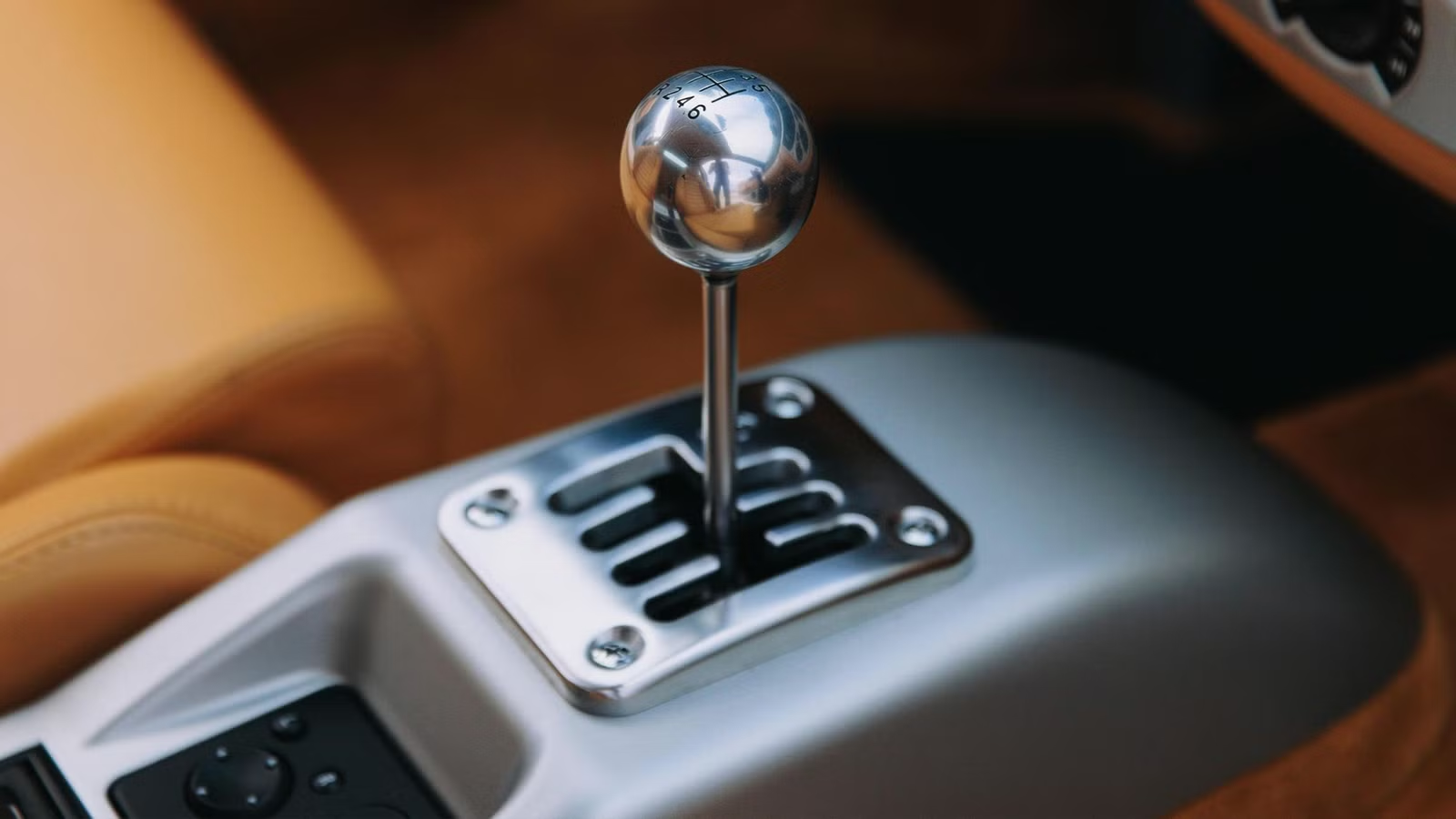
The stick shift has never been more culturally relevant than it is right now. As automakers race toward electrification and dual-clutch gearboxes chase millisecond shift times, the humble manual transmission has quietly become a statement — a deliberate choice made by drivers who want to feel every gear change in their bones. A shrinking but fiercely committed group of manufacturers still builds sports cars where three pedals and a gearstick are the whole point. Some have championed the clutch pedal for decades; others offer it alongside brilliant automatics, giving enthusiasts the choice they deserve. Here are ten brands that keep the art of the manual alive.
BMW

BMW has a strong reputation for creating brilliant driver’s cars, and that includes some genuinely great manual transmission sports cars. Perhaps the finest of those is the Z4 M Coupe. The spiritual successor to the original ‘clown shoe’ Z3 M Coupe, this car packs a 3.2-liter inline-6 producing 338 hp and 269 lb-ft of torque in European trim, or 330 hp and 262 lb-ft in US-spec form. It also came exclusively with a 6-speed manual transmission — the only way BMW thought it should be driven. That combination launches the Z4 M Coupe from 0–60 mph in around 5 seconds, with an electronically limited top speed of 155 mph.
You could argue that BMW has made more powerful sports cars since the Z4 M Coupe. But there’s a unique charm to this car that nothing else in BMW’s lineup has matched. Only the original Z3 M Coupe comes close, and it isn’t as refined — or as good-looking — as the Z4.
Lotus


For its entire existence, Lotus has been known as one of the premier brands for raw, lightweight sports cars, and most of its models have earned near-universal approval. Perhaps the best of those has to be the Elise. It ran from 1996 to 2021, and every version was built around that classic Lotus philosophy of “simplify and add lightness.” The earliest models used a 1.8-liter Rover K-Series engine and a 5-speed manual transmission, producing anywhere between 145 and 190 bhp. By the time the final Series 3 Elise arrived, it was powered by 1.6-liter, 1.8-liter, and supercharged 1.8-liter Toyota engines, all paired with 6-speed manual transmissions.
The supercharged version produced as much as 240 bhp. While that sounds modest by modern standards, the Elise always tipped the scales at under 1,000 kg (2,205 lbs). That featherweight figure gives it a power-to-weight ratio closer to a supercar’s than a conventional small sports car’s.
So many enthusiasts insist that everyone should try a Lotus Elise. When you consider its power-to-weight ratio and its commitment to old-school sports car feel, it’s not hard to understand why.
Chevrolet

Chevrolet may not be the first name that springs to mind when enthusiasts outside North America think of great manual sports cars. But this General Motors brand has produced some legitimately brilliant machines. The best of Chevrolet’s manual sports cars has to be the C6-generation Corvette. A manual transmission was available with every engine option in the C6 lineup — including the ZR1, which carries a 6.2-liter supercharged V8 producing 638 hp and 604 lb-ft of torque. That made it one of the most powerful American sports cars of its era, with a 0–60 time of 3.3 seconds (as tested by MotorTrend) and a top speed of up to 205 mph.
With the passage of time, the C6 Corvette has become something of a sports car bargain on the used market — and that’s an opportunity worth taking seriously.
Honda

Honda has a reputation for being two things: a builder of cars that can last a lifetime, and a creator of some of the best performance cars on the planet — especially sports cars and hot hatches.
There are plenty of legendary Honda sports cars, but the best has to be the S2000. A compact convertible designed to rival the finest European roadsters, it features a naturally aspirated inline-4 VTEC engine — 2.0 liters for global markets and 2.2 liters for North America and Japan — that absolutely loves to rev. It also came exclusively with a slick 6-speed manual transmission. Pair that with minimal driver aids and a curb weight of just 2,855–2,864 lbs, and you have a raw, almost Lotus-like driving experience. S2000s are well on their way to becoming seriously valuable, and it’s easy to see why.
Toyota

Another Japanese manufacturer renowned for building some of the most reliable cars on earth, Toyota has also produced some remarkable sports cars. Enthusiasts can debate which sporting Toyota deserves the top spot, but there’s one that nearly everyone agrees outshines the rest: the A80 Supra. Made famous through Japanese tuner culture and its starring role in the Fast & Furious franchise, it may not have been the most powerful sports car of its era — the twin-turbo version produced around 325 hp from the factory — but its tuning potential was extraordinary. The legendary 2JZ engine could be pushed to staggering power levels, cementing the A80 Supra as an enduring icon of car culture.
Ferrari

Ferrari no longer offers a manual transmission in any of its current models. But in years past, the Ferrari gated manual was one of the most iconic shifters ever fitted to a production car. Among the many great Ferraris offered with a manual gearbox, the best has to be one of the last to ever receive one: the F430, Ferrari’s mid-engined V8 of the mid-2000s. Its 4.3-liter V8 spun to 8,500 rpm, producing one of the most spine-tingling engine notes you’ll ever hear. Add the satisfying click-clack of the open-gate shifter, and you’re left wondering why Ferrari moved away from the manual so quickly. It’s also a surprisingly usable supercar — especially by the standards of its day.
Mazda

Among Japanese brands, few have embraced the sports car as wholeheartedly as Mazda. The brand has produced several iconic sporting models over the years, and they’ve almost always come with three pedals and a stick — including the current Miata. But as beloved as the Miata is, the best Mazda manual sports car has to be the FD-generation RX-7, a car with a legendary reputation earned for all the right reasons.
Unlike every other car on this list, the FD RX-7 doesn’t use a conventional piston engine. Instead, it relies on the 13B-REW turbocharged twin-rotor Wankel — widely regarded as one of the finest engines Mazda has ever built. It’s hard to argue with that assessment: the engine produces up to 261 hp, revs to a screaming 8,000 rpm, and delivers its power with the silky smoothness that only a rotary can manage.
Enthusiasts have always had a soft spot for cars that dare to be different, and the FD RX-7 fits that description perfectly. Its rounded, distinctly ’90s styling has aged gracefully, and the rotary engine gives it a character that no other manual sports car can replicate. It’s little surprise, then, that these cars are climbing steadily in value.
Nissan

Nissan is another Japanese manufacturer you might not immediately associate with great sports cars — but not only has it delivered on that front, it’s also one of the few brands that has consistently kept manual options alive in its performance lineup. There have been many great Nissan sports cars, but none will ever eclipse the R34 Skyline GT-R. An absolute monster for its era, it can still hold its own against some of the best sports cars built today — particularly when tuned. Like the A80 Toyota Supra, these cars can be pushed to over 1,000 hp in the right hands. The R34 GT-R’s technology was also genuinely impressive for its time, featuring sophisticated all-wheel-drive and traction control systems that give it an almost uncanny sense of grip.
Subaru

Subaru is something of an outlier here. The brand is typically associated with rally-bred performance cars and practical family wagons and crossovers. But it has produced a couple of sports cars, and one of them is genuinely excellent: the Subaru BRZ, the other half of the joint venture that also gave us the Toyota GR86. It shares its 2.4-liter flat-4 engine with its Toyota sibling, producing 228–232 hp depending on market and 184 lb-ft of torque, good for a 0–60 time of around 5.4 seconds and an electronically limited top speed of 140 mph. Crucially, a 6-speed manual transmission has always been on the options list.
The BRZ’s numbers alone don’t tell the whole story. It has earned a well-deserved reputation as a driver’s car that rewards skill and commitment. It’s also highly tunable, with a thriving aftermarket that can push its power-to-weight ratio into genuinely exciting territory.
Porsche

If any manufacturer has held the flag for the manual transmission more consistently than any other, it’s Porsche. In an era where even Lotus has begun stepping back from the clutch pedal, Porsche remains steadfastly committed to giving drivers the choice to row their own gears. It has also produced some of the greatest manual sports cars ever made. The finest of that bunch is the sublime Porsche Carrera GT — often regarded as the last truly analog supercar, and one of the greatest driver’s cars ever built. Driver aids are minimal, there’s no concession to fuel economy, and at the heart of it all sits a screaming naturally aspirated V10 mounted just behind the cabin, paired with a distinctive but deeply satisfying 6-speed manual transmission.
The Carrera GT is not a forgiving car. Push it beyond your limits and it will punish you. But those skilled enough to tame it are rewarded with a driving experience that no modern sports car or supercar can replicate.
Sources: BMW, Chevrolet, Ferrari, Honda, Lotus, Mazda, MotorTrend, Nissan, Porsche, Subaru, Toyota

Related posts
Latest Post


No Comments